 Add to Chrome
 Add to Firefox
 Add to Edge
Learning Normal Representations for Blood Biomarkers
May 18, 2026
Blood-based biomarkers underpin clinical diagnosis and management, yet their interpretation relies largely on fixed population reference intervals that ignore stable, intra-patient variability. As such, population-based interpretation can mask meaningful deviation from an individual's baseline, risking delayed disease detection. To remedy this, there have been increasing efforts to personalize blood biomarker interpretation using individual testing histories. However, these methods may overfit to sparse data, inflating false-positive rates and unnecessary follow-up, and can also unwittingly include unrecognized or subclinical disease. Here, we leverage nearly 2 billion longitudinal laboratory measurements from over 1.6 million individuals across North America, the Middle East, and East Asia, to show that while laboratory values are highly individual, purely personalized intervals routinely overfit, classifying up to 68% of measurements as abnormal, without corresponding associations with adverse clinical outcomes. We then introduce NORMA, a conditional transformer-based framework that generates reference intervals by conditioning on both a patient's history and population-level data about "normal" variation. NORMA-derived intervals achieve higher precision for predicting outcomes, including mortality, acute kidney injury, and chronic disease. These findings caution against over-personalization in laboratory medicine and demonstrate that anchoring individual trajectories to population-level priors outperforms either approach alone. To promote transparency, we publicly release the model, code, and an interactive user interface for accessible, individualized laboratory interpretation.

One Patient, Many Contexts: Scaling Medical AI Through Contextual Intelligence
Jun 11, 2025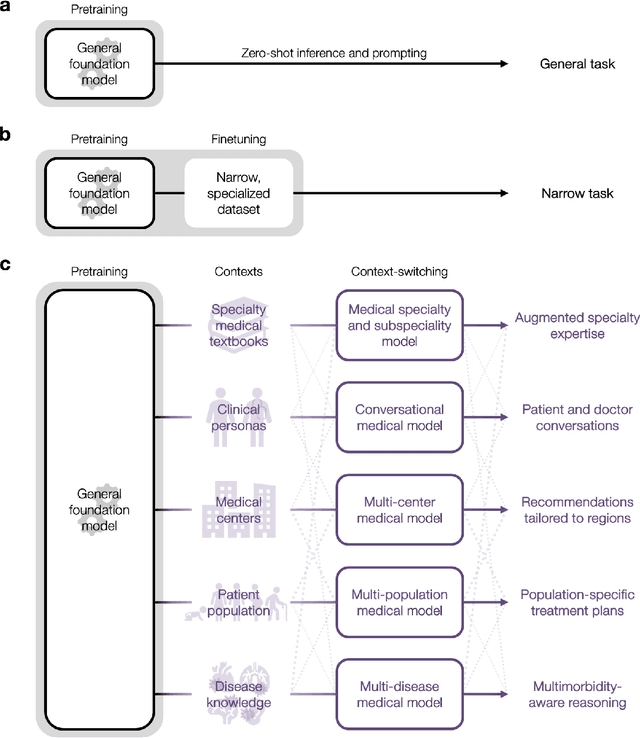
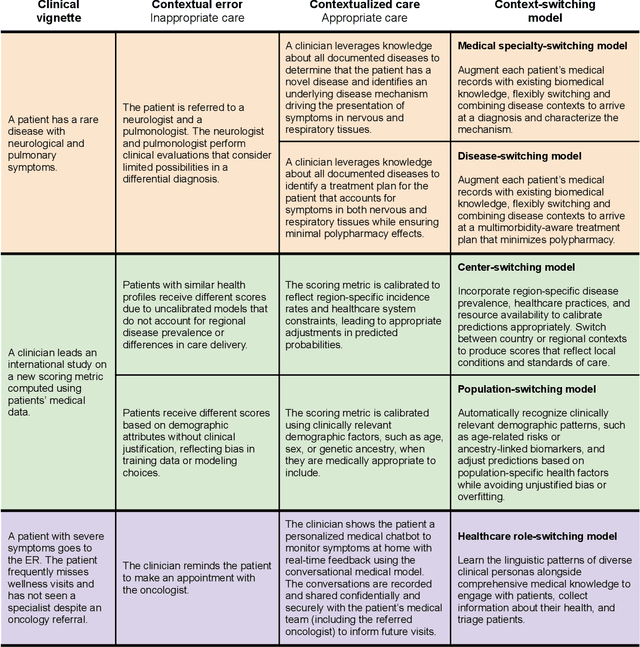
Medical foundation models, including language models trained on clinical notes, vision-language models on medical images, and multimodal models on electronic health records, can summarize clinical notes, answer medical questions, and assist in decision-making. Adapting these models to new populations, specialties, or settings typically requires fine-tuning, careful prompting, or retrieval from knowledge bases. This can be impractical, and limits their ability to interpret unfamiliar inputs and adjust to clinical situations not represented during training. As a result, models are prone to contextual errors, where predictions appear reasonable but fail to account for critical patient-specific or contextual information. These errors stem from a fundamental limitation that current models struggle with: dynamically adjusting their behavior across evolving contexts of medical care. In this Perspective, we outline a vision for context-switching in medical AI: models that dynamically adapt their reasoning without retraining to new specialties, populations, workflows, and clinical roles. We envision context-switching AI to diagnose, manage, and treat a wide range of diseases across specialties and regions, and expand access to medical care.