 Add to Chrome
 Add to Firefox
 Add to Edge
Self-supervision drives representational convergence in medical foundation models more than clinical supervision
Jul 22, 2026
Medical image encoders from different groups are increasingly treated as interchangeable, on the assumption that scale and clinical supervision concentrate their representations onto a shared structure. Whether this convergence is real, what produces it, and whether it is clinically usable are untested, and the similarity measures behind such claims are fragile. We present a controlled dissection across 18 image and 7 text encoders, all open-weight and run locally, spanning 7M to 27B parameters and five imaging modalities, including 650,982 chest radiographs from six datasets. To isolate cause, we train encoders that vary only the objective under fixed data, architecture, and scale, and reproduce the effect in a synthetic model. Convergence is modest but above a random floor, driven by the self-supervised objective, not clinical supervision: matched self-supervised encoders aligned most (40.4% on chest radiography), with label-supervised (21.1%) and image-text (3.3%) far lower, and did not grow with size (Spearman 0.302, p=0.223) or capability. It is within-modality, does not reach clinical language, and does not reproduce how radiologists judge case similarity. Yet a linear classifier transfers across encoders and to five held-out hospitals, retaining about 85% of within-encoder performance. Convergence in medical imaging is therefore set by the pretraining objective, not inherited from scale or clinical supervision. Interoperability is accordingly something to design for through that objective, and to validate where the shared geometry is weakest, across patient subgroups and against clinical judgment.

Bayesian uncertainty estimation improves clinical decision making in medical AI agents
Jul 22, 2026Machine learning models for medical image analysis typically lack a reliable measure of confidence, limiting their use in ambiguous or atypical cases. Here we show that Monte Carlo dropout, applied to a multi-task chest-radiograph classifier (eight thoracic findings, 137,593 training images), provides an epistemic uncertainty signal that tracks generalisation across training-set scales and flags confident yet error-prone predictions. Adding this signal to the point prediction raised error-detection AUROC from 0.74 to 0.77 ($Δ$AUROC +0.023, 95% CI [+0.014, +0.033]). In a controlled 2x2 factorial experiment, a clinical-decision-support agent exploited this uncertainty only when it was delivered as a binary error-risk flag rather than as raw scores, cutting confident misdiagnoses on unreliable findings from 8.5% to 2.7%. Epistemic uncertainty estimation thus carries decision-relevant information beyond point predictions, but its value for downstream agents depends on how it is communicated.
Foundation-model-guided radiogenomic discovery linking cancer genomes to cancer scans
Jul 22, 2026The function of many genes is still unknown, and conventional driver-discovery methods, which rely on how frequently a gene is mutated, cannot assess genes that are only rarely affected. Here we pair Evo~2-based genome analysis with routine clinical imaging to identify gene--phenotype associations at genome-wide scale. For every somatic mutation across three TCGA cohorts (cRCC=clear cell renal cell carcinoma, HCC=hepatocellular carcinoma, and BC=breast cancer; $n = 340$ total), Evo~2 predicts a severity score, with no task-specific training. Per-gene severity summaries are then correlated with radiomic features extracted from paired tumor segmentations, controlling for total mutation burden. In TCGA-cRCC ($n = 162$), this sweep recovers established renal-cancer drivers and identifies 46 additional genes reaching false discovery rate (FDR) significance absent from curated cancer-gene panels, several of which are Mendelian ciliopathy and cytoskeletal-disease genes. These results demonstrate that pairing a genomic language model with widely available clinical imaging can serve as a hypothesis-free discovery tool for gene--imaging associations invisible to conventional approaches.
Multi-Teacher Contrastive Distillation for Edge-Efficient Pathology Foundation Models
Jul 06, 2026Computational pathology foundation models (PFMs) have advanced whole-slide image analysis. However, their size and inference cost hinder local deployment in pathology departments. We propose MuCoDi, a pretraining framework that distills frozen tile embeddings from multiple PFMs into compact edge-oriented encoders. Instead of regressing individual teacher features, MuCoDi trains lightweight MobileOne and RepViT students with a contrastive distillation objective adapted from MoCo v3, where cached Virchow2, UNI2, and H-Optimus-1 embeddings replace momentum-encoder keys. We pretrain students on 14.3M TCGA tiles from only 11.8K WSIs and evaluate frozen encoders on 23 clinically curated downstream classification tasks. RepViT-based MuCoEdge students retain near-teacher performance while reducing model size by orders of magnitude: MuCoEdge-R2.3 and MuCoEdge-R1.5 reach 71.0% external AUROC, within 0.8 percentage points of the best teacher (Virchow2, 71.8%), while MuCoEdge-R2.3 obtains the best external F1 and the second-best AUPRC (51.8% and 53.3%). MuCoEdge-R1.0 reaches 70.9% AUROC with only 6.4M parameters and 1.12 GFLOPs. On a Raspberry Pi 5, sub-million-parameter MobileOne students achieve up to 605-fold single-tile speedup over Virchow2 while retaining 66.5% to 66.9% external AUROC, demonstrating that PFM-quality pathology representations can be moved toward practical edge deployment. Code is available at https://anonymous.4open.science/r/mucodi-6243.
Quantifying the human visual exposome with vision language models
May 05, 2026The visual environment is a fundamental yet unquantified determinant of mental health. While the concept of the environmental exposome is well established, current methods rely on coarse geospatial proxies or biased self reports, failing to capture the first person visual context of daily life. We addressed this gap by coupling ecological momentary assessment with vision language models (VLMs) to quantify the semantic richness of human visual experience. Across 2674 participant generated photographs, VLM derived estimates of greenness robustly predicted momentary affect and chronic stress, consistent with established benchmarks. We then developed a semi autonomous large language model (LLM) based pipeline that mined over seven million scientific publications to extract nearly 1000 environmental features empirically linked to mental health. When applied to real world imagery, up to 33 percent of VLM extracted context ratings significantly correlated with affect and stress. These findings establish a scalable objective paradigm for visual exposomics, enabling high throughput decoding of how the visible world is associated with mental health.
Agentic Systems in Radiology: Design, Applications, Evaluation, and Challenges
Oct 10, 2025Building agents, systems that perceive and act upon their environment with a degree of autonomy, has long been a focus of AI research. This pursuit has recently become vastly more practical with the emergence of large language models (LLMs) capable of using natural language to integrate information, follow instructions, and perform forms of "reasoning" and planning across a wide range of tasks. With its multimodal data streams and orchestrated workflows spanning multiple systems, radiology is uniquely suited to benefit from agents that can adapt to context and automate repetitive yet complex tasks. In radiology, LLMs and their multimodal variants have already demonstrated promising performance for individual tasks such as information extraction and report summarization. However, using LLMs in isolation underutilizes their potential to support complex, multi-step workflows where decisions depend on evolving context from multiple information sources. Equipping LLMs with external tools and feedback mechanisms enables them to drive systems that exhibit a spectrum of autonomy, ranging from semi-automated workflows to more adaptive agents capable of managing complex processes. This review examines the design of such LLM-driven agentic systems, highlights key applications, discusses evaluation methods for planning and tool use, and outlines challenges such as error cascades, tool-use efficiency, and health IT integration.
Resolution scaling governs DINOv3 transfer performance in chest radiograph classification
Oct 08, 2025Self-supervised learning (SSL) has advanced visual representation learning, but its value in chest radiography, a high-volume imaging modality with fine-grained findings, remains unclear. Meta's DINOv3 extends earlier SSL models through Gram-anchored self-distillation. Whether these design choices improve transfer learning for chest radiography has not been systematically tested. We benchmarked DINOv3 against DINOv2 and ImageNet initialization across seven datasets (n>814,000). Two representative backbones were evaluated: ViT-B/16 and ConvNeXt-B. Images were analyzed at 224x224, 512x512, and 1024x1024 pixels. We additionally assessed frozen features from a 7B model. The primary outcome was mean AUROC across labels. At 224x224, DINOv3 and DINOv2 achieved comparable performance on adult datasets. Increasing resolution to 512x512 yielded consistent improvements for DINOv3 over both DINOv2 and ImageNet. In contrast, results in pediatric cohort showed no differences across initializations. Across all settings, ConvNeXt-B outperformed ViT-B/16. Models using frozen DINOv3-7B features underperformed relative to fully finetuned 86-89M-parameter backbones, highlighting the importance of domain adaptation. Scaling to 1024x1024 did not further improve accuracy. Resolution-related gains were most evident for boundary-dependent and small focal abnormalities. In chest radiography, higher input resolution is critical for leveraging the benefits of modern self-supervised models. 512x512 pixels represent a practical upper limit where DINOv3-initialized ConvNeXt-B networks provide the strongest performance, while larger inputs offer minimal return on cost. Clinically, these findings support use of finetuned, mid-sized backbones at 512x512 for chest radiograph interpretation, with the greatest gains expected in detecting subtle or boundary-centered lesions relevant to emergency and critical care settings.
MedicalPatchNet: A Patch-Based Self-Explainable AI Architecture for Chest X-ray Classification
Sep 09, 2025Deep neural networks excel in radiological image classification but frequently suffer from poor interpretability, limiting clinical acceptance. We present MedicalPatchNet, an inherently self-explainable architecture for chest X-ray classification that transparently attributes decisions to distinct image regions. MedicalPatchNet splits images into non-overlapping patches, independently classifies each patch, and aggregates predictions, enabling intuitive visualization of each patch's diagnostic contribution without post-hoc techniques. Trained on the CheXpert dataset (223,414 images), MedicalPatchNet matches the classification performance (AUROC 0.907 vs. 0.908) of EfficientNet-B0, while substantially improving interpretability: MedicalPatchNet demonstrates substantially improved interpretability with higher pathology localization accuracy (mean hit-rate 0.485 vs. 0.376 with Grad-CAM) on the CheXlocalize dataset. By providing explicit, reliable explanations accessible even to non-AI experts, MedicalPatchNet mitigates risks associated with shortcut learning, thus improving clinical trust. Our model is publicly available with reproducible training and inference scripts and contributes to safer, explainable AI-assisted diagnostics across medical imaging domains. We make the code publicly available: https://github.com/TruhnLab/MedicalPatchNet
A deep learning framework for efficient pathology image analysis
Feb 18, 2025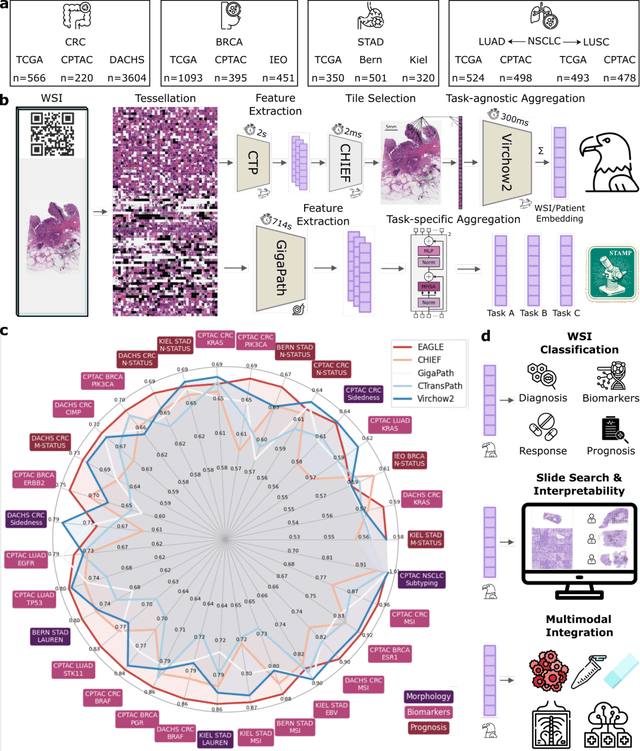
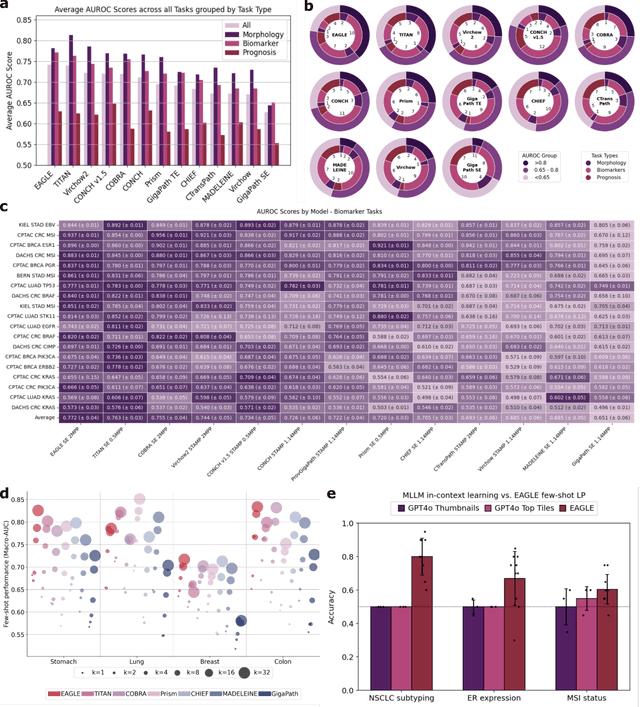
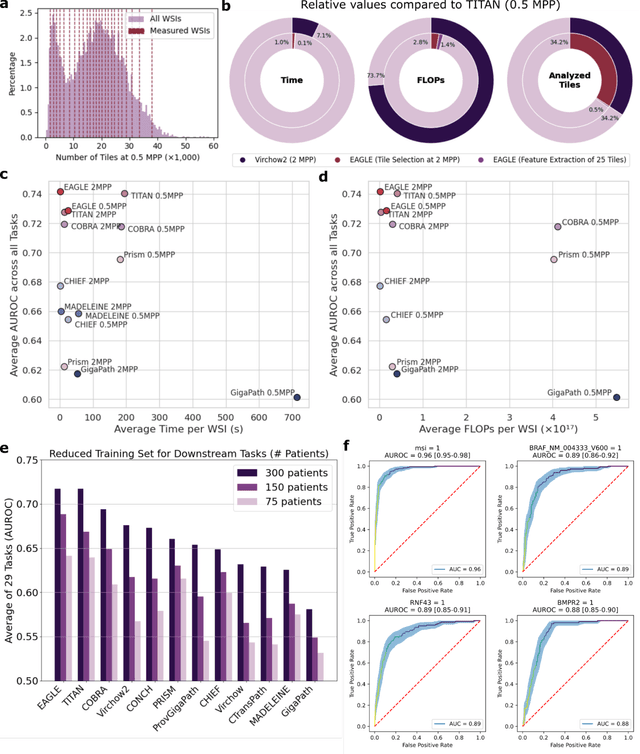
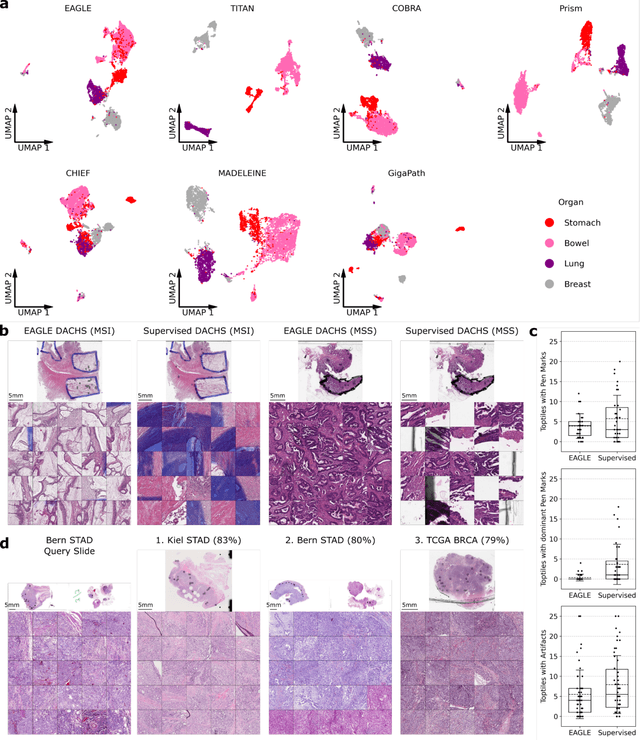
Artificial intelligence (AI) has transformed digital pathology by enabling biomarker prediction from high-resolution whole slide images (WSIs). However, current methods are computationally inefficient, processing thousands of redundant tiles per WSI and requiring complex aggregator models. We introduce EAGLE (Efficient Approach for Guided Local Examination), a deep learning framework that emulates pathologists by selectively analyzing informative regions. EAGLE incorporates two foundation models: CHIEF for efficient tile selection and Virchow2 for extracting high-quality features. Benchmarking was conducted against leading slide- and tile-level foundation models across 31 tasks from four cancer types, spanning morphology, biomarker prediction and prognosis. EAGLE outperformed state-of-the-art foundation models by up to 23% and achieved the highest AUROC overall. It processed a slide in 2.27 seconds, reducing computational time by more than 99% compared to existing models. This efficiency enables real-time workflows, allows pathologists to validate all tiles which are used by the model during analysis, and eliminates dependence on high-performance computing, making AI-powered pathology more accessible. By reliably identifying meaningful regions and minimizing artifacts, EAGLE provides robust and interpretable outputs, supporting rapid slide searches, integration into multi-omics pipelines and emerging clinical foundation models.
LLM Agents Making Agent Tools
Feb 17, 2025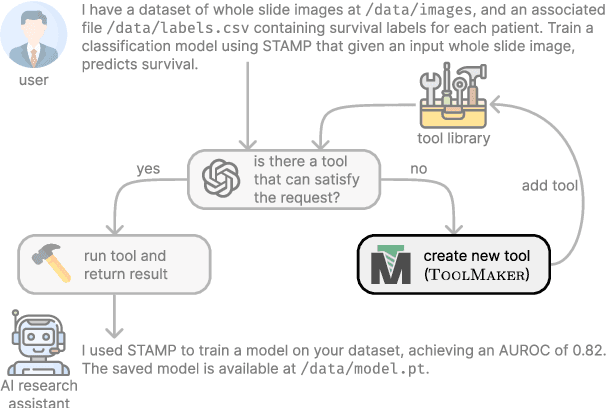
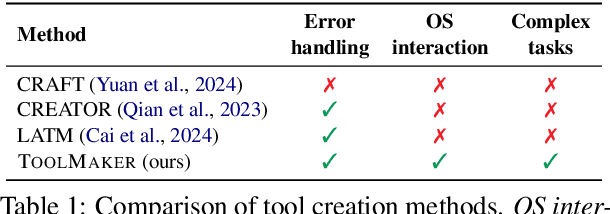
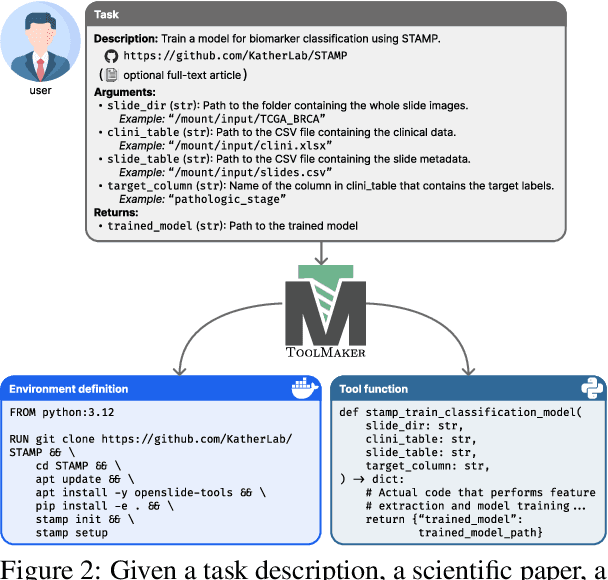
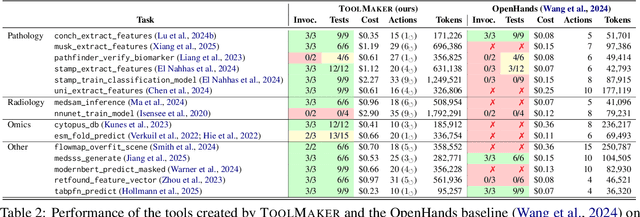
Tool use has turned large language models (LLMs) into powerful agents that can perform complex multi-step tasks by dynamically utilising external software components. However, these tools must be implemented in advance by human developers, hindering the applicability of LLM agents in domains which demand large numbers of highly specialised tools, like in life sciences and medicine. Motivated by the growing trend of scientific studies accompanied by public code repositories, we propose ToolMaker, a novel agentic framework that autonomously transforms papers with code into LLM-compatible tools. Given a short task description and a repository URL, ToolMaker autonomously installs required dependencies and generates code to perform the task, using a closed-loop self-correction mechanism to iteratively diagnose and rectify errors. To evaluate our approach, we introduce a benchmark comprising 15 diverse and complex computational tasks spanning both medical and non-medical domains with over 100 unit tests to objectively assess tool correctness and robustness. ToolMaker correctly implements 80% of the tasks, substantially outperforming current state-of-the-art software engineering agents. ToolMaker therefore is a step towards fully autonomous agent-based scientific workflows.