 Add to Chrome
 Add to Firefox
 Add to Edge
Multi-Teacher Contrastive Distillation for Edge-Efficient Pathology Foundation Models
Jul 06, 2026
Computational pathology foundation models (PFMs) have advanced whole-slide image analysis. However, their size and inference cost hinder local deployment in pathology departments. We propose MuCoDi, a pretraining framework that distills frozen tile embeddings from multiple PFMs into compact edge-oriented encoders. Instead of regressing individual teacher features, MuCoDi trains lightweight MobileOne and RepViT students with a contrastive distillation objective adapted from MoCo v3, where cached Virchow2, UNI2, and H-Optimus-1 embeddings replace momentum-encoder keys. We pretrain students on 14.3M TCGA tiles from only 11.8K WSIs and evaluate frozen encoders on 23 clinically curated downstream classification tasks. RepViT-based MuCoEdge students retain near-teacher performance while reducing model size by orders of magnitude: MuCoEdge-R2.3 and MuCoEdge-R1.5 reach 71.0% external AUROC, within 0.8 percentage points of the best teacher (Virchow2, 71.8%), while MuCoEdge-R2.3 obtains the best external F1 and the second-best AUPRC (51.8% and 53.3%). MuCoEdge-R1.0 reaches 70.9% AUROC with only 6.4M parameters and 1.12 GFLOPs. On a Raspberry Pi 5, sub-million-parameter MobileOne students achieve up to 605-fold single-tile speedup over Virchow2 while retaining 66.5% to 66.9% external AUROC, demonstrating that PFM-quality pathology representations can be moved toward practical edge deployment. Code is available at https://anonymous.4open.science/r/mucodi-6243.

A deep learning framework for efficient pathology image analysis
Feb 18, 2025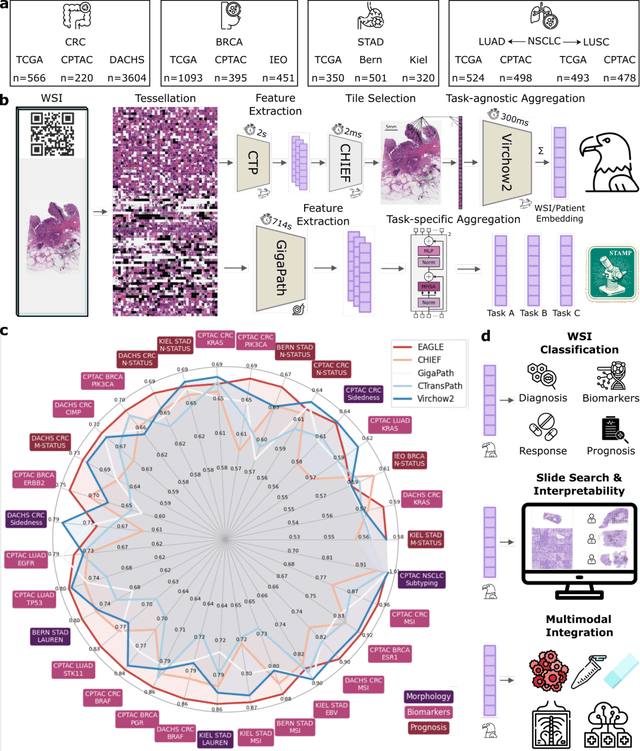
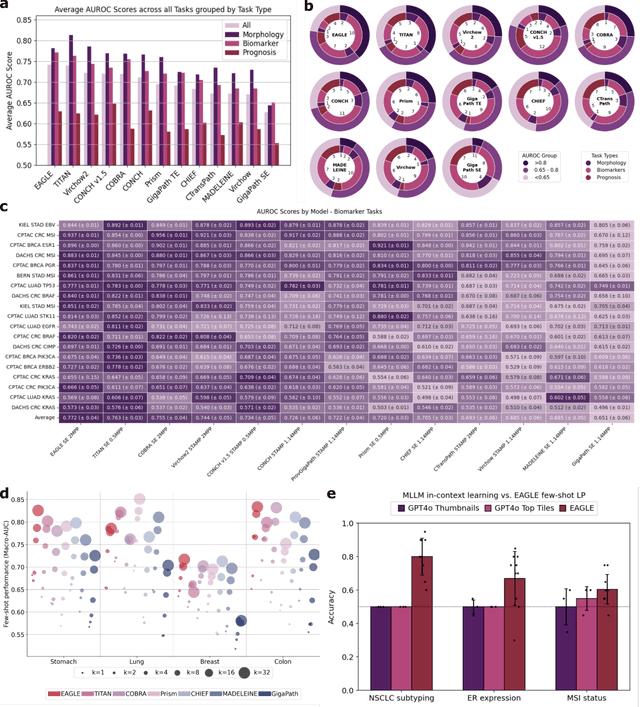
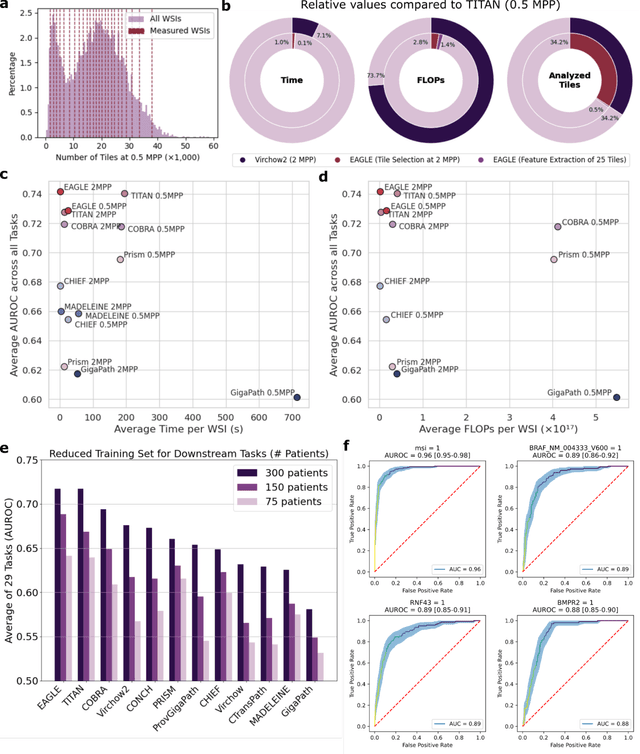
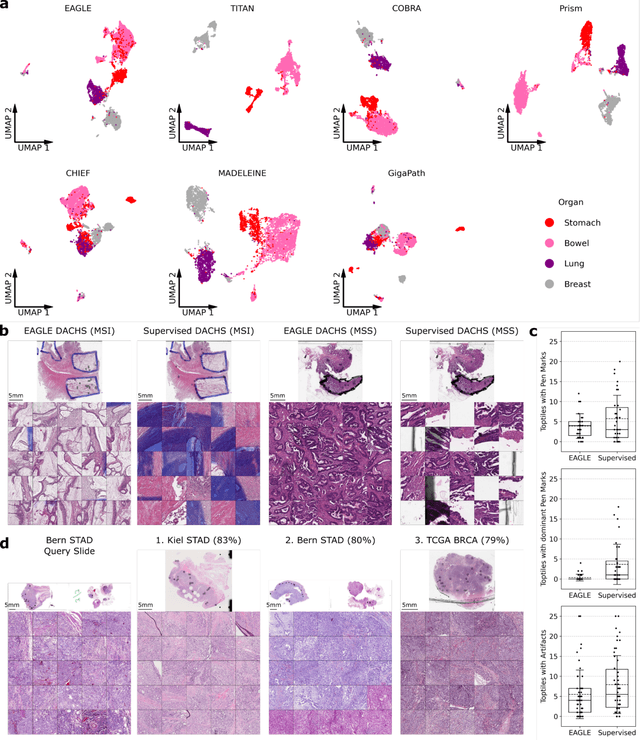
Artificial intelligence (AI) has transformed digital pathology by enabling biomarker prediction from high-resolution whole slide images (WSIs). However, current methods are computationally inefficient, processing thousands of redundant tiles per WSI and requiring complex aggregator models. We introduce EAGLE (Efficient Approach for Guided Local Examination), a deep learning framework that emulates pathologists by selectively analyzing informative regions. EAGLE incorporates two foundation models: CHIEF for efficient tile selection and Virchow2 for extracting high-quality features. Benchmarking was conducted against leading slide- and tile-level foundation models across 31 tasks from four cancer types, spanning morphology, biomarker prediction and prognosis. EAGLE outperformed state-of-the-art foundation models by up to 23% and achieved the highest AUROC overall. It processed a slide in 2.27 seconds, reducing computational time by more than 99% compared to existing models. This efficiency enables real-time workflows, allows pathologists to validate all tiles which are used by the model during analysis, and eliminates dependence on high-performance computing, making AI-powered pathology more accessible. By reliably identifying meaningful regions and minimizing artifacts, EAGLE provides robust and interpretable outputs, supporting rapid slide searches, integration into multi-omics pipelines and emerging clinical foundation models.