 Add to Chrome
 Add to Firefox
 Add to Edge
AUDITFLOW: Executable Symbolic Environments for Structured Financial Reporting Verification
Jun 02, 2026
Structured financial audit verification is difficult for language-model agents because correctness depends on structured evidence rather than text alone. A model must link reported facts to taxonomy concepts, traverse calculation or dimensional relations, and recompute expected values before applying an audit rule. We propose AuditFlow, a graph-grounded multi-agent framework that separates adaptive search from deterministic verification. AuditFlow builds a symbolic environment from a static US-GAAP taxonomy graph and a dynamic XBRL filing graph, and exposes it through typed tools for fact retrieval, taxonomy traversal, numerical checking, and rule evaluation. Two junior auditors inspect each case from regulatory and evidentiary views, while a senior auditor resolves disagreements and can request further investigation. The final reports are fused through evidential aggregation to produce an audit verdict, expected value, evidence trail, and trustworthiness score. On a FinAuditing-derived FinMR sample, AuditFlow reaches 82.09% joint audit accuracy under GPT-5.5, outperforming the strongest baseline by 14.93 points. Removing deterministic checks drops accuracy to 17.91%, showing that the symbolic environment performs the verification step that the model cannot reliably replace.

Reasoning Models Ace the CFA Exams
Dec 09, 2025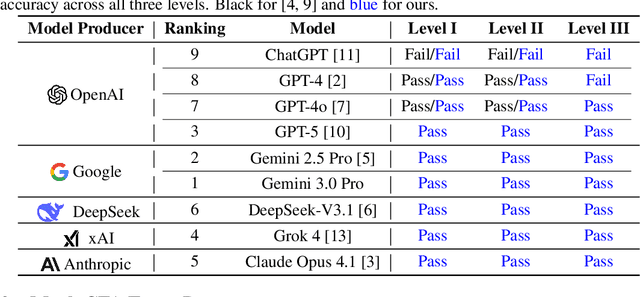
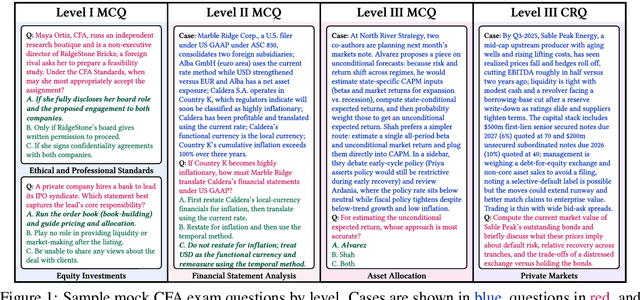
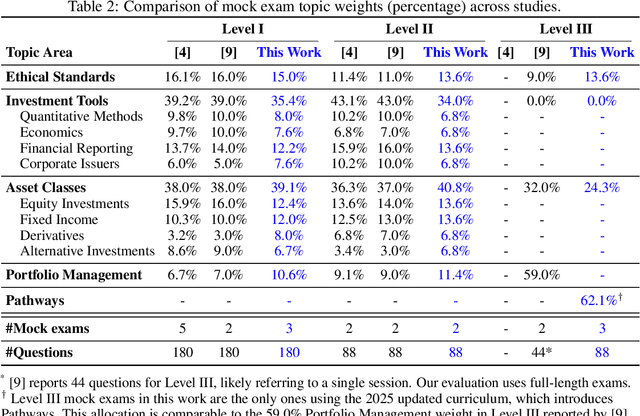
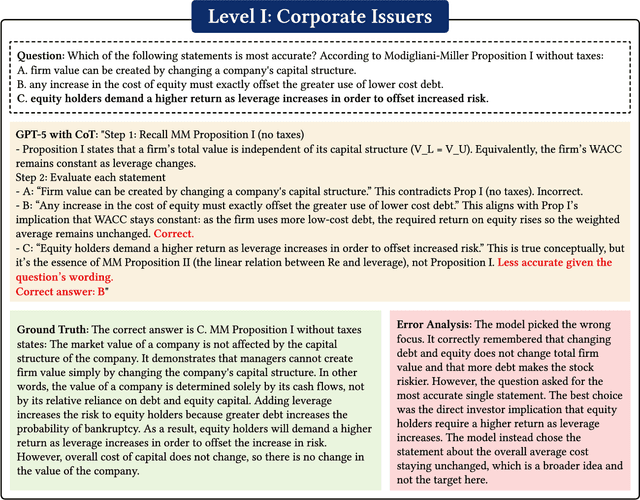
Previous research has reported that large language models (LLMs) demonstrate poor performance on the Chartered Financial Analyst (CFA) exams. However, recent reasoning models have achieved strong results on graduate-level academic and professional examinations across various disciplines. In this paper, we evaluate state-of-the-art reasoning models on a set of mock CFA exams consisting of 980 questions across three Level I exams, two Level II exams, and three Level III exams. Using the same pass/fail criteria from prior studies, we find that most models clear all three levels. The models that pass, ordered by overall performance, are Gemini 3.0 Pro, Gemini 2.5 Pro, GPT-5, Grok 4, Claude Opus 4.1, and DeepSeek-V3.1. Specifically, Gemini 3.0 Pro achieves a record score of 97.6% on Level I. Performance is also strong on Level II, led by GPT-5 at 94.3%. On Level III, Gemini 2.5 Pro attains the highest score with 86.4% on multiple-choice questions while Gemini 3.0 Pro achieves 92.0% on constructed-response questions.
FinLoRA: Benchmarking LoRA Methods for Fine-Tuning LLMs on Financial Datasets
May 26, 2025Low-rank adaptation (LoRA) methods show great potential for scaling pre-trained general-purpose Large Language Models (LLMs) to hundreds or thousands of use scenarios. However, their efficacy in high-stakes domains like finance is rarely explored, e.g., passing CFA exams and analyzing SEC filings. In this paper, we present the open-source FinLoRA project that benchmarks LoRA methods on both general and highly professional financial tasks. First, we curated 19 datasets covering diverse financial applications; in particular, we created four novel XBRL analysis datasets based on 150 SEC filings. Second, we evaluated five LoRA methods and five base LLMs. Finally, we provide extensive experimental results in terms of accuracy, F1, and BERTScore and report computational cost in terms of time and GPU memory during fine-tuning and inference stages. We find that LoRA methods achieved substantial performance gains of 36\% on average over base models. Our FinLoRA project provides an affordable and scalable approach to democratize financial intelligence to the general public. Datasets, LoRA adapters, code, and documentation are available at https://github.com/Open-Finance-Lab/FinLoRA