 Add to Chrome
 Add to Firefox
 Add to Edge
Mind the Privileged-to-Camera Gap: Actor-Centric Sidecar Supervision for Camera-First Open-Loop Waypoint Prediction
Jun 18, 2026
Camera-first autonomous-driving models predict future ego waypoints from images, ego-state features, and route commands, but waypoint supervision alone does not explicitly supervise actor-level representations of nearby road users. We study this as supervised representation learning for open-loop waypoint prediction. The deployable model uses multi-view RGB, ego state, and route command at inference. During training, simulator-derived sidecar labels supervise actor grounding, privileged hindsight actor relevance relative to the logged ego trajectory, and selected-actor short-horizon motion; these labels are never inference inputs. We evaluate route-disjoint splits with matched architecture, optimizer, validation criterion, checkpoint selection, and three seeds. A plain waypoint-only RGB baseline obtains 1.815$\pm$0.02 m final displacement error (FDE), and the matched no-teacher non-sidecar RGB control obtains 1.716$\pm$0.02 m. Road-user sidecar supervision (RU-sidecar) reduces FDE to 1.223$\pm$0.01 m, a 32.6% reduction over the plain baseline and 28.7% over the matched no-teacher non-sidecar RGB control. It improves over the plain baseline on 1445/1494 routes and over the matched no-teacher non-sidecar RGB control on 1417/1494 routes. Actor-conditioned slices show gains in all nonempty subsets, including 29.1% reduction for samples with at least four valid sidecar actors and 30.0% when a vulnerable road user is present. Optional simulator-state teacher alignment reaches 1.186$\pm$0.15 m FDE, but higher seed variability makes it secondary. Non-deployable simulator-state diagnostics remain stronger, indicating a privileged-to-camera gap. The evidence is limited to open-loop simulation diagnostics.

Towards Generative Predictive Display for Vision-Based Teleoperation: A Zero-Shot Benchmark of Off-the-Shelf Video Models
May 10, 2026Teleoperation systems are fundamentally limited by communication latency, which degrades situational awareness and control performance. Predictive display aims to mitigate this limitation by presenting an estimate of the current visual state rather than delayed observations. While recent advances in generative video models enable high-quality video synthesis, their suitability for latency-sensitive predictive display remains unclear. This paper presents a zero-shot benchmark of off-the-shelf generative video models for short-horizon predictive display, without task-specific fine-tuning. We formulate the problem as rollout-based future frame prediction and develop a unified benchmarking pipeline using simulated driving data from the CARLA simulator. Five publicly released video models spanning transformer-based and diffusion-based families are evaluated across two resolutions and two conditioning regimes (multi-frame and single-frame). Performance is assessed using prediction accuracy (mean absolute difference), per-rollout latency, peak GPU memory usage, and temporal error evolution across the prediction horizon. On this zero-shot benchmark, no tested model simultaneously achieves low rollout error, non-divergent per-step error behavior, and real-time inference at the source frame rate. Increasing model scale or resolution yields limited and, in some cases, inverted improvements. These findings highlight a gap between general-purpose generative video synthesis and the requirements of predictive display in teleoperation, suggesting that practical deployment will require either explicit short-horizon temporal supervision, in-domain adaptation, or aggressive inference optimization rather than direct application of off-the-shelf models. Code, configurations, and qualitative results are released on the project page: https://bimilab.github.io/paper-GenPD
Defining and Evaluation Method for External Human-Machine Interfaces
Apr 14, 2026As the number of fatalities involving Autonomous Vehicles increase, the need for a universal method of communicating between vehicles and other agents on the road has also increased. Over the past decade, numerous proposals of external Human-Machine Interfaces (eHMIs) have been brought forward with the purpose of bridging this communication gap, with none yet to be determined as the ideal one. This work proposes a universal evaluation method conformed of 223 questions to objectively evaluate and compare different proposals and arrive at a conclusion. The questionnaire is divided into 7 categories that evaluate different aspects of any given proposal that uses eHMIs: ease of standardization, cost effectiveness, accessibility, ease of understanding, multifacetedness in communication, positioning, and readability. In order to test the method it was used on four existing proposals, plus a baseline using only kinematic motions, in order to both exemplify the application of the evaluation method and offer a baseline score for future comparison. The result of this testing suggests that the ideal method of machine-human communication is a combination of intentionally-designed vehicle kinematics and distributed well-placed text-based displays, but it also reveals knowledge gaps in the readability of eHMIs and the speed at which different observers may learn their meaning. This paper proposes future work related to these uncertainties, along with future testing with the proposed method.
Using Unwrapped Full Color Space Palette Recording to Measure Exposedness of a Vehicle Exterior Parts for External Human Machine Interfaces
Apr 13, 2026One of the concerns with autonomous vehicles is their ability to communicate their intent to other road users, specially pedestrians, in order to prevent accidents. External Human-Machine Interfaces (eHMIs) are the proposed solution to this issue, through the introduction of electronic devices on the exterior of a vehicle that communicate when the vehicle is planning on slowing down or yielding. This paper uses the technique of unwrapping the faces of a mesh onto a texture where every pixel is a unique color, as well as a series of animated simulations made and ran in the Unity game engine, to measure how many times is each point on a 2015 Ford F-150 King Ranch is unobstructed to a pedestrian attempting to cross the road at a four-way intersection. By cross-referencing the results with a color-coded map of the labeled parts on the exterior of the vehicle, it was concluded that while the bumper, grill, and hood were the parts of the vehicle visible to the crossing pedestrian most often, the existence of other vehicles on the same lane that might obstruct the view of these makes them insufficient. The study recommends instead a distributive approach to eHMIs by using both the windshield and frontal fenders as simultaneous placements for these devices.
InDRiVE: Reward-Free World-Model Pretraining for Autonomous Driving via Latent Disagreement
Dec 21, 2025Model-based reinforcement learning (MBRL) can reduce interaction cost for autonomous driving by learning a predictive world model, but it typically still depends on task-specific rewards that are difficult to design and often brittle under distribution shift. This paper presents InDRiVE, a DreamerV3-style MBRL agent that performs reward-free pretraining in CARLA using only intrinsic motivation derived from latent ensemble disagreement. Disagreement acts as a proxy for epistemic uncertainty and drives the agent toward under-explored driving situations, while an imagination-based actor-critic learns a planner-free exploration policy directly from the learned world model. After intrinsic pretraining, we evaluate zero-shot transfer by freezing all parameters and deploying the pretrained exploration policy in unseen towns and routes. We then study few-shot adaptation by training a task policy with limited extrinsic feedback for downstream objectives (lane following and collision avoidance). Experiments in CARLA across towns, routes, and traffic densities show that disagreement-based pretraining yields stronger zero-shot robustness and robust few-shot collision avoidance under town shift and matched interaction budgets, supporting the use of intrinsic disagreement as a practical reward-free pretraining signal for reusable driving world models.
A Comprehensive Review of Reinforcement Learning for Autonomous Driving in the CARLA Simulator
Sep 10, 2025Autonomous-driving research has recently embraced deep Reinforcement Learning (RL) as a promising framework for data-driven decision making, yet a clear picture of how these algorithms are currently employed, benchmarked and evaluated is still missing. This survey fills that gap by systematically analysing around 100 peer-reviewed papers that train, test or validate RL policies inside the open-source CARLA simulator. We first categorize the literature by algorithmic family model-free, model-based, hierarchical, and hybrid and quantify their prevalence, highlighting that more than 80% of existing studies still rely on model-free methods such as DQN, PPO and SAC. Next, we explain the diverse state, action and reward formulations adopted across works, illustrating how choices of sensor modality (RGB, LiDAR, BEV, semantic maps, and carla kinematics states), control abstraction (discrete vs. continuous) and reward shaping are used across various literature. We also consolidate the evaluation landscape by listing the most common metrics (success rate, collision rate, lane deviation, driving score) and the towns, scenarios and traffic configurations used in CARLA benchmarks. Persistent challenges including sparse rewards, sim-to-real transfer, safety guarantees and limited behaviour diversity are distilled into a set of open research questions, and promising directions such as model-based RL, meta-learning and richer multi-agent simulations are outlined. By providing a unified taxonomy, quantitative statistics and a critical discussion of limitations, this review aims to serve both as a reference for newcomers and as a roadmap for advancing RL-based autonomous driving toward real-world deployment.
Systematic Evaluation of Initial States and Exploration-Exploitation Strategies in PID Auto-Tuning: A Framework-Driven Approach Applied on Mobile Robots
May 06, 2025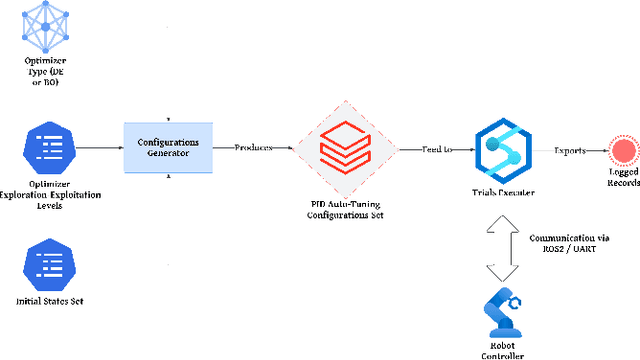
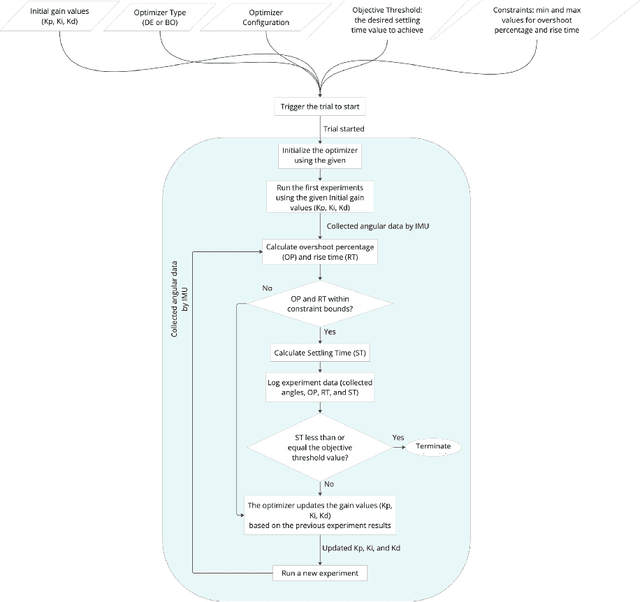

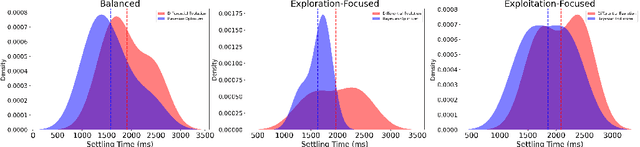
PID controllers are widely used in control systems because of their simplicity and effectiveness. Although advanced optimization techniques such as Bayesian Optimization and Differential Evolution have been applied to address the challenges of automatic tuning of PID controllers, the influence of initial system states on convergence and the balance between exploration and exploitation remains underexplored. Moreover, experimenting the influence directly on real cyber-physical systems such as mobile robots is crucial for deriving realistic insights. In the present paper, a novel framework is introduced to evaluate the impact of systematically varying these factors on the PID auto-tuning processes that utilize Bayesian Optimization and Differential Evolution. Testing was conducted on two distinct PID-controlled robotic platforms, an omnidirectional robot and a differential drive mobile robot, to assess the effects on convergence rate, settling time, rise time, and overshoot percentage. As a result, the experimental outcomes yield evidence on the effects of the systematic variations, thereby providing an empirical basis for future research studies in the field.
DriveNetBench: An Affordable and Configurable Single-Camera Benchmarking System for Autonomous Driving Networks
May 03, 2025Validating autonomous driving neural networks often demands expensive equipment and complex setups, limiting accessibility for researchers and educators. We introduce DriveNetBench, an affordable and configurable benchmarking system designed to evaluate autonomous driving networks using a single-camera setup. Leveraging low-cost, off-the-shelf hardware, and a flexible software stack, DriveNetBench enables easy integration of various driving models, such as object detection and lane following, while ensuring standardized evaluation in real-world scenarios. Our system replicates common driving conditions and provides consistent, repeatable metrics for comparing network performance. Through preliminary experiments with representative vision models, we illustrate how DriveNetBench effectively measures inference speed and accuracy within a controlled test environment. The key contributions of this work include its affordability, its replicability through open-source software, and its seamless integration into existing workflows, making autonomous vehicle research more accessible.
InDRiVE: Intrinsic Disagreement based Reinforcement for Vehicle Exploration through Curiosity Driven Generalized World Model
Mar 07, 2025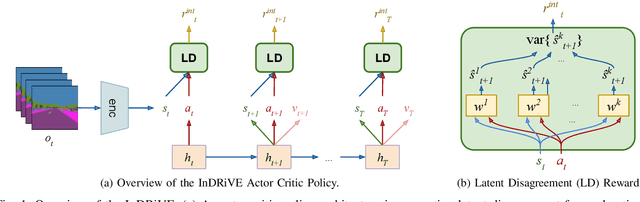
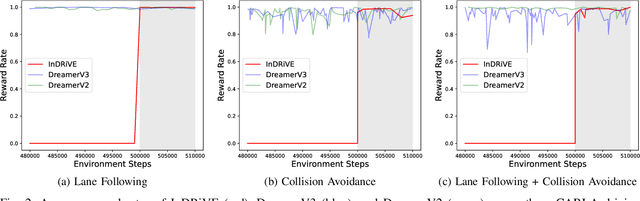
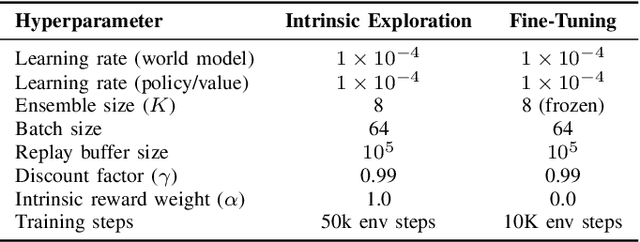

Model-based Reinforcement Learning (MBRL) has emerged as a promising paradigm for autonomous driving, where data efficiency and robustness are critical. Yet, existing solutions often rely on carefully crafted, task specific extrinsic rewards, limiting generalization to new tasks or environments. In this paper, we propose InDRiVE (Intrinsic Disagreement based Reinforcement for Vehicle Exploration), a method that leverages purely intrinsic, disagreement based rewards within a Dreamer based MBRL framework. By training an ensemble of world models, the agent actively explores high uncertainty regions of environments without any task specific feedback. This approach yields a task agnostic latent representation, allowing for rapid zero shot or few shot fine tuning on downstream driving tasks such as lane following and collision avoidance. Experimental results in both seen and unseen environments demonstrate that InDRiVE achieves higher success rates and fewer infractions compared to DreamerV2 and DreamerV3 baselines despite using significantly fewer training steps. Our findings highlight the effectiveness of purely intrinsic exploration for learning robust vehicle control behaviors, paving the way for more scalable and adaptable autonomous driving systems.
Perceptual Motor Learning with Active Inference Framework for Robust Lateral Control
Mar 05, 2025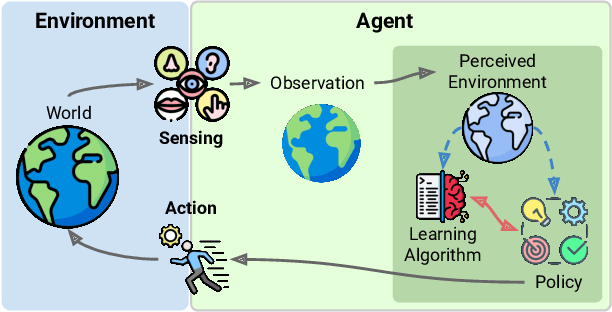
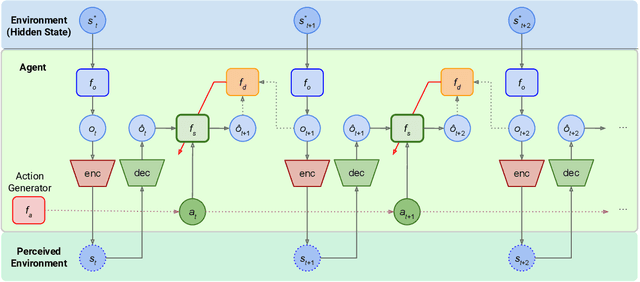
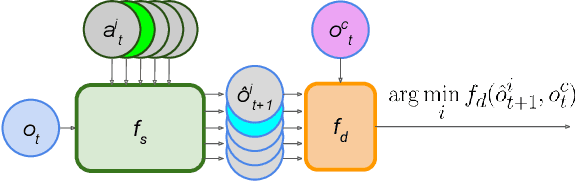

This paper presents a novel Perceptual Motor Learning (PML) framework integrated with Active Inference (AIF) to enhance lateral control in Highly Automated Vehicles (HAVs). PML, inspired by human motor learning, emphasizes the seamless integration of perception and action, enabling efficient decision-making in dynamic environments. Traditional autonomous driving approaches--including modular pipelines, imitation learning, and reinforcement learning--struggle with adaptability, generalization, and computational efficiency. In contrast, PML with AIF leverages a generative model to minimize prediction error ("surprise") and actively shape vehicle control based on learned perceptual-motor representations. Our approach unifies deep learning with active inference principles, allowing HAVs to perform lane-keeping maneuvers with minimal data and without extensive retraining across different environments. Extensive experiments in the CARLA simulator demonstrate that PML with AIF enhances adaptability without increasing computational overhead while achieving performance comparable to conventional methods. These findings highlight the potential of PML-driven active inference as a robust alternative for real-world autonomous driving applications.