 Add to Chrome
 Add to Firefox
 Add to Edge
Blue Data Intelligence Layer: Streaming Data and Agents for Multi-source Multi-modal Data-Centric Applications
Apr 16, 2026
NL2SQL systems aim to address the growing need for natural language interaction with data. However, real-world information rarely maps to a single SQL query because (1) users express queries iteratively (2) questions often span multiple data sources beyond the closed-world assumption of a single database, and (3) queries frequently rely on commonsense or external knowledge. Consequently, satisfying realistic data needs require integrating heterogeneous sources, modalities, and contextual data. In this paper, we present Blue's Data Intelligence Layer (DIL) designed to support multi-source, multi-modal, and data-centric applications. Blue is a compound AI system that orchestrates agents and data for enterprise settings. DIL serves as the data intelligence layer for agentic data processing, to bridge the semantic gap between user intent and available information by unifying structured enterprise data, world knowledge accessible through LLMs, and personal context obtained through interaction. At the core of DIL is a data registry that stores metadata for diverse data sources and modalities to enable both native and natural language queries. DIL treats LLMs, the Web, and the User as source 'databases', each with their own query interface, elevating them to first-class data sources. DIL relies on data planners to transform user queries into executable query plans. These plans are declarative abstractions that unify relational operators with other operators spanning multiple modalities. DIL planners support decomposition of complex requests into subqueries, retrieval from diverse sources, and finally reasoning and integration to produce final results. We demonstrate DIL through two interactive scenarios in which user queries dynamically trigger multi-source retrieval, cross-modal reasoning, and result synthesis, illustrating how compound AI systems can move beyond single database NL2SQL.

Towards Reliable Benchmarking: A Contamination Free, Controllable Evaluation Framework for Multi-step LLM Function Calling
Sep 30, 2025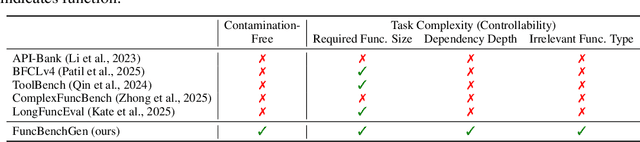
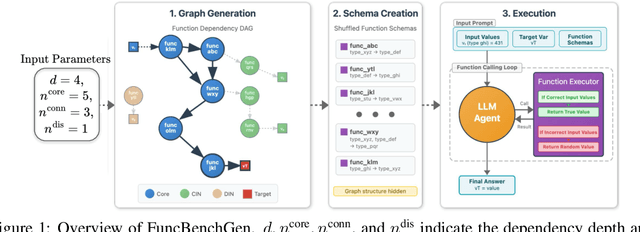
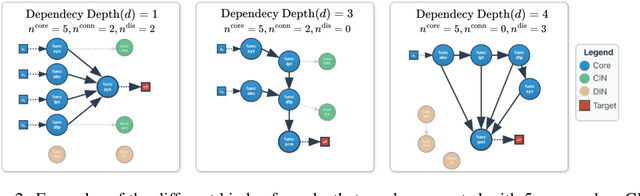
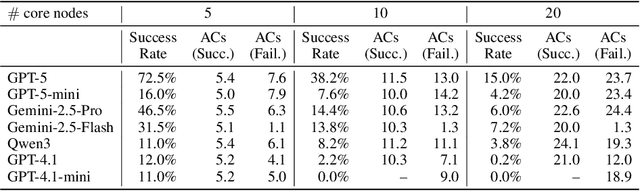
As language models gain access to external tools via structured function calls, they become increasingly more capable of solving complex, multi-step tasks. However, existing benchmarks for tool-augmented language models (TaLMs) provide insufficient control over factors such as the number of functions accessible, task complexity, and input size, and remain vulnerable to data contamination. We present FuncBenchGen, a unified, contamination-free framework that evaluates TaLMs by generating synthetic multi-step tool-use tasks. The key idea is to cast tool use as traversal over a hidden function-dependency DAG where nodes are function calls and an edge between nodes represents one function consuming the output of another. Given a set of external function schemas, initial variable values, and a target variable, models must compose the correct call sequence to compute the target variable. FuncBenchGen allows users to precisely control task difficulty (e.g., graph size, dependency depth, and distractor functions) while avoiding data leakage. We apply our FuncBenchGen framework to evaluate seven LLMs on tool use tasks of varying difficulty. Reasoning-optimized models consistently outperform general-purpose models with GPT-5 significantly outperforming other models. Performance declines sharply as dependency depth increases. Furthermore, connected irrelevant functions prove especially difficult to handle. We find that strong models often make syntactically valid function calls but propagate incorrect or stale argument values across steps, revealing brittle state tracking by LLMs in multi-turn tool use. Motivated by this observation, we introduce a simple mitigation strategy that explicitly restates prior variable values to the agent at each step. Surprisingly, this lightweight change yields substantial gains across models. e.g., yielding a success rate improvement from 62.5% to 81.3% for GPT-5.