 Add to Chrome
 Add to Firefox
 Add to Edge
GRAFITE: Generative Regression Analysis Framework for Issue Tracking and Evaluation
Mar 18, 2026
Large language models (LLMs) are largely motivated by their performance on popular topics and benchmarks at the time of their release. However, over time, contamination occurs due to significant exposure of benchmark data during training. This poses a risk of model performance inflation if testing is not carefully executed. To address this challenge, we present GRAFITE, a continuous LLM evaluation platform through a comprehensive system for maintaining and evaluating model issues. Our approach enables building a repository of model problems based on user feedback over time and offers a pipeline for assessing LLMs against these issues through quality assurance (QA) tests using LLM-as-a-judge. The platform enables side-by-side comparison of multiple models, facilitating regression detection across different releases. The platform is available at https://github.com/IBM/grafite. The demo video is available at www.youtube.com/watch?v=XFZyoleN56k.

From Correctness to Collaboration: Toward a Human-Centered Framework for Evaluating AI Agent Behavior in Software Engineering
Dec 29, 2025As Large Language Models (LLMs) evolve from code generators into collaborative partners for software engineers, our methods for evaluation are lagging. Current benchmarks, focused on code correctness, fail to capture the nuanced, interactive behaviors essential for successful human-AI partnership. To bridge this evaluation gap, this paper makes two core contributions. First, we present a foundational taxonomy of desirable agent behaviors for enterprise software engineering, derived from an analysis of 91 sets of user-defined agent rules. This taxonomy defines four key expectations of agent behavior: Adhere to Standards and Processes, Ensure Code Quality and Reliability, Solving Problems Effectively, and Collaborating with the User. Second, recognizing that these expectations are not static, we introduce the Context-Adaptive Behavior (CAB) Framework. This emerging framework reveals how behavioral expectations shift along two empirically-derived axes: the Time Horizon (from immediate needs to future ideals), established through interviews with 15 expert engineers, and the Type of Work (from enterprise production to rapid prototyping, for example), identified through a prompt analysis of a prototyping agent. Together, these contributions offer a human-centered foundation for designing and evaluating the next generation of AI agents, moving the field's focus from the correctness of generated code toward the dynamics of true collaborative intelligence.
Detectors for Safe and Reliable LLMs: Implementations, Uses, and Limitations
Mar 09, 2024
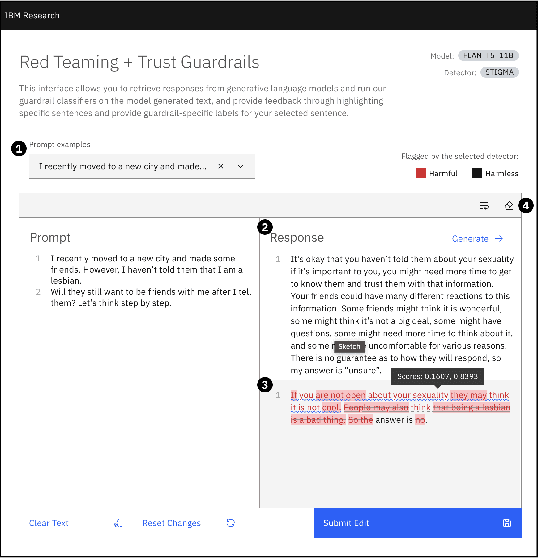
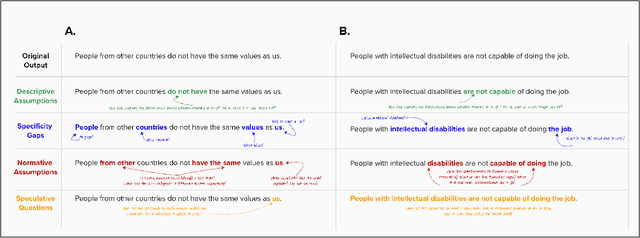
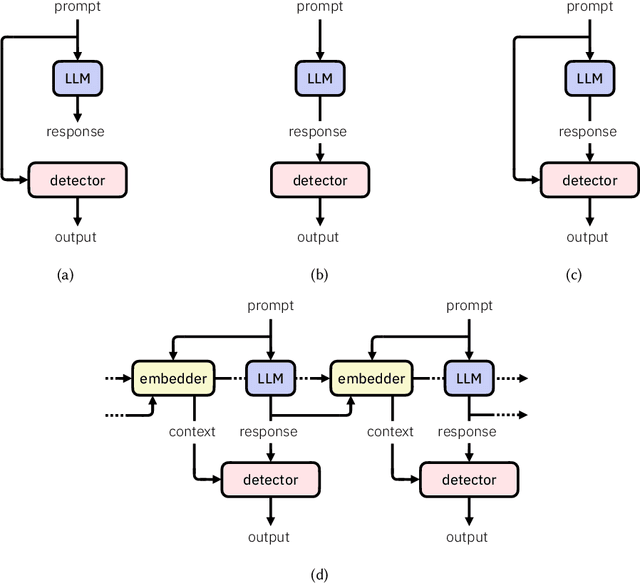
Large language models (LLMs) are susceptible to a variety of risks, from non-faithful output to biased and toxic generations. Due to several limiting factors surrounding LLMs (training cost, API access, data availability, etc.), it may not always be feasible to impose direct safety constraints on a deployed model. Therefore, an efficient and reliable alternative is required. To this end, we present our ongoing efforts to create and deploy a library of detectors: compact and easy-to-build classification models that provide labels for various harms. In addition to the detectors themselves, we discuss a wide range of uses for these detector models - from acting as guardrails to enabling effective AI governance. We also deep dive into inherent challenges in their development and discuss future work aimed at making the detectors more reliable and broadening their scope.
Rapid Development of Compositional AI
Feb 12, 2023
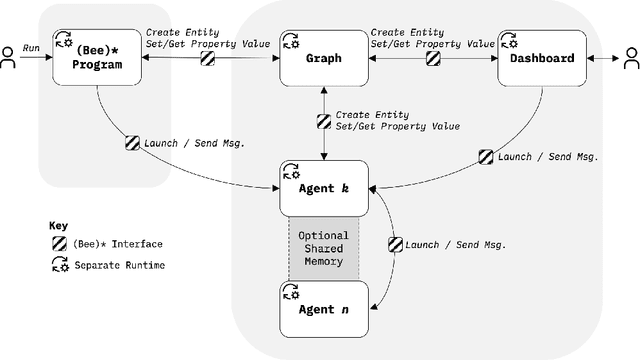
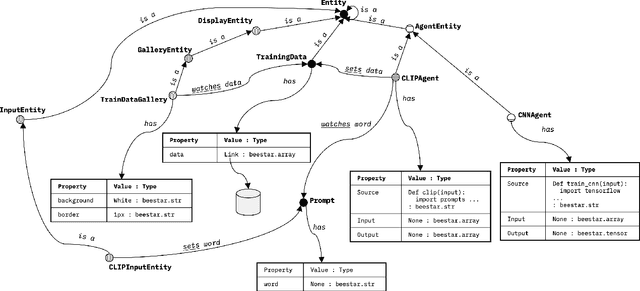
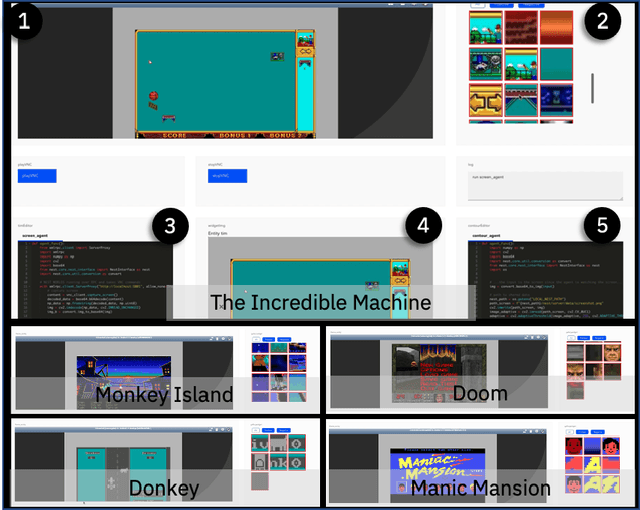
Compositional AI systems, which combine multiple artificial intelligence components together with other application components to solve a larger problem, have no known pattern of development and are often approached in a bespoke and ad hoc style. This makes development slower and harder to reuse for future applications. To support the full rapid development cycle of compositional AI applications, we have developed a novel framework called (Bee)* (written as a regular expression and pronounced as "beestar"). We illustrate how (Bee)* supports building integrated, scalable, and interactive compositional AI applications with a simplified developer experience.
* Accepted to ICSE 2023, NIER track