 Add to Chrome
 Add to Firefox
 Add to Edge
Reconfigurable Computing Challenge: Real-Time Graph Neural Networks for Online Event Selection in Big Science
May 11, 2026
Graph neural networks are increasingly adopted in trigger systems for collider experiments, where strict latency and throughput constraints render deployment on embedded platforms challenging. As detectors move towards higher granularity, the number of inputs per inference increase and FPGA-only solutions face resource bottlenecks. This work presents an end-to-end demonstrator for the real-time deployment of a dynamic Graph Neural Network for the Belle II electromagnetic calorimeter hardware trigger on the AMD Versal VCK190, leveraging both FPGA fabric and AI Engine tiles. We develop a Python-based semi-automated design flow covering operator fusion, partitioning, mapping, spatial parallelization, and kernel-level optimization. Our design achieves a throughput of 2.94 million events per second at an end-to-end latency of 7.15 microseconds. Compared to the FPGA-only baseline, this represents a 53% throughput improvement while reducing DSP utilization from 99% to 19% at 29% AI Engine tile utilization. To validate the deployment, an interactive visualization pipeline enables real-time monitoring of inference results on the physical demonstrator.

DendroNN: Dendrocentric Neural Networks for Energy-Efficient Classification of Event-Based Data
Mar 10, 2026Spatiotemporal information is at the core of diverse sensory processing and computational tasks. Feed-forward spiking neural networks can be used to solve these tasks while offering potential benefits in terms of energy efficiency by computing event-based. However, they have trouble decoding temporal information with high accuracy. Thus, they commonly resort to recurrence or delays to enhance their temporal computing ability which, however, bring downsides in terms of hardware-efficiency. In the brain, dendrites are computational powerhouses that just recently started to be acknowledged in such machine learning systems. In this work, we focus on a sequence detection mechanism present in branches of dendrites and translate it into a novel type of neural network by introducing a dendrocentric neural network, DendroNN. DendroNNs identify unique incoming spike sequences as spatiotemporal features. This work further introduces a rewiring phase to train the non-differentiable spike sequences without the use of gradients. During the rewiring, the network memorizes frequently occurring sequences and additionally discards those that do not contribute any discriminative information. The networks display competitive accuracies across various event-based time series datasets. We also propose an asynchronous digital hardware architecture using a time-wheel mechanism that builds on the event-driven design of DendroNNs, eliminating per-step global updates typical of delay- or recurrence-based models. By leveraging a DendroNN's dynamic and static sparsity along with intrinsic quantization, it achieves up to 4x higher efficiency than state-of-the-art neuromorphic hardware at comparable accuracy on the same audio classification task, demonstrating its suitability for spatiotemporal event-based computing. This work offers a novel approach to low-power spatiotemporal processing on event-driven hardware.
SINRL: Socially Integrated Navigation with Reinforcement Learning using Spiking Neural Networks
Dec 08, 2025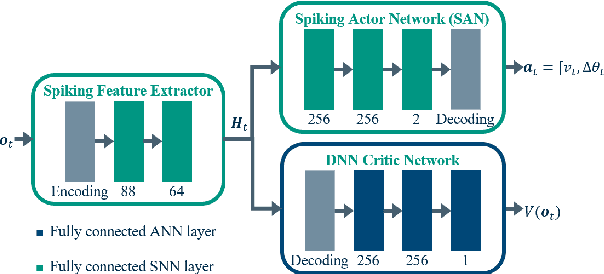
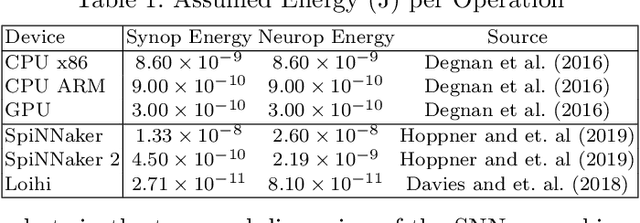
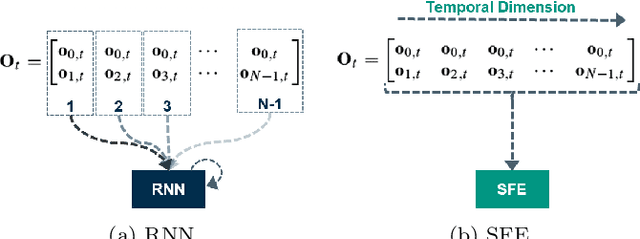
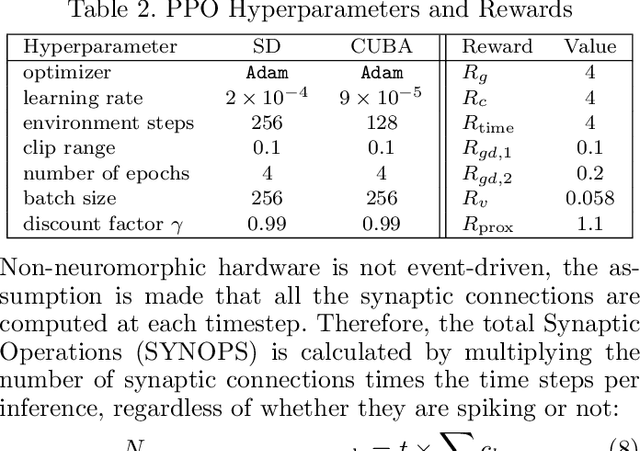
Integrating autonomous mobile robots into human environments requires human-like decision-making and energy-efficient, event-based computation. Despite progress, neuromorphic methods are rarely applied to Deep Reinforcement Learning (DRL) navigation approaches due to unstable training. We address this gap with a hybrid socially integrated DRL actor-critic approach that combines Spiking Neural Networks (SNNs) in the actor with Artificial Neural Networks (ANNs) in the critic and a neuromorphic feature extractor to capture temporal crowd dynamics and human-robot interactions. Our approach enhances social navigation performance and reduces estimated energy consumption by approximately 1.69 orders of magnitude.
Design Space Exploration on Efficient and Accurate Human Pose Estimation from Sparse IMU-Sensing
Jul 21, 2023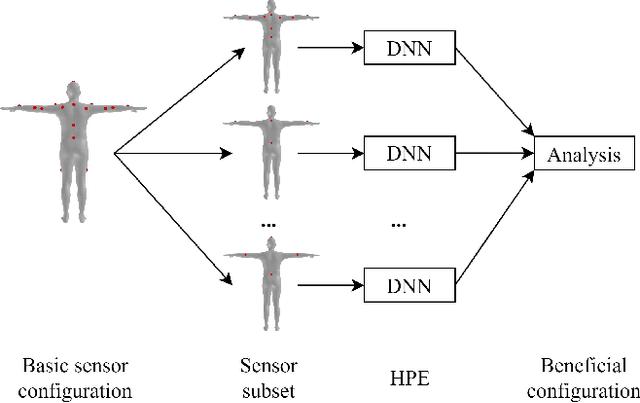
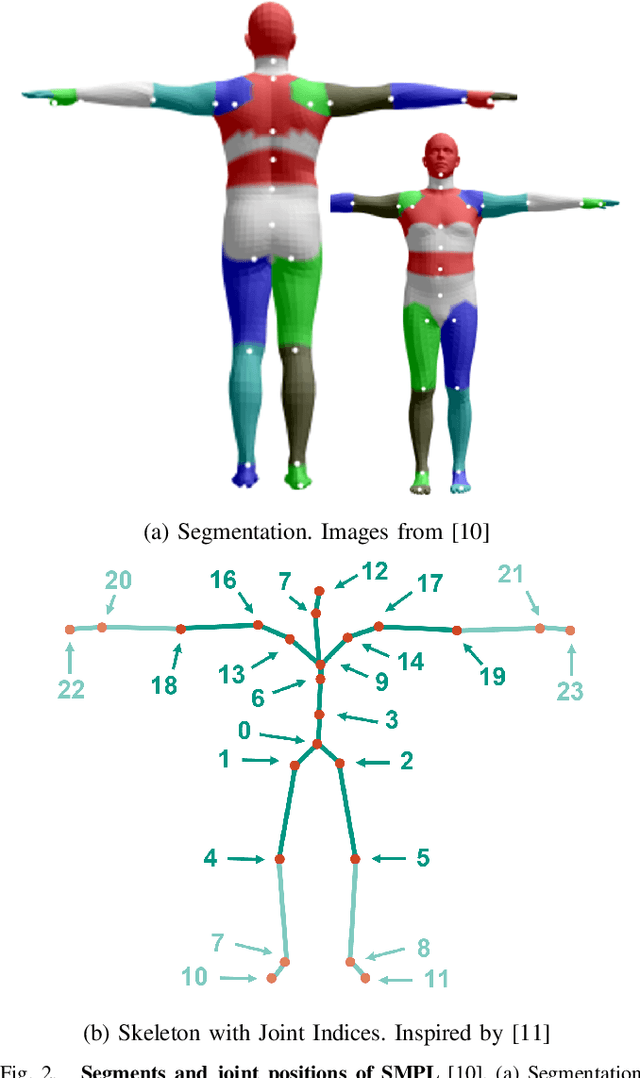
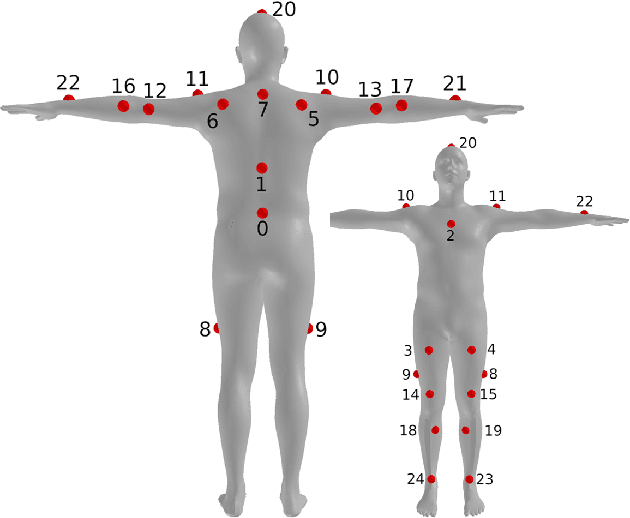
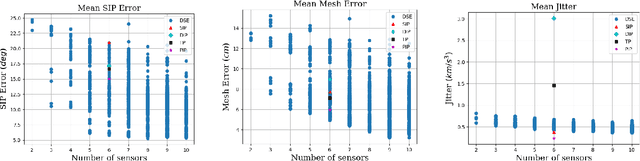
Human Pose Estimation (HPE) to assess human motion in sports, rehabilitation or work safety requires accurate sensing without compromising the sensitive underlying personal data. Therefore, local processing is necessary and the limited energy budget in such systems can be addressed by Inertial Measurement Units (IMU) instead of common camera sensing. The central trade-off between accuracy and efficient use of hardware resources is rarely discussed in research. We address this trade-off by a simulative Design Space Exploration (DSE) of a varying quantity and positioning of IMU-sensors. First, we generate IMU-data from a publicly available body model dataset for different sensor configurations and train a deep learning model with this data. Additionally, we propose a combined metric to assess the accuracy-resource trade-off. We used the DSE as a tool to evaluate sensor configurations and identify beneficial ones for a specific use case. Exemplary, for a system with equal importance of accuracy and resources, we identify an optimal sensor configuration of 4 sensors with a mesh error of 6.03 cm, increasing the accuracy by 32.7% and reducing the hardware effort by two sensors compared to state of the art. Our work can be used to design health applications with well-suited sensor positioning and attention to data privacy and resource-awareness.