 Add to Chrome
 Add to Firefox
 Add to Edge
QCalEval: Benchmarking Vision-Language Models for Quantum Calibration Plot Understanding
Apr 28, 2026
Quantum computing calibration depends on interpreting experimental data, and calibration plots provide the most universal human-readable representation for this task, yet no systematic evaluation exists of how well vision-language models (VLMs) interpret them. We introduce QCalEval, the first VLM benchmark for quantum calibration plots: 243 samples across 87 scenario types from 22 experiment families, spanning superconducting qubits and neutral atoms, evaluated on six question types in both zero-shot and in-context learning settings. The best general-purpose zero-shot model reaches a mean score of 72.3, and many open-weight models degrade under multi-image in-context learning, whereas frontier closed models improve substantially. A supervised fine-tuning ablation at the 9-billion-parameter scale shows that SFT improves zero-shot performance but cannot close the multimodal in-context learning gap. As a reference case study, we release NVIDIA Ising Calibration 1, an open-weight model based on Qwen3.5-35B-A3B that reaches 74.7 zero-shot average score.

Optimizing parametrized quantum circuits via noise-induced breaking of symmetries
Nov 23, 2020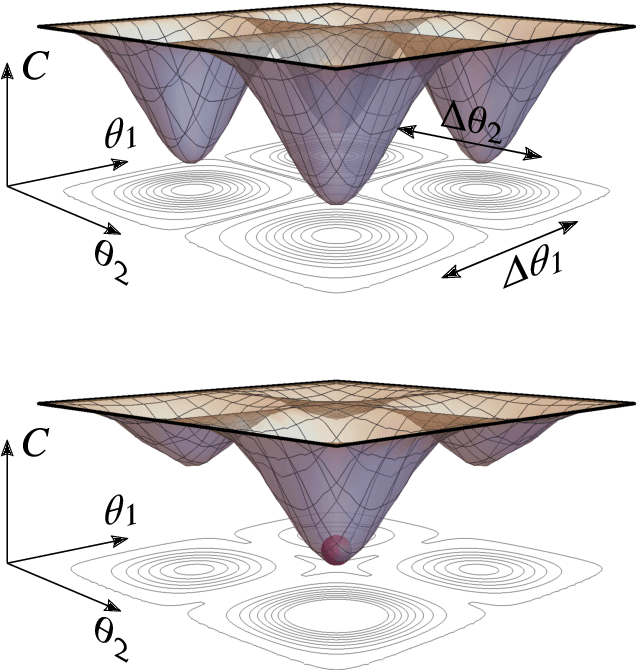
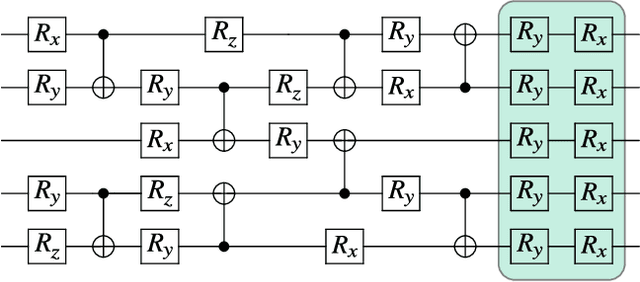
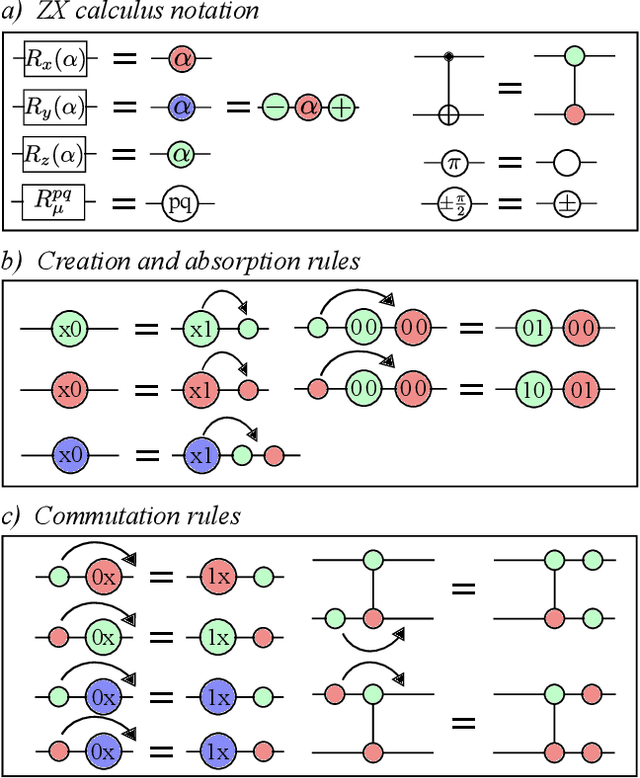
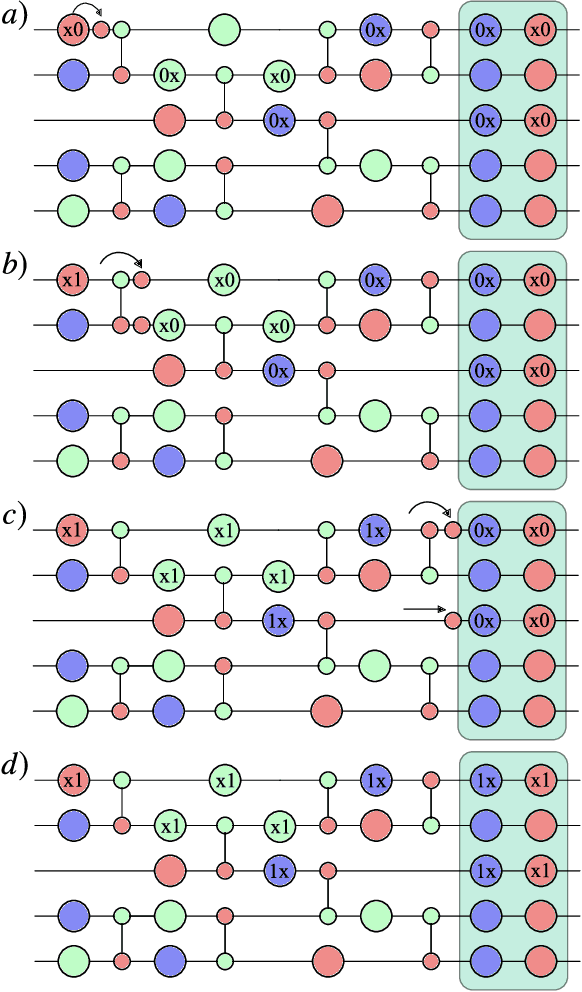
Very little is known about the cost landscape for parametrized Quantum Circuits (PQCs). Nevertheless, PQCs are employed in Quantum Neural Networks and Variational Quantum Algorithms, which may allow for near-term quantum advantage. Such applications require good optimizers to train PQCs. Recent works have focused on quantum-aware optimizers specifically tailored for PQCs. However, ignorance of the cost landscape could hinder progress towards such optimizers. In this work, we analytically prove two results for PQCs: (1) We find an exponentially large symmetry in PQCs, yielding an exponentially large degeneracy of the minima in the cost landscape. (2) We show that noise (specifically non-unital noise) can break these symmetries and lift the degeneracy of minima, making many of them local minima instead of global minima. Based on these results, we introduce an optimization method called Symmetry-based Minima Hopping (SYMH), which exploits the underlying symmetries in PQCs to hop between local minima in the cost landscape. The versatility of SYMH allows it to be combined with local optimizers (e.g., gradient descent) with minimal overhead. Our numerical simulations show that SYMH improves the overall optimizer performance.