 Add to Chrome
 Add to Firefox
 Add to Edge
QCalEval: Benchmarking Vision-Language Models for Quantum Calibration Plot Understanding
Apr 28, 2026
Quantum computing calibration depends on interpreting experimental data, and calibration plots provide the most universal human-readable representation for this task, yet no systematic evaluation exists of how well vision-language models (VLMs) interpret them. We introduce QCalEval, the first VLM benchmark for quantum calibration plots: 243 samples across 87 scenario types from 22 experiment families, spanning superconducting qubits and neutral atoms, evaluated on six question types in both zero-shot and in-context learning settings. The best general-purpose zero-shot model reaches a mean score of 72.3, and many open-weight models degrade under multi-image in-context learning, whereas frontier closed models improve substantially. A supervised fine-tuning ablation at the 9-billion-parameter scale shows that SFT improves zero-shot performance but cannot close the multimodal in-context learning gap. As a reference case study, we release NVIDIA Ising Calibration 1, an open-weight model based on Qwen3.5-35B-A3B that reaches 74.7 zero-shot average score.

BIRD-PCC: Bi-directional Range Image-based Deep LiDAR Point Cloud Compression
Mar 09, 2023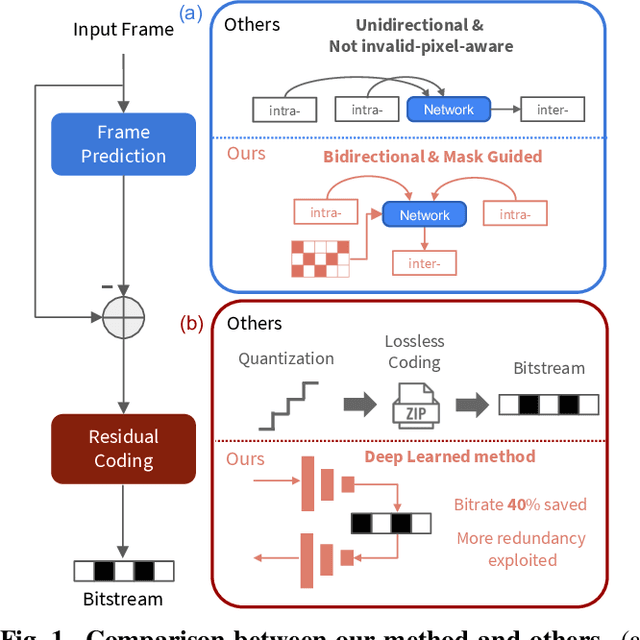
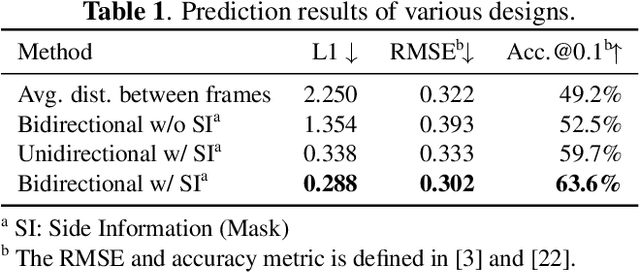
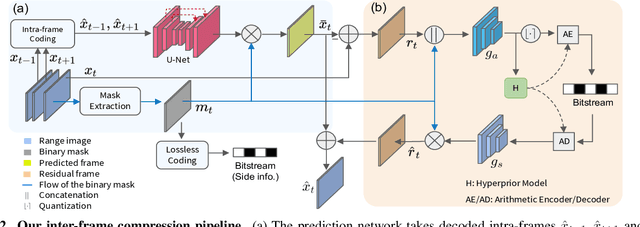
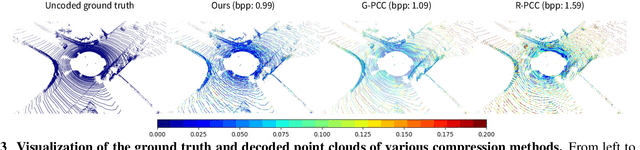
The large amount of data collected by LiDAR sensors brings the issue of LiDAR point cloud compression (PCC). Previous works on LiDAR PCC have used range image representations and followed the predictive coding paradigm to create a basic prototype of a coding framework. However, their prediction methods give an inaccurate result due to the negligence of invalid pixels in range images and the omission of future frames in the time step. Moreover, their handcrafted design of residual coding methods could not fully exploit spatial redundancy. To remedy this, we propose a coding framework BIRD-PCC. Our prediction module is aware of the coordinates of invalid pixels in range images and takes a bidirectional scheme. Also, we introduce a deep-learned residual coding module that can further exploit spatial redundancy within a residual frame. Experiments conducted on SemanticKITTI and KITTI-360 datasets show that BIRD-PCC outperforms other methods in most bitrate conditions and generalizes well to unseen environments.