 Add to Chrome
 Add to Firefox
 Add to Edge
Fine-tuning Small Language Models as Efficient Enterprise Search Relevance Labelers
Jan 06, 2026
In enterprise search, building high-quality datasets at scale remains a central challenge due to the difficulty of acquiring labeled data. To resolve this challenge, we propose an efficient approach to fine-tune small language models (SLMs) for accurate relevance labeling, enabling high-throughput, domain-specific labeling comparable or even better in quality to that of state-of-the-art large language models (LLMs). To overcome the lack of high-quality and accessible datasets in the enterprise domain, our method leverages on synthetic data generation. Specifically, we employ an LLM to synthesize realistic enterprise queries from a seed document, apply BM25 to retrieve hard negatives, and use a teacher LLM to assign relevance scores. The resulting dataset is then distilled into an SLM, producing a compact relevance labeler. We evaluate our approach on a high-quality benchmark consisting of 923 enterprise query-document pairs annotated by trained human annotators, and show that the distilled SLM achieves agreement with human judgments on par with or better than the teacher LLM. Furthermore, our fine-tuned labeler substantially improves throughput, achieving 17 times increase while also being 19 times more cost-effective. This approach enables scalable and cost-effective relevance labeling for enterprise-scale retrieval applications, supporting rapid offline evaluation and iteration in real-world settings.

SLATE: A Sequence Labeling Approach for Task Extraction from Free-form Inked Content
Nov 17, 2022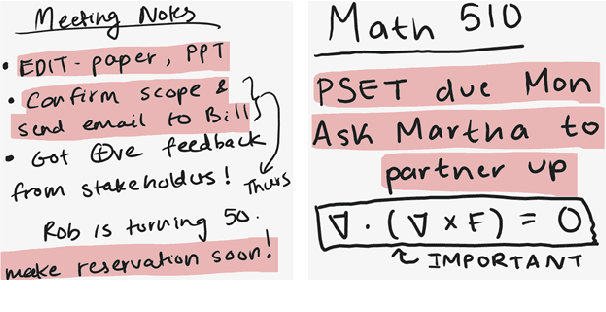
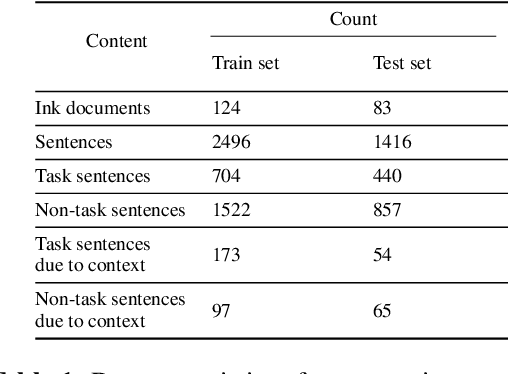
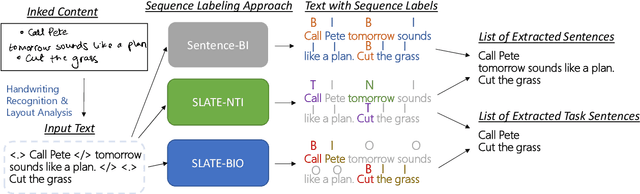
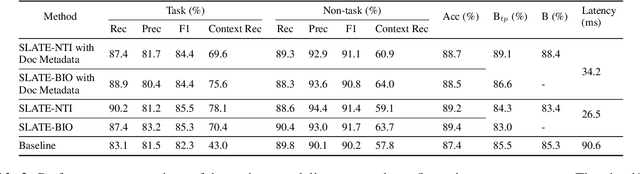
We present SLATE, a sequence labeling approach for extracting tasks from free-form content such as digitally handwritten (or "inked") notes on a virtual whiteboard. Our approach allows us to create a single, low-latency model to simultaneously perform sentence segmentation and classification of these sentences into task/non-task sentences. SLATE greatly outperforms a baseline two-model (sentence segmentation followed by classification model) approach, achieving a task F1 score of 84.4%, a sentence segmentation (boundary similarity) score of 88.4% and three times lower latency compared to the baseline. Furthermore, we provide insights into tackling challenges of performing NLP on the inking domain. We release both our code and dataset for this novel task.