 Add to Chrome
 Add to Firefox
 Add to Edge
Debate is efficient with your time
Feb 09, 2026
AI safety via debate uses two competing models to help a human judge verify complex computational tasks. Previous work has established what problems debate can solve in principle, but has not analysed the practical cost of human oversight: how many queries must the judge make to the debate transcript? We introduce Debate Query Complexity}(DQC), the minimum number of bits a verifier must inspect to correctly decide a debate. Surprisingly, we find that PSPACE/poly (the class of problems which debate can efficiently decide) is precisely the class of functions decidable with O(log n) queries. This characterisation shows that debate is remarkably query-efficient: even for highly complex problems, logarithmic oversight suffices. We also establish that functions depending on all their input bits require Omega(log n) queries, and that any function computable by a circuit of size s satisfies DQC(f) <= log(s) + 3. Interestingly, this last result implies that proving DQC lower bounds of log(n) + 6 for languages in P would yield new circuit lower bounds, connecting debate query complexity to central questions in circuit complexity.

Coresets for Decision Trees of Signals
Oct 07, 2021


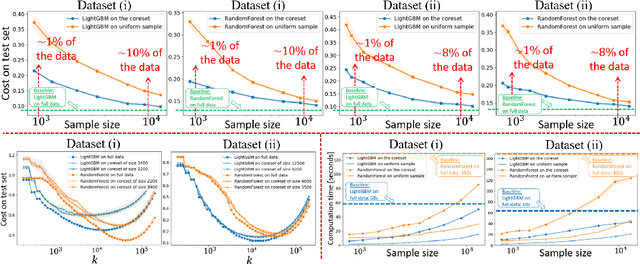
A $k$-decision tree $t$ (or $k$-tree) is a recursive partition of a matrix (2D-signal) into $k\geq 1$ block matrices (axis-parallel rectangles, leaves) where each rectangle is assigned a real label. Its regression or classification loss to a given matrix $D$ of $N$ entries (labels) is the sum of squared differences over every label in $D$ and its assigned label by $t$. Given an error parameter $\varepsilon\in(0,1)$, a $(k,\varepsilon)$-coreset $C$ of $D$ is a small summarization that provably approximates this loss to \emph{every} such tree, up to a multiplicative factor of $1\pm\varepsilon$. In particular, the optimal $k$-tree of $C$ is a $(1+\varepsilon)$-approximation to the optimal $k$-tree of $D$. We provide the first algorithm that outputs such a $(k,\varepsilon)$-coreset for \emph{every} such matrix $D$. The size $|C|$ of the coreset is polynomial in $k\log(N)/\varepsilon$, and its construction takes $O(Nk)$ time. This is by forging a link between decision trees from machine learning -- to partition trees in computational geometry. Experimental results on \texttt{sklearn} and \texttt{lightGBM} show that applying our coresets on real-world data-sets boosts the computation time of random forests and their parameter tuning by up to x$10$, while keeping similar accuracy. Full open source code is provided.