 Add to Chrome
 Add to Firefox
 Add to Edge
Knowledge Integration Decay in Search-Augmented Reasoning of Large Language Models
Feb 10, 2026
Modern Large Language Models (LLMs) have demonstrated remarkable capabilities in complex tasks by employing search-augmented reasoning to incorporate external knowledge into long chains of thought. However, we identify a critical yet underexplored bottleneck in this paradigm, termed Knowledge Integration Decay (KID). Specifically, we observe that as the length of reasoning generated before search grows, models increasingly fail to integrate retrieved evidence into subsequent reasoning steps, limiting performance even when relevant information is available. To address this, we propose Self-Anchored Knowledge Encoding (SAKE), a training-free inference-time strategy designed to stabilize knowledge utilization. By anchoring retrieved knowledge at both the beginning and end of the reasoning process, SAKE prevents it from being overshadowed by prior context, thereby preserving its semantic integrity. Extensive experiments on multi-hop QA and complex reasoning benchmarks demonstrate that SAKE significantly mitigates KID and improves performance, offering a lightweight yet effective solution for knowledge integration in agentic LLMs.

Correcting Negative Bias in Large Language Models through Negative Attention Score Alignment
Jul 31, 2024


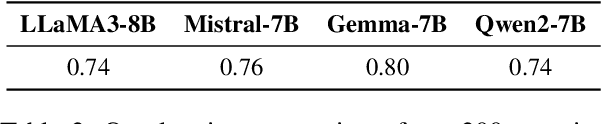
A binary decision task, like yes-no questions or answer verification, reflects a significant real-world scenario such as where users look for confirmation about the correctness of their decisions on specific issues. In this work, we observe that language models exhibit a negative bias in the binary decisions of complex reasoning tasks. Based on our observations and the rationale about attention-based model dynamics, we propose a negative attention score (NAS) to systematically and quantitatively formulate negative bias. Based on NAS, we identify attention heads that attend to negative tokens provided in the instructions as answer candidate of binary decisions, regardless of the question in the prompt, and validate their association with the negative bias. Additionally, we propose the negative attention score alignment (NASA) method, which is a parameter-efficient fine-tuning technique to address the extracted negatively biased attention heads. Experimental results from various domains of reasoning tasks and large model search space demonstrate that NASA significantly reduces the gap between precision and recall caused by negative bias while preserving their generalization abilities. Our codes are available at \url{https://github.com/ysw1021/NASA}.