 Add to Chrome
 Add to Firefox
 Add to Edge
Beyond Visual CoT: Internalized Visual Thinking for Proactive Video Reasoning
Aug 16, 2026
Multimodal large language models increasingly use visual chain-of-thought (Visual CoT) to reason about spatial, temporal, and embodied environments. By generating intermediate reasoning images, Visual CoT provides an intuitive mechanism for visual foresight but introduces substantial inference overhead, which is particularly problematic for proactive video reasoning. We ask whether models can learn to think visually during training while reasoning directly at inference. We introduce Internalized Visual Thinking (IVT), a post-training framework that jointly optimizes textual prediction and next-embedding prediction over unlabeled videos. Given a partially observed video, IVT predicts latent representations of future frames together with the target textual answer, encouraging the model to capture motion, object transitions, interactions, and latent intent. At inference, IVT generates the answer directly without synthesizing or re-encoding future frames. We conduct controlled studies across target representations, decoder designs, prediction horizons, data mixtures, training curricula, and predictive objectives. IVT improves over direct-answer fine-tuning on all six evaluation settings while retaining the same inference pathway. Compared with explicit Visual CoT, IVT achieves comparable or better performance and reduces average end-to-end latency by more than 5x. Together, our findings suggest that explicit pixel-space generation at inference time, as used in visual chain-of-thought, may not be necessary for effective proactive video reasoning. Predictive world modeling can be internalized during training to produce multimodal reasoners that are both more accurate and substantially more efficient.

High Fidelity 3D Reconstructions with Limited Physical Views
Oct 22, 2021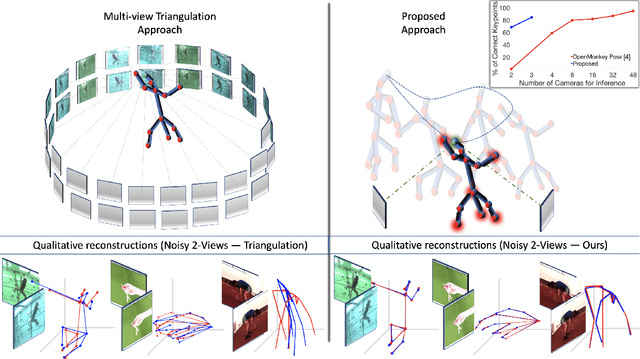

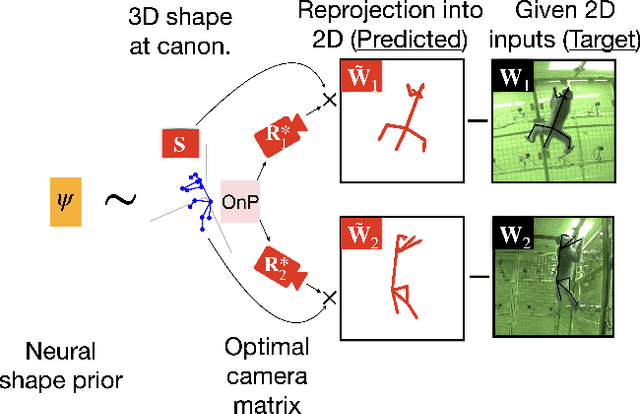

Multi-view triangulation is the gold standard for 3D reconstruction from 2D correspondences given known calibration and sufficient views. However in practice, expensive multi-view setups -- involving tens sometimes hundreds of cameras -- are required in order to obtain the high fidelity 3D reconstructions necessary for many modern applications. In this paper we present a novel approach that leverages recent advances in 2D-3D lifting using neural shape priors while also enforcing multi-view equivariance. We show how our method can achieve comparable fidelity to expensive calibrated multi-view rigs using a limited (2-3) number of uncalibrated camera views.
Deep Active Object Recognition by Joint Label and Action Prediction
Dec 17, 2015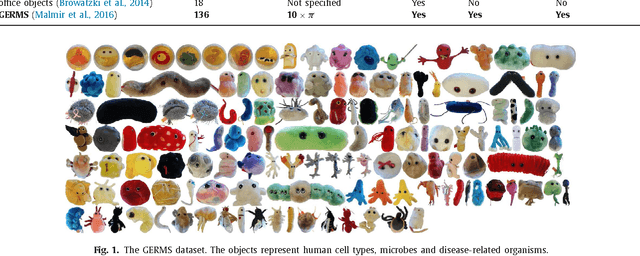
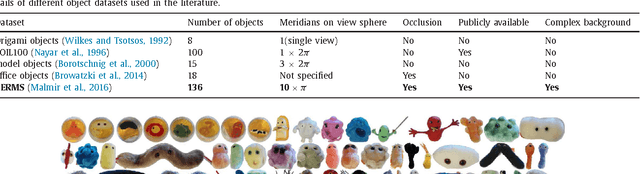
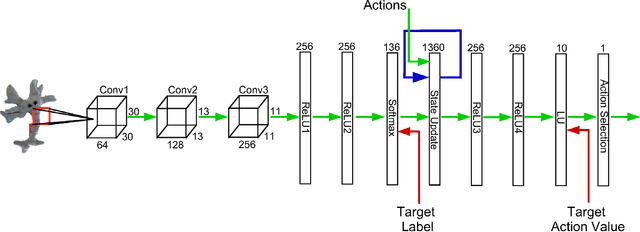
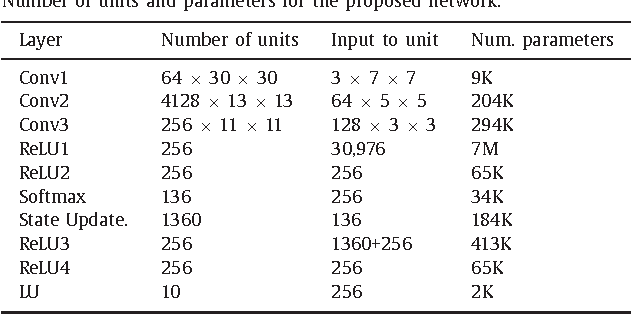
An active object recognition system has the advantage of being able to act in the environment to capture images that are more suited for training and that lead to better performance at test time. In this paper, we propose a deep convolutional neural network for active object recognition that simultaneously predicts the object label, and selects the next action to perform on the object with the aim of improving recognition performance. We treat active object recognition as a reinforcement learning problem and derive the cost function to train the network for joint prediction of the object label and the action. A generative model of object similarities based on the Dirichlet distribution is proposed and embedded in the network for encoding the state of the system. The training is carried out by simultaneously minimizing the label and action prediction errors using gradient descent. We empirically show that the proposed network is able to predict both the object label and the actions on GERMS, a dataset for active object recognition. We compare the test label prediction accuracy of the proposed model with Dirichlet and Naive Bayes state encoding. The results of experiments suggest that the proposed model equipped with Dirichlet state encoding is superior in performance, and selects images that lead to better training and higher accuracy of label prediction at test time.