 Add to Chrome
 Add to Firefox
 Add to Edge
Fine-Tuning Generative Models for Extreme Events via CVaR-Penalized Wasserstein Gradient Flows
Aug 12, 2026
We propose CVaR-penalized Generative Particle Algorithm (CVaR-GPA), a robust, tail-agnostic algorithm for fine-tuning generative models to learn heavy-tailed distributions and capture extreme events, requiring no prior knowledge or estimation of the target's tail characteristics. The method is the Wasserstein gradient flow of the Lipschitz-regularized Kullback-Leibler (KL) divergence penalized by a Conditional Value-at-Risk (CVaR) discrepancy term: the Lipschitz-regularized KL divergence enables robust learning under minimal assumptions on the target distribution, while the CVaR penalty restores the velocity that otherwise vanishes prematurely in the under-sampled tails. The penalized flow admits a bounded but non-Lipschitz velocity field. This departs from the Lipschitz transport maps of standard generators, which preserve the tail behavior of a light-tailed source, and enables transport toward heavier-tailed targets. To define this flow on empirical measures, we derive the first-variation subgradients of CVaR from its Rockafellar-Uryasev representation, valid precisely where the classical density-based formula fails. The particle algorithm CVaR-GPA fine-tunes the output samples of any pre-trained model, without access to its architecture, and runs on an adaptive time horizon set by a kinetic-energy stopping criterion rather than a preset depth. On synthetic isotropic and anisotropic Student-$t$ target distributions, Neal's funnel distribution, and the real-world high-dimensional Fama-French 25 portfolio dataset, CVaR-GPA dramatically improves global and tail accuracy on heavy-tailed targets over the pre-trained baseline.

Sharp Stability Threshold and Certification for Designing Stable Residual Architectures
Jul 16, 2026We propose \emph{the sublinear-growth principle} for deep residual architectures -- a sharp stability threshold on the input-magnitude exponent of every residual block's velocity field: $$\|v(x, t)\| \leq c\,\|x\|^q + b, \qquad q \in [0, 1].$$ The threshold $q = 1$ is established via two independent arguments. Classical ODE theory gives a global forward flow on $[0, T]$ at $q \le 1$ and exhibits divergent velocity fields at any $q > 1$. The optimal-control analysis, via the Hamilton-Jacobi-Bellman equation, sharpens this to a selection statement: the training optimum is bang-bang on the boundary of the admissible class, so the optimum at $q > 1$ blows up while the optimum at $q \le 1$ is safe by construction. The exponent criterion $q \le 1$ is thereby a necessary and sufficient condition for stable training. It clarifies architectural placements that ensure the stability of training and inference, explaining, for instance, the stabilizing role of layer normalization. The sublinear-growth velocity fields form \emph{the right function space} on which forward dynamics, adjoint sensitivity, and architectural composition are all well-controlled. An arithmetic of input-magnitude exponents under the five operations that build residual blocks enables efficient certification of $q_k \le 1$ at the level of architectural primitives, in place of ad hoc trial and error in the search for stable neural architectural designs. A parameter-free modification reduces the supercritical Mamba block from $q = 5$ to $q = 1$ without layer normalization, demonstrating this point. Experiments on Mamba and PatchTST confirm that the $q \le 1$ variants train stably: the criterion is the input-magnitude exponent, not the presence of a normalization layer.
ISOMORPH: A Supply Chain Digital Twin for Simulation, Dataset Generation, and Forecasting Benchmarks
May 12, 2026Open time-series forecasting (TSF) benchmarks cover retail, energy, weather, and traffic, but supply-chain logistics remains underserved. We introduce ISOMORPH, the first public digital twin of a multi-echelon logistics network with fully interpretable, user-configurable parameters and modular topology, demand process, and control rules. The simulator advances a directed routing graph in discrete time: demand arrives at the destination, is served from stock or recorded as backlog, and triggers replenishment through the network. The state vector tracks per-node on-hand inventory with outstanding orders, in-transit shipments, and a smoothed demand estimate, so the dynamics close as a Markov chain on a tractable state space whose transition kernel acts linearly on the empirical distribution of the state. The released data reproduces the bullwhip effect at empirically consistent magnitudes, and three conservation laws encoded in the Markov chain serve as verification tools when users extend the simulator. We release datasets at two catalogue scales ($C=50$ and $C=200$) with six scenario sweeps producing 30 additional rollouts and 20 Latin-hypercube perturbations, exhibiting dynamics absent from fixed TSF benchmarks: variance amplification, cascading bottlenecks, regime shifts, and cross-channel coupling through shared macro shocks. Zero-shot evaluation of four foundation models (Chronos, Moirai, TimesFM, Lag-Llama) shows MASE values exceeding public GIFT-Eval references at low-to-moderate horizons, supporting incorporation into existing benchmarks. The same pairing produces forecast confidence bands via Latin-hypercube perturbation of demand-side knobs, forward UQ from parameter uncertainty unavailable on standard TSF datasets, demonstrating that foundation models can serve as fast surrogates for the digital twin's forward UQ. Code (MIT): https://github.com/tuhinsahai/ISOMORPH.
Combining Wasserstein-1 and Wasserstein-2 proximals: robust manifold learning via well-posed generative flows
Jul 16, 2024We formulate well-posed continuous-time generative flows for learning distributions that are supported on low-dimensional manifolds through Wasserstein proximal regularizations of $f$-divergences. Wasserstein-1 proximal operators regularize $f$-divergences so that singular distributions can be compared. Meanwhile, Wasserstein-2 proximal operators regularize the paths of the generative flows by adding an optimal transport cost, i.e., a kinetic energy penalization. Via mean-field game theory, we show that the combination of the two proximals is critical for formulating well-posed generative flows. Generative flows can be analyzed through optimality conditions of a mean-field game (MFG), a system of a backward Hamilton-Jacobi (HJ) and a forward continuity partial differential equations (PDEs) whose solution characterizes the optimal generative flow. For learning distributions that are supported on low-dimensional manifolds, the MFG theory shows that the Wasserstein-1 proximal, which addresses the HJ terminal condition, and the Wasserstein-2 proximal, which addresses the HJ dynamics, are both necessary for the corresponding backward-forward PDE system to be well-defined and have a unique solution with provably linear flow trajectories. This implies that the corresponding generative flow is also unique and can therefore be learned in a robust manner even for learning high-dimensional distributions supported on low-dimensional manifolds. The generative flows are learned through adversarial training of continuous-time flows, which bypasses the need for reverse simulation. We demonstrate the efficacy of our approach for generating high-dimensional images without the need to resort to autoencoders or specialized architectures.
Learning heavy-tailed distributions with Wasserstein-proximal-regularized $α$-divergences
May 22, 2024In this paper, we propose Wasserstein proximals of $\alpha$-divergences as suitable objective functionals for learning heavy-tailed distributions in a stable manner. First, we provide sufficient, and in some cases necessary, relations among data dimension, $\alpha$, and the decay rate of data distributions for the Wasserstein-proximal-regularized divergence to be finite. Finite-sample convergence rates for the estimation in the case of the Wasserstein-1 proximal divergences are then provided under certain tail conditions. Numerical experiments demonstrate stable learning of heavy-tailed distributions -- even those without first or second moment -- without any explicit knowledge of the tail behavior, using suitable generative models such as GANs and flow-based models related to our proposed Wasserstein-proximal-regularized $\alpha$-divergences. Heuristically, $\alpha$-divergences handle the heavy tails and Wasserstein proximals allow non-absolute continuity between distributions and control the velocities of flow-based algorithms as they learn the target distribution deep into the tails.
Lipschitz regularized gradient flows and latent generative particles
Nov 07, 2022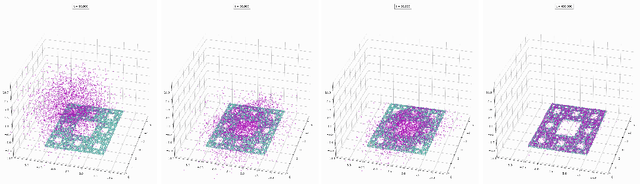
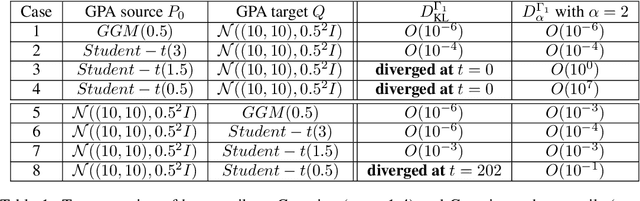
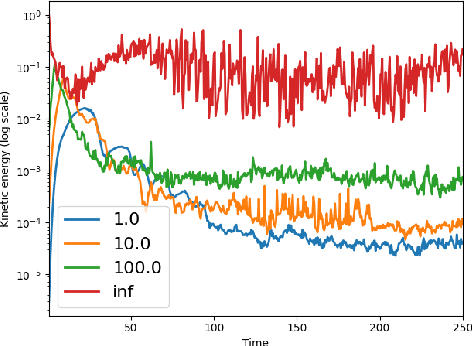

Lipschitz regularized f-divergences are constructed by imposing a bound on the Lipschitz constant of the discriminator in the variational representation. They interpolate between the Wasserstein metric and f-divergences and provide a flexible family of loss functions for non-absolutely continuous (e.g. empirical) distributions, possibly with heavy tails. We construct Lipschitz regularized gradient flows on the space of probability measures based on these divergences. Examples of such gradient flows are Lipschitz regularized Fokker-Planck and porous medium partial differential equations (PDEs) for the Kullback-Leibler and alpha-divergences, respectively. The regularization corresponds to imposing a Courant-Friedrichs-Lewy numerical stability condition on the PDEs. For empirical measures, the Lipschitz regularization on gradient flows induces a numerically stable transporter/discriminator particle algorithm, where the generative particles are transported along the gradient of the discriminator. The gradient structure leads to a regularized Fisher information (particle kinetic energy) used to track the convergence of the algorithm. The Lipschitz regularized discriminator can be implemented via neural network spectral normalization and the particle algorithm generates approximate samples from possibly high-dimensional distributions known only from data. Notably, our particle algorithm can generate synthetic data even in small sample size regimes. A new data processing inequality for the regularized divergence allows us to combine our particle algorithm with representation learning, e.g. autoencoder architectures. The resulting algorithm yields markedly improved generative properties in terms of efficiency and quality of the synthetic samples. From a statistical mechanics perspective the encoding can be interpreted dynamically as learning a better mobility for the generative particles.