 Add to Chrome
 Add to Firefox
 Add to Edge
ISOMORPH: A Supply Chain Digital Twin for Simulation, Dataset Generation, and Forecasting Benchmarks
May 12, 2026
Open time-series forecasting (TSF) benchmarks cover retail, energy, weather, and traffic, but supply-chain logistics remains underserved. We introduce ISOMORPH, the first public digital twin of a multi-echelon logistics network with fully interpretable, user-configurable parameters and modular topology, demand process, and control rules. The simulator advances a directed routing graph in discrete time: demand arrives at the destination, is served from stock or recorded as backlog, and triggers replenishment through the network. The state vector tracks per-node on-hand inventory with outstanding orders, in-transit shipments, and a smoothed demand estimate, so the dynamics close as a Markov chain on a tractable state space whose transition kernel acts linearly on the empirical distribution of the state. The released data reproduces the bullwhip effect at empirically consistent magnitudes, and three conservation laws encoded in the Markov chain serve as verification tools when users extend the simulator. We release datasets at two catalogue scales ($C=50$ and $C=200$) with six scenario sweeps producing 30 additional rollouts and 20 Latin-hypercube perturbations, exhibiting dynamics absent from fixed TSF benchmarks: variance amplification, cascading bottlenecks, regime shifts, and cross-channel coupling through shared macro shocks. Zero-shot evaluation of four foundation models (Chronos, Moirai, TimesFM, Lag-Llama) shows MASE values exceeding public GIFT-Eval references at low-to-moderate horizons, supporting incorporation into existing benchmarks. The same pairing produces forecast confidence bands via Latin-hypercube perturbation of demand-side knobs, forward UQ from parameter uncertainty unavailable on standard TSF datasets, demonstrating that foundation models can serve as fast surrogates for the digital twin's forward UQ. Code (MIT): https://github.com/tuhinsahai/ISOMORPH.

Dictionary learning for Kernel EDMD
Apr 28, 2026Studying nonlinear dynamical systems through their state space behavior can be challenging, and one possible alternative is to analyze them via their associated Koopman operator. This turns the nonlinear problem into a linear, infinite-dimensional one. To approximate the operator in finite dimensions, extended dynamic mode decomposition (EDMD) is a commonly used algorithm. It requires a finite list of functionals and a set of snapshots from the system to compute an approximation of the operator and its corresponding spectrum. Instead of choosing the list of functionals directly, it can be implicitly defined via kernels, a method known as kernel extended dynamic mode decomposition (kEDMD). However, one still needs to define the kernel and choose its parameter values. In this paper, we aim to streamline this process by extending dictionary learning for EDMD to kernel learning in kEDMD. By simplifying kEDMD we show how to perform gradient-based optimization over the learnable kernel parameters, and demonstrate that this method leads to useful kernels for the original kEDMD. The focus of our work is a method that takes a weighted list of kernels with randomly initialized values as input and outputs a list of kernels and parameter values suitable for approximating the Koopman operator of the underlying system. We demonstrate that unimportant kernels can be removed from the list by analyzing the weights in the weighted sum. We evaluate the method across several experiments, including the Duffing oscillator and the Kuramoto-Sivashinsky PDE, showcasing the method's different strengths.
Adaptive Kernel Selection for Kernelized Diffusion Maps
Apr 20, 2026Selecting an appropriate kernel is a central challenge in kernel-based spectral methods. In \emph{Kernelized Diffusion Maps} (KDM), the kernel determines the accuracy of the RKHS estimator of a diffusion-type operator and hence the quality and stability of the recovered eigenfunctions. We introduce two complementary approaches to adaptive kernel selection for KDM. First, we develop a variational outer loop that learns continuous kernel parameters, including bandwidths and mixture weights, by differentiating through the Cholesky-reduced KDM eigenproblem with an objective combining eigenvalue maximization, subspace orthonormality, and RKHS regularization. Second, we propose an unsupervised cross-validation pipeline that selects kernel families and bandwidths using an eigenvalue-sum criterion together with random Fourier features for scalability. Both methods share a common theoretical foundation: we prove Lipschitz dependence of KDM operators on kernel weights, continuity of spectral projectors under a gap condition, a residual-control theorem certifying proximity to the target eigenspace, and exponential consistency of the cross-validation selector over a finite kernel dictionary.
Kernel Methods for Stochastic Dynamical Systems with Application to Koopman Eigenfunctions: Feynman-Kac Representations and RKHS Approximation
Mar 01, 2026We extend the unified kernel framework for transport equations and Koopman eigenfunctions, developed in previous work by the authors for deterministic systems, to stochastic differential equations (SDEs). In the deterministic setting, three analytically grounded constructions-Lions-type variational principles, Green's function convolution, and resolvent operators along characteristic flows--were shown to yield identical reproducing kernels. For stochastic systems, the Koopman generator includes a second-order diffusion term, transforming the first-order hyperbolic transport equation into a second-order elliptic-parabolic PDE. This fundamental change necessitates replacing the method of characteristics with probabilistic representations based on the Feynman--Kac formula. Our main contributions include: (i) extension of all three kernel constructions to stochastic systems via Feynman--Kac path-integral representations; (ii) proof of kernel equivalence under uniform ellipticity assumptions; (iii) a collocation-based computational framework incorporating second-order differential operators; (iv) error bounds separating RKHS approximation error from Monte Carlo sampling error; (v) analysis of how diffusion affects numerical conditioning; and (vi) connections to generator EDMD, diffusion maps, and kernel analog forecasting. Numerical experiments on Ornstein--Uhlenbeck processes, nonlinear SDEs with varying diffusion strength, and multi-dimensional systems validate the theoretical developments and demonstrate that moderate diffusion can improve numerical stability through elliptic regularization.
KROM: Kernelized Reduced Order Modeling
Feb 27, 2026We propose KROM, a kernel-based reduced-order framework for fast solution of nonlinear partial differential equations. KROM formulates PDE solution as a minimum-norm (Gaussian-process) recovery problem in an RKHS, and accelerates the resulting kernel solves by sparsifying the precision matrix via sparse Cholesky factorization. A central ingredient is an empirical kernel constructed from a snapshot library of PDE solutions (generated under varying forcings, initial data, boundary data, or parameters). This snapshot-driven kernel adapts to problem-specific structure -- boundary behavior, oscillations, nonsmooth features, linear constraints, conservation and dissipation laws -- thereby reducing the dependence on hand-tuned stationary kernels. The resulting method yields an implicit reduced model: after sparsification, only a localized subset of effective degrees of freedom is used online. We report numerical results for semilinear elliptic equations, discontinuous-coefficient Darcy flow, viscous Burgers, Allen--Cahn, and two-dimensional Navier--Stokes, showing that empirical kernels can match or outperform Matérn baselines, especially in nonsmooth regimes. We also provide error bounds that separate discretization effects, snapshot-space approximation error, and sparse-Cholesky approximation error.
Fluids You Can Trust: Property-Preserving Operator Learning for Incompressible Flows
Feb 17, 2026We present a novel property-preserving kernel-based operator learning method for incompressible flows governed by the incompressible Navier-Stokes equations. Traditional numerical solvers incur significant computational costs to respect incompressibility. Operator learning offers efficient surrogate models, but current neural operators fail to exactly enforce physical properties such as incompressibility, periodicity, and turbulence. Our method maps input functions to expansion coefficients of output functions in a property-preserving kernel basis, ensuring that predicted velocity fields analytically and simultaneously preserve the aforementioned physical properties. We evaluate the method on challenging 2D and 3D, laminar and turbulent, incompressible flow problems. Our method achieves up to six orders of magnitude lower relative $\ell_2$ errors upon generalization and trains up to five orders of magnitude faster compared to neural operators. Moreover, while our method enforces incompressibility analytically, neural operators exhibit very large deviations. Our results show that our method provides an accurate and efficient surrogate for incompressible flows.
Solving Functional PDEs with Gaussian Processes and Applications to Functional Renormalization Group Equations
Dec 24, 2025We present an operator learning framework for solving non-perturbative functional renormalization group equations, which are integro-differential equations defined on functionals. Our proposed approach uses Gaussian process operator learning to construct a flexible functional representation formulated directly on function space, making it independent of a particular equation or discretization. Our method is flexible, and can apply to a broad range of functional differential equations while still allowing for the incorporation of physical priors in either the prior mean or the kernel design. We demonstrate the performance of our method on several relevant equations, such as the Wetterich and Wilson--Polchinski equations, showing that it achieves equal or better performance than existing approximations such as the local-potential approximation, while being significantly more flexible. In particular, our method can handle non-constant fields, making it promising for the study of more complex field configurations, such as instantons.
Data-Efficient Kernel Methods for Learning Differential Equations and Their Solution Operators: Algorithms and Error Analysis
Mar 02, 2025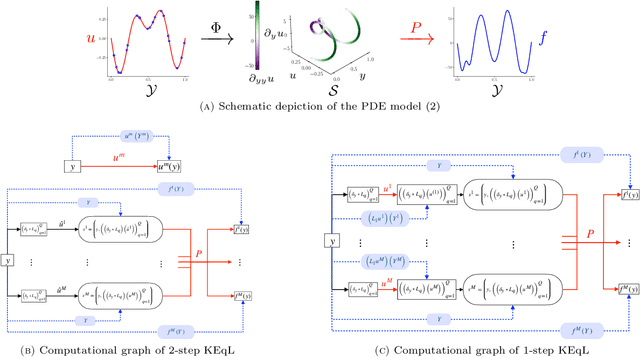
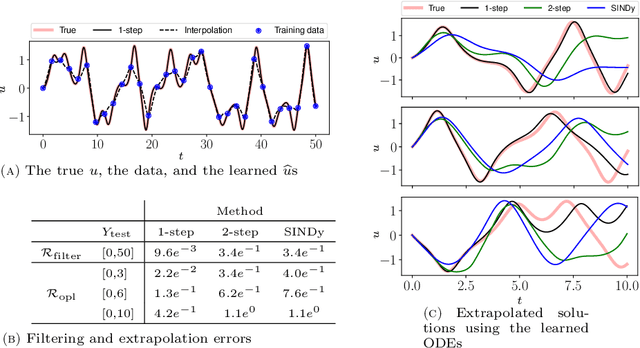
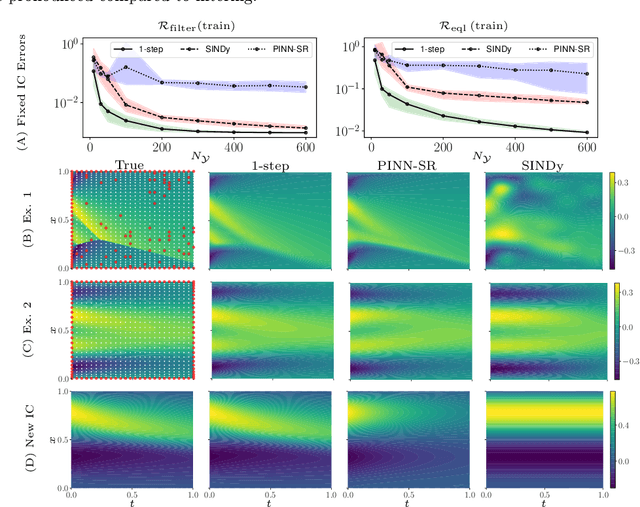
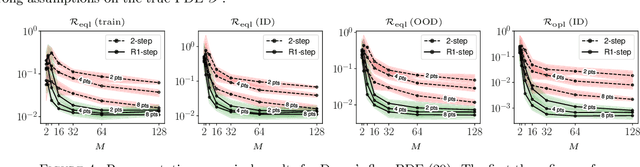
We introduce a novel kernel-based framework for learning differential equations and their solution maps that is efficient in data requirements, in terms of solution examples and amount of measurements from each example, and computational cost, in terms of training procedures. Our approach is mathematically interpretable and backed by rigorous theoretical guarantees in the form of quantitative worst-case error bounds for the learned equation. Numerical benchmarks demonstrate significant improvements in computational complexity and robustness while achieving one to two orders of magnitude improvements in terms of accuracy compared to state-of-the-art algorithms.
Solving Roughly Forced Nonlinear PDEs via Misspecified Kernel Methods and Neural Networks
Jan 29, 2025We consider the use of Gaussian Processes (GPs) or Neural Networks (NNs) to numerically approximate the solutions to nonlinear partial differential equations (PDEs) with rough forcing or source terms, which commonly arise as pathwise solutions to stochastic PDEs. Kernel methods have recently been generalized to solve nonlinear PDEs by approximating their solutions as the maximum a posteriori estimator of GPs that are conditioned to satisfy the PDE at a finite set of collocation points. The convergence and error guarantees of these methods, however, rely on the PDE being defined in a classical sense and its solution possessing sufficient regularity to belong to the associated reproducing kernel Hilbert space. We propose a generalization of these methods to handle roughly forced nonlinear PDEs while preserving convergence guarantees with an oversmoothing GP kernel that is misspecified relative to the true solution's regularity. This is achieved by conditioning a regular GP to satisfy the PDE with a modified source term in a weak sense (when integrated against a finite number of test functions). This is equivalent to replacing the empirical $L^2$-loss on the PDE constraint by an empirical negative-Sobolev norm. We further show that this loss function can be used to extend physics-informed neural networks (PINNs) to stochastic equations, thereby resulting in a new NN-based variant termed Negative Sobolev Norm-PINN (NeS-PINN).
Kernel Methods for the Approximation of the Eigenfunctions of the Koopman Operator
Dec 21, 2024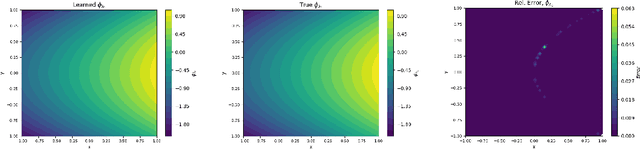
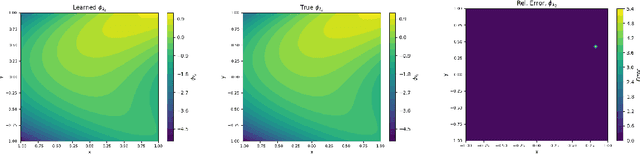
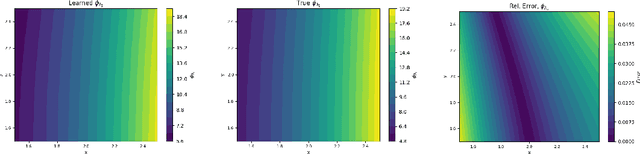
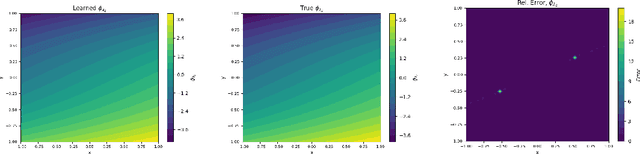
The Koopman operator provides a linear framework to study nonlinear dynamical systems. Its spectra offer valuable insights into system dynamics, but the operator can exhibit both discrete and continuous spectra, complicating direct computations. In this paper, we introduce a kernel-based method to construct the principal eigenfunctions of the Koopman operator without explicitly computing the operator itself. These principal eigenfunctions are associated with the equilibrium dynamics, and their eigenvalues match those of the linearization of the nonlinear system at the equilibrium point. We exploit the structure of the principal eigenfunctions by decomposing them into linear and nonlinear components. The linear part corresponds to the left eigenvector of the system's linearization at the equilibrium, while the nonlinear part is obtained by solving a partial differential equation (PDE) using kernel methods. Our approach avoids common issues such as spectral pollution and spurious eigenvalues, which can arise in previous methods. We demonstrate the effectiveness of our algorithm through numerical examples.