 Add to Chrome
 Add to Firefox
 Add to Edge
EgoVerse: An Egocentric Human Dataset for Robot Learning from Around the World
Apr 08, 2026
Robot learning increasingly depends on large and diverse data, yet robot data collection remains expensive and difficult to scale. Egocentric human data offer a promising alternative by capturing rich manipulation behavior across everyday environments. However, existing human datasets are often limited in scope, difficult to extend, and fragmented across institutions. We introduce EgoVerse, a collaborative platform for human data-driven robot learning that unifies data collection, processing, and access under a shared framework, enabling contributions from individual researchers, academic labs, and industry partners. The current release includes 1,362 hours (80k episodes) of human demonstrations spanning 1,965 tasks, 240 scenes, and 2,087 unique demonstrators, with standardized formats, manipulation-relevant annotations, and tooling for downstream learning. Beyond the dataset, we conduct a large-scale study of human-to-robot transfer with experiments replicated across multiple labs, tasks, and robot embodiments under shared protocols. We find that policy performance generally improves with increased human data, but that effective scaling depends on alignment between human data and robot learning objectives. Together, the dataset, platform, and study establish a foundation for reproducible progress in human data-driven robot learning. Videos and additional information can be found at https://egoverse.ai/

Coherence-Driven Multimodal Safety Dialogue with Active Learning for Embodied Agents
Oct 18, 2024


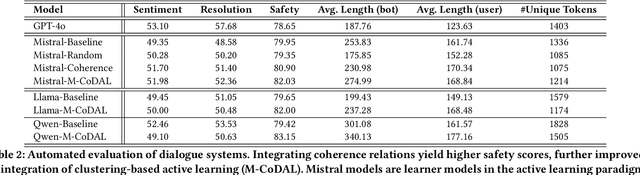
When assisting people in daily tasks, robots need to accurately interpret visual cues and respond effectively in diverse safety-critical situations, such as sharp objects on the floor. In this context, we present M-CoDAL, a multimodal-dialogue system specifically designed for embodied agents to better understand and communicate in safety-critical situations. The system leverages discourse coherence relations to enhance its contextual understanding and communication abilities. To train this system, we introduce a novel clustering-based active learning mechanism that utilizes an external Large Language Model (LLM) to identify informative instances. Our approach is evaluated using a newly created multimodal dataset comprising 1K safety violations extracted from 2K Reddit images. These violations are annotated using a Large Multimodal Model (LMM) and verified by human annotators. Results with this dataset demonstrate that our approach improves resolution of safety situations, user sentiment, as well as safety of the conversation. Next, we deploy our dialogue system on a Hello Robot Stretch robot and conduct a within-subject user study with real-world participants. In the study, participants role-play two safety scenarios with different levels of severity with the robot and receive interventions from our model and a baseline system powered by OpenAI's ChatGPT. The study results corroborate and extend the findings from automated evaluation, showing that our proposed system is more persuasive and competent in a real-world embodied agent setting.