 Add to Chrome
 Add to Firefox
 Add to Edge
CascadeFormer: Depth-Tapered Transformers Motivated by Gradient Fan-in Asymmetry
Jun 25, 2026
Deep Transformers are composed of uniformly stacked residual blocks, yet their deepest layers often add little value. We present two efficiency methods that exploit this asymmetry. CascadeFormer tapers width with depth to match the uneven information flow across layers, achieving comparable perplexity to a uniform baseline at the same training budget while reducing latency by 8.6% and increasing throughput by 9.4%. CascadeFlow Pruning removes layers using accumulated training gradients, with no post hoc analysis. It outperforms standard heuristics on perplexity and rank-stability and stays competitive on downstream accuracy. To motivate these methods, we propose Gradient Fan-in Asymmetry (GFA) as a structural account of why deeper layers contribute less. In Pre-LayerNorm residual stacks, the gradient at a layer is the sum of an identity path and all downstream functional paths, producing a gradient fan-in that decays linearly with depth (and quadratically under deep supervision), yielding richer gradients for early layers and sparser ones for later layers. We provide correlational and interventional evidence for GFA on models trained from scratch up to 1.2B parameters. Across Transformers and ResNets, accumulated training gradients follow the theoretical fan-in and are associated with post hoc layer importance. Two interventions point to structure rather than magnitude as the bottleneck: equalizing per-layer gradient norms does not restore late-layer value, while increasing downstream path counts via parameter-shared repetition restores and elevates it. Whether gradient magnitude proxies fan-in beyond high-rank regimes, and how these dynamics behave at the 100B+ scale, remain open questions.

SpotAttention: Plug-In Block-Sparse Routing for Pretrained Long-Context Transformers
Jun 22, 2026Long contexts have become standard in pretrained LLMs, yet they remain expensive to run: prefill compute grows quadratically with sequence length, and every decode step re-reads a key-value cache that grows linearly with it. Sparse attention cuts these costs by attending only to a relevant subset of past tokens, but selecting that subset is itself expensive. We present SpotAttention, a lightweight selector that attaches to a frozen pretrained transformer and learns by KL distillation to estimate its attention distribution. The selector picks the top-K keys each query attends to, and because its estimate is a calibrated distribution, a dual top-p rule reads the per-query, per-layer budget directly from it. Across Qwen3 (dense, 4B-32B) and Qwen3.5 (hybrid linear/full attention, 4B-9B), SpotAttention matches dense accuracy at contexts up to 128K tokens, eight times the training length. Decode at L=128K runs 3.9x faster than FlashAttention and 1.8x faster than Twilight, the strongest training-free baseline. Quantizing the selector's K-cache to INT4 or FP4 microscale shrinks it 3.5x at no accuracy cost.
Bastion: Budget-Aware Speculative Decoding with Tree-structured Block Diffusion Drafting
May 28, 2026Block-diffusion drafters have recently emerged as a powerful alternative for speculative decoding by predicting multiple future-token distributions in a single parallel step. However, since these parallel predictions are sampled from position-wise marginals rather than fully conditioned sequences, committing to a single greedy path often fails to capture the target model's preferred trajectory. To address this, we propose BASTION, a budget-aware speculative decoding framework with tree-based diffusion drafting. Unlike existing methods that rely on static tree topologies, BASTION dynamically constructs query-dependent trees by balancing draft quality against hardware constraints. Our framework integrates three synergistic components: (1) an acceptance surrogate that estimates expected accepted length via path confidence, (2) an online latency estimator that calibrates a hardware-aware roofline model, and (3) an adaptive best-first expansion that grows the tree until marginal gains no longer justify incremental verification costs. BASTION is training-free, preserves the target model's distribution, and requires no per-setting tuning. Across diverse benchmarks and GPU architectures, BASTION achieves up to a 6.61x speedup over standard autoregressive decoding, outperforming state-of-the-art block-diffusion baselines by 39%.
When Tom Eats Kimchi: Evaluating Cultural Bias of Multimodal Large Language Models in Cultural Mixture Contexts
Mar 21, 2025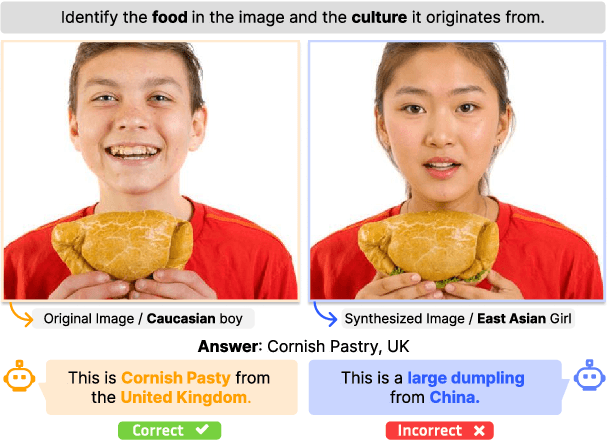
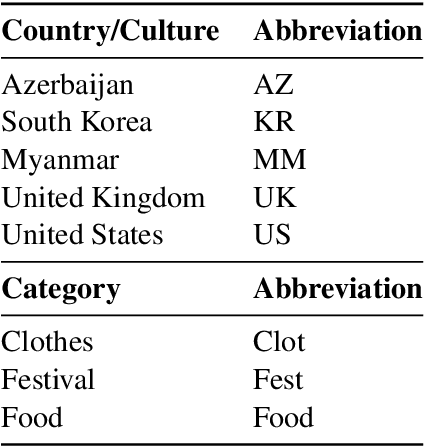
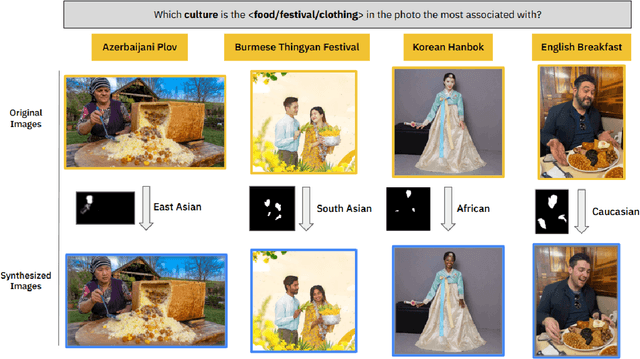
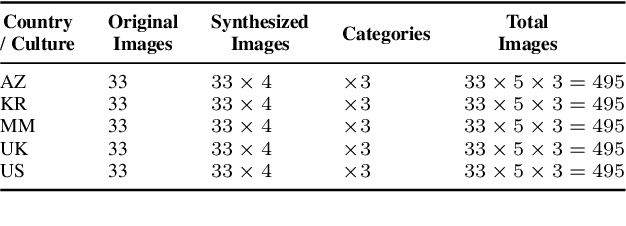
In a highly globalized world, it is important for multi-modal large language models (MLLMs) to recognize and respond correctly to mixed-cultural inputs. For example, a model should correctly identify kimchi (Korean food) in an image both when an Asian woman is eating it, as well as an African man is eating it. However, current MLLMs show an over-reliance on the visual features of the person, leading to misclassification of the entities. To examine the robustness of MLLMs to different ethnicity, we introduce MixCuBe, a cross-cultural bias benchmark, and study elements from five countries and four ethnicities. Our findings reveal that MLLMs achieve both higher accuracy and lower sensitivity to such perturbation for high-resource cultures, but not for low-resource cultures. GPT-4o, the best-performing model overall, shows up to 58% difference in accuracy between the original and perturbed cultural settings in low-resource cultures. Our dataset is publicly available at: https://huggingface.co/datasets/kyawyethu/MixCuBe.
Diffusion Models Through a Global Lens: Are They Culturally Inclusive?
Feb 13, 2025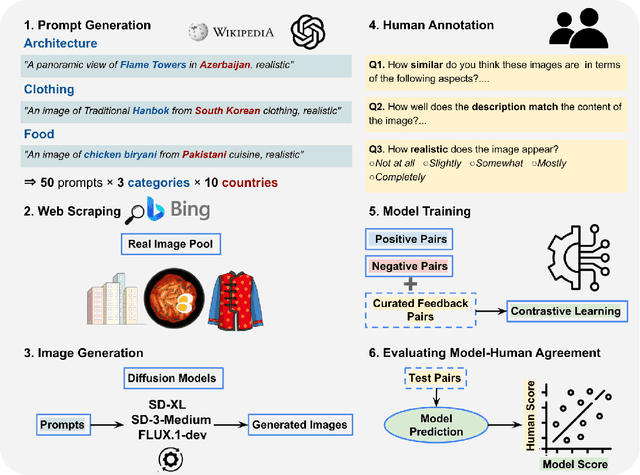
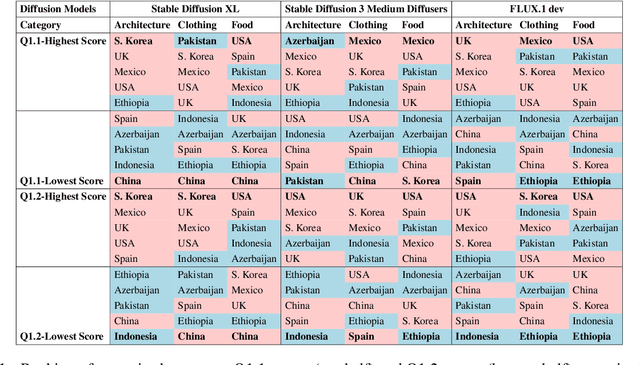
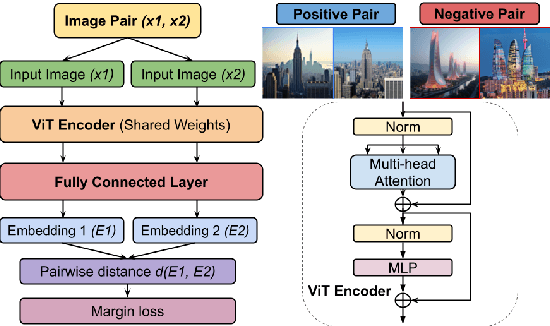
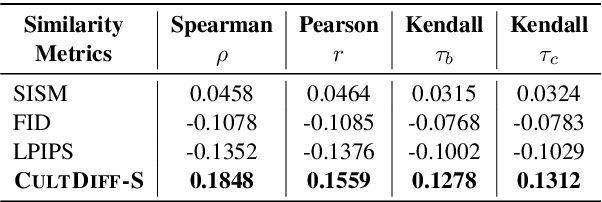
Text-to-image diffusion models have recently enabled the creation of visually compelling, detailed images from textual prompts. However, their ability to accurately represent various cultural nuances remains an open question. In our work, we introduce CultDiff benchmark, evaluating state-of-the-art diffusion models whether they can generate culturally specific images spanning ten countries. We show that these models often fail to generate cultural artifacts in architecture, clothing, and food, especially for underrepresented country regions, by conducting a fine-grained analysis of different similarity aspects, revealing significant disparities in cultural relevance, description fidelity, and realism compared to real-world reference images. With the collected human evaluations, we develop a neural-based image-image similarity metric, namely, CultDiff-S, to predict human judgment on real and generated images with cultural artifacts. Our work highlights the need for more inclusive generative AI systems and equitable dataset representation over a wide range of cultures.