 Add to Chrome
 Add to Firefox
 Add to Edge
Hybrid Beamforming in Non-Terrestrial Networks: Architectures, Design Challenges, and Opportunities
Aug 09, 2026
Hybrid analog-digital beamforming (HBF) has emerged as a key enabling technology for non-terrestrial networks (NTNs), where large antenna arrays are required to compensate for severe propagation loss but fully digital beamforming is often impractical due to radio-frequency (RF) chain cost, power consumption, and payload limitations. Compared with terrestrial networks, NTN platforms such as low Earth orbit (LEO) satellites and unmanned aerial vehicles (UAVs) impose distinctive HBF design challenges, including high mobility, Doppler effects, sparse line-of-sight-dominant channels, stringent on-board energy budgets, and, for UAVs, the additional coupling between beamforming and controllable platform placement or trajectory. This survey provides a systematic review of HBF techniques for NTN systems, with emphasis on LEO satellite and UAV communications. We first introduce common HBF architectures, signal models, channel representations, analog and digital precoder designs, and learning-aided approaches that form the shared technical foundation of existing works. We then survey both platforms under a common set of five categories, which cover system architecture and precoding design, time-varying beam management, network-level cooperation and scheduling, sensing capability and reconfigurable surfaces, and security and multiple access. Their platform-specific content differs most sharply in the second one, since the dominant time-varying mechanism is traffic-driven beam hopping on an LEO payload but mobility-aware beam tracking on a UAV. Finally, we discuss open research challenges and future directions toward scalable, robust, and hardware-efficient HBF in next-generation NTNs.

In-context Cross-Density Adaptation on Noisy Mammogram Abnormalities Detection
Jun 12, 2023This paper investigates the impact of breast density distribution on the generalization performance of deep-learning models on mammography images using the VinDr-Mammo dataset. We explore the use of domain adaptation techniques, specifically Domain Adaptive Object Detection (DAOD) with the Noise Latent Transferability Exploration (NLTE) framework, to improve model performance across breast densities under noisy labeling circumstances. We propose a robust augmentation framework to bridge the domain gap between the source and target inside a dataset. Our results show that DAOD-based methods, along with the proposed augmentation framework, can improve the generalization performance of deep-learning models (+5% overall mAP improvement approximately in our experimental results compared to commonly used detection models). This paper highlights the importance of domain adaptation techniques in medical imaging, particularly in the context of breast density distribution, which is critical in mammography.
Resource Allocation in Mobility-Aware Federated Learning Networks: A Deep Reinforcement Learning Approach
Oct 21, 2019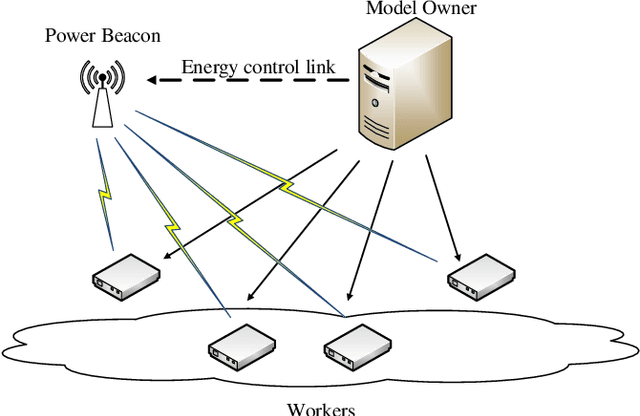
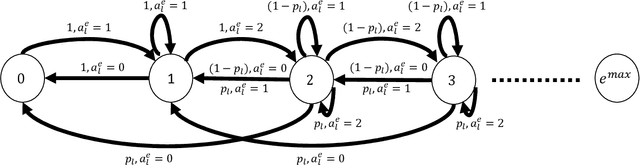
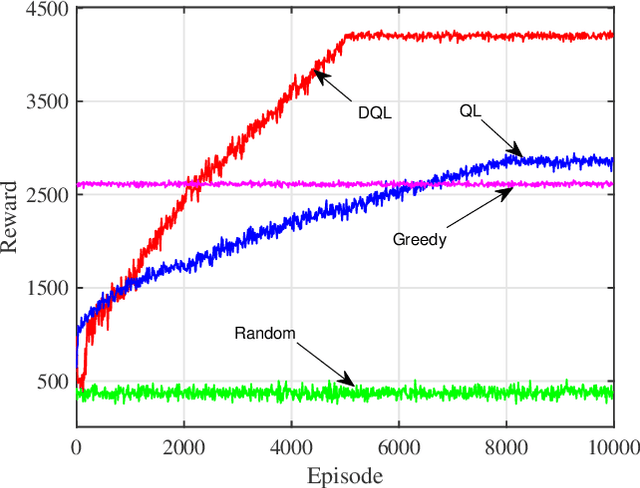
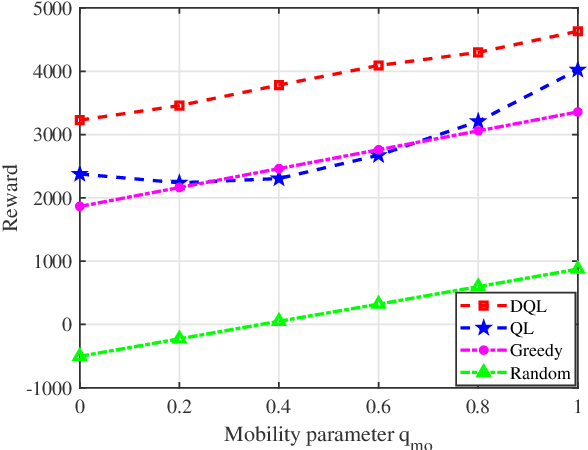
Federated learning allows mobile devices, i.e., workers, to use their local data to collaboratively train a global model required by the model owner. Federated learning thus addresses the privacy issues of traditional machine learning. However, federated learning faces the energy constraints of the workers and the high network resource cost due to the fact that a number of global model transmissions may be required to achieve the target accuracy. To address the energy constraint, a power beacon can be used that recharges energy to the workers. However, the model owner may need to pay an energy cost to the power beacon for the energy recharge. To address the high network resource cost, the model owner can use a WiFi channel, called default channel, for the global model transmissions. However, communication interruptions may occur due to the instability of the default channel quality. For this, special channels such as LTE channels can be used, but this incurs channel cost. As such, the problem of the model owner is to decide amounts of energy recharged to the workers and to choose channels used to transmit its global model to the workers to maximize the number of global model transmissions while minimizing the energy and channel costs. This is challenging for the model owner under the uncertainty of the channel, energy and mobility states of the workers. In this paper, we thus propose to employ the Deep Q-Network (DQN) that enables the model owner to find the optimal decisions on the energy and the channels without any a priori network knowledge. Simulation results show that the proposed DQN always achieves better performance compared to the conventional algorithms.