 Add to Chrome
 Add to Firefox
 Add to Edge
AlphaOracle: Oracle bone script decipherment via human-workflow-inspired deep learning
Jul 20, 2026
Approximately 3,000 of the 4,500 oracle bone script (OBS) characters remain undeciphered due to fragmentary inscriptions and sparse evidence. Current AI approaches fail to replicate expert workflows that integrate form analysis, contextual semantics, and philological reasoning. We introduce AlphaOracle, a human-workflow-inspired framework that systematizes OBS decipherment using the largest digitized corpus to date. Its multi-stage pipeline comprises: (i) rubbing parsing; (ii) radical-based morphological analysis with diachronic modeling; (iii) contextual retrieval with semantic alignment; and (iv) philological validation against classical sources. Each stage generates explicit, confidence-weighted evidence chains, culminating in interpretable reports for scholarly verification. Across multiple test characters, AlphaOracle's readings strongly agreed with expert interpretations. In a study of 86 domain specialists, it reduced analysis time by 64% and 79% of participants rated it highly useful. Notably, AlphaOracle resolves the character "Lao" as a toponymic or clan designation, offering concrete revisions to Shang administrative and social interpretations. These results suggest that computational methods aligned with philological practice can facilitate OBS research and provide a conceptual reference for studies of other undeciphered scripts.
* Accepted by The Innovation 2026

Deciphering Oracle Bone Language with Diffusion Models
Jun 02, 2024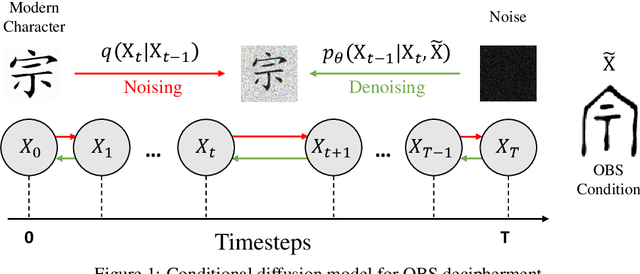


Originating from China's Shang Dynasty approximately 3,000 years ago, the Oracle Bone Script (OBS) is a cornerstone in the annals of linguistic history, predating many established writing systems. Despite the discovery of thousands of inscriptions, a vast expanse of OBS remains undeciphered, casting a veil of mystery over this ancient language. The emergence of modern AI technologies presents a novel frontier for OBS decipherment, challenging traditional NLP methods that rely heavily on large textual corpora, a luxury not afforded by historical languages. This paper introduces a novel approach by adopting image generation techniques, specifically through the development of Oracle Bone Script Decipher (OBSD). Utilizing a conditional diffusion-based strategy, OBSD generates vital clues for decipherment, charting a new course for AI-assisted analysis of ancient languages. To validate its efficacy, extensive experiments were conducted on an oracle bone script dataset, with quantitative results demonstrating the effectiveness of OBSD. Code and decipherment results will be made available at https://github.com/guanhaisu/OBSD.