 Add to Chrome
 Add to Firefox
 Add to Edge
Advancing Structured Priors for Sparse-Voxel Surface Reconstruction
Jan 25, 2026
Reconstructing accurate surfaces with radiance fields has progressed rapidly, yet two promising explicit representations, 3D Gaussian Splatting and sparse-voxel rasterization, exhibit complementary strengths and weaknesses. 3D Gaussian Splatting converges quickly and carries useful geometric priors, but surface fidelity is limited by its point-like parameterization. Sparse-voxel rasterization provides continuous opacity fields and crisp geometry, but its typical uniform dense-grid initialization slows convergence and underutilizes scene structure. We combine the advantages of both by introducing a voxel initialization method that places voxels at plausible locations and with appropriate levels of detail, yielding a strong starting point for per-scene optimization. To further enhance depth consistency without blurring edges, we propose refined depth geometry supervision that converts multi-view cues into direct per-ray depth regularization. Experiments on standard benchmarks demonstrate improvements over prior methods in geometric accuracy, better fine-structure recovery, and more complete surfaces, while maintaining fast convergence.

Dynamic-SUPERB Phase-2: A Collaboratively Expanding Benchmark for Measuring the Capabilities of Spoken Language Models with 180 Tasks
Nov 08, 2024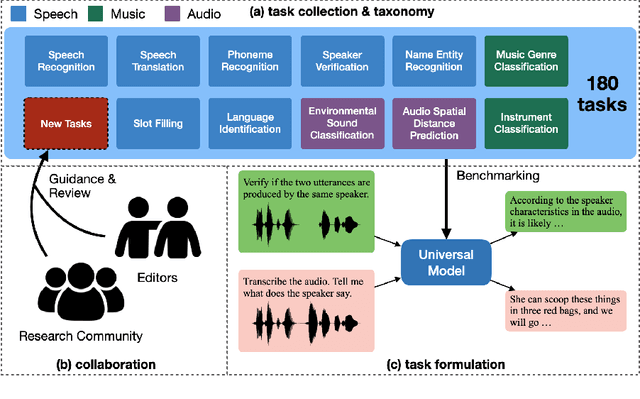
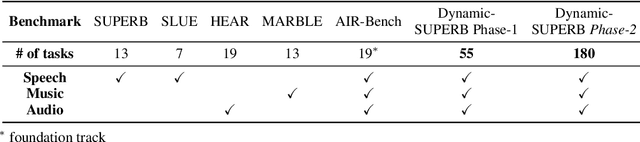
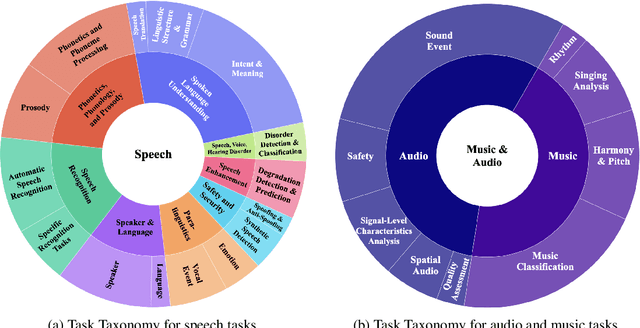
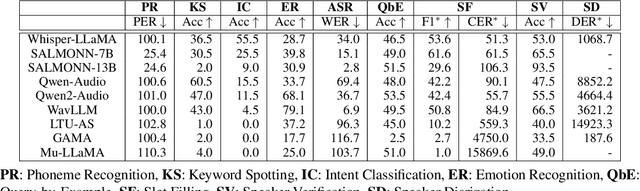
Multimodal foundation models, such as Gemini and ChatGPT, have revolutionized human-machine interactions by seamlessly integrating various forms of data. Developing a universal spoken language model that comprehends a wide range of natural language instructions is critical for bridging communication gaps and facilitating more intuitive interactions. However, the absence of a comprehensive evaluation benchmark poses a significant challenge. We present Dynamic-SUPERB Phase-2, an open and evolving benchmark for the comprehensive evaluation of instruction-based universal speech models. Building upon the first generation, this second version incorporates 125 new tasks contributed collaboratively by the global research community, expanding the benchmark to a total of 180 tasks, making it the largest benchmark for speech and audio evaluation. While the first generation of Dynamic-SUPERB was limited to classification tasks, Dynamic-SUPERB Phase-2 broadens its evaluation capabilities by introducing a wide array of novel and diverse tasks, including regression and sequence generation, across speech, music, and environmental audio. Evaluation results indicate that none of the models performed well universally. SALMONN-13B excelled in English ASR, while WavLLM demonstrated high accuracy in emotion recognition, but current models still require further innovations to handle a broader range of tasks. We will soon open-source all task data and the evaluation pipeline.