 Add to Chrome
 Add to Firefox
 Add to Edge
Low-Rate Wrist SpO2 Estimation under Micro-Perturbations Using Motion-Aware Beat Selection and Perfusion-Guided Calibration
Jul 09, 2026
Continuous oxygen saturation (SPO2) monitoring from photoplethysmography (PPG) is important for wearable health sensing, but wrist-based SPO2 estimation remains challenging due to subtle wrist micro-perturbations and inter-subject differences in local perfusion status. These factors can destabilize the red-to-infrared ratio-of-ratios (R) and reduce the reliability of conventional fixed R-SPO2 mapping. This paper proposes a lightweight low-rate wrist SPO2 estimation framework that integrates motion-aware beat selection and perfusion-guided calibration. The proposed method extracts beat-level alternating-current/direct-current (AC/DC) components from dual-wavelength PPG signals, computes beat-level R values, and uses accelerometer-derived motion scores to weight beats within each sliding window. A subject-specific perfusion reference is further used to guide calibration across different perfusion conditions. Experiments on a private wearable dataset show that the proposed method achieves the best 25 Hz performance, with an MAE of 2.305$\pm$1.113% and an RMSE of 3.117$\pm$1.743%, while maintaining performance comparable to the 100 Hz sampling rate and reducing PPG sensor power consumption for energy-efficient wearable implementation. These results demonstrate the effectiveness of the proposed framework for low-rate wrist SPO2 estimation under micro-perturbations.

Unit-Independent Low-Rate Wrist GSR Processing for Stress Detection Using Phasic nSCR Features
Jul 09, 2026Galvanic skin response (GSR) is widely used for stress detection, but wrist-based GSR remains challenging because its absolute amplitude can differ substantially from laboratory-grade palmar measurements. In this paper, we propose a unit-independent low-rate wrist GSR processing pipeline to extract the number of skin conductance responses per minute (nSCR/min) as a stress-related feature. We collect paired wrist and palmar GSR recordings from 31 participants during sitting baseline, standing baseline, neutral speaking, and the Trier Social Stress Test (TSST), a laboratory social stressor task. The proposed pipeline cleans the raw GSR signal, decomposes it into tonic skin conductance level (SCL) and phasic skin conductance response (SCR), applies robust z-score normalization, and detects phasic SCR peaks to compute nSCR/min. Using random forest on 25Hz We-Be GSR, nSCR/min achieved balanced accuracies of 0.823 and 0.871 for binary classification between TSST and the sitting and standing baselines, respectively. Moreover, the 25Hz We-Be GSR features achieved comparable balanced accuracy to the original 100Hz features across the evaluated tasks. These results suggest the feasibility of low-rate, unit-independent wrist GSR processing for wearable stress detection.
Is Mamba Reliable for Medical Imaging?
Feb 16, 2026State-space models like Mamba offer linear-time sequence processing and low memory, making them attractive for medical imaging. However, their robustness under realistic software and hardware threat models remains underexplored. This paper evaluates Mamba on multiple MedM-NIST classification benchmarks under input-level attacks, including white-box adversarial perturbations (FGSM/PGD), occlusion-based PatchDrop, and common acquisition corruptions (Gaussian noise and defocus blur) as well as hardware-inspired fault attacks emulated in software via targeted and random bit-flip injections into weights and activations. We profile vulnerabilities and quantify impacts on accuracy indicating that defenses are needed for deployment.
Pyramid: Machine Learning Framework to Estimate the Optimal Timing and Resource Usage of a High-Level Synthesis Design
Jul 29, 2019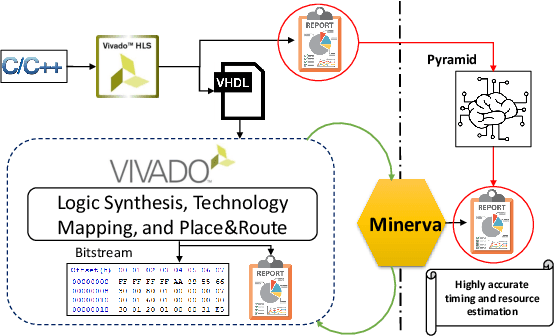
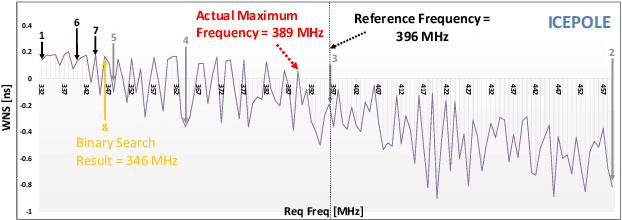
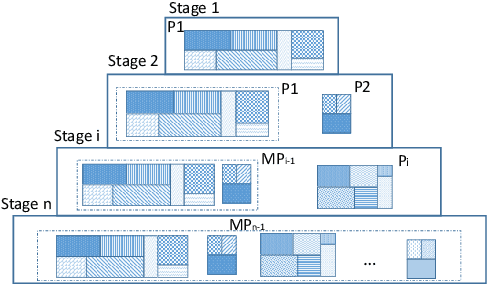

The emergence of High-Level Synthesis (HLS) tools shifted the paradigm of hardware design by making the process of mapping high-level programming languages to hardware design such as C to VHDL/Verilog feasible. HLS tools offer a plethora of techniques to optimize designs for both area and performance, but resource usage and timing reports of HLS tools mostly deviate from the post-implementation results. In addition, to evaluate a hardware design performance, it is critical to determine the maximum achievable clock frequency. Obtaining such information using static timing analysis provided by CAD tools is difficult, due to the multitude of tool options. Moreover, a binary search to find the maximum frequency is tedious, time-consuming, and often does not obtain the optimal result. To address these challenges, we propose a framework, called Pyramid, that uses machine learning to accurately estimate the optimal performance and resource utilization of an HLS design. For this purpose, we first create a database of C-to-FPGA results from a diverse set of benchmarks. To find the achievable maximum clock frequency, we use Minerva, which is an automated hardware optimization tool. Minerva determines the close-to-optimal settings of tools, using static timing analysis and a heuristic algorithm, and targets either optimal throughput or throughput-to-area. Pyramid uses the database to train an ensemble machine learning model to map the HLS-reported features to the results of Minerva. To this end, Pyramid re-calibrates the results of HLS to bridge the accuracy gap and enable developers to estimate the throughput or throughput-to-area of hardware design with more than 95% accuracy and alleviates the need to perform actual implementation for estimation.