 Add to Chrome
 Add to Firefox
 Add to Edge
Machine Learning-Driven Creep Law Discovery Across Alloy Compositional Space
Jan 13, 2026
Hihg-temperature creep characterization of structural alloys traditionally relies on serial uniaxial tests, which are highly inefficient for exploring the large search space of alloy compositions and for material discovery. Here, we introduce a machine-learning-assisted, high-throughput framework for creep law identification based on a dimple array bulge instrument (DABI) configuration, which enables parallel creep testing of 25 dimples, each fabricated from a different alloy, in a single experiment. Full-field surface displacements of dimples undergoing time-dependent creep-induced bulging under inert gas pressure are measured by 3D digital image correlation. We train a recurrent neural network (RNN) as a surrogate model, mapping creep parameters and loading conditions to the time-dependent deformation response of DABI. Coupling this surrogate with a particle swarm optimization scheme enables rapid and global inverse identification with sparsity regularization of creep parameters from experiment displacement-time histories. In addition, we propose a phenomenological creep law with a time-dependent stress exponent that captures the sigmoidal primary creep observed in wrought INCONEL 625 and extracts its temperature dependence from DABI test at multiple temperatures. Furthermore, we employ a general creep law combining several conventional forms together with regularized inversion to identify the creep laws for 47 additional Fe-, Ni-, and Co-rich alloys and to automatically select the dominant functional form for each alloy. This workflow combined with DABI experiment provides a quantitative, high-throughput creep characterization platform that is compatible with data mining, composition-property modeling, and nonlinear structural optimization with creep behavior across a large alloy design space.

Mechanical Characterization and Inverse Design of Stochastic Architected Metamaterials Using Neural Operators
Nov 23, 2023Machine learning (ML) is emerging as a transformative tool for the design of architected materials, offering properties that far surpass those achievable through lab-based trial-and-error methods. However, a major challenge in current inverse design strategies is their reliance on extensive computational and/or experimental datasets, which becomes particularly problematic for designing micro-scale stochastic architected materials that exhibit nonlinear mechanical behaviors. Here, we introduce a new end-to-end scientific ML framework, leveraging deep neural operators (DeepONet), to directly learn the relationship between the complete microstructure and mechanical response of architected metamaterials from sparse but high-quality in situ experimental data. The approach facilitates the inverse design of structures tailored to specific nonlinear mechanical behaviors. Results obtained from spinodal microstructures, printed using two-photon lithography, reveal that the prediction error for mechanical responses is within a range of 5 - 10%. Our work underscores that by employing neural operators with advanced micro-mechanics experimental techniques, the design of complex micro-architected materials with desired properties becomes feasible, even in scenarios constrained by data scarcity. Our work marks a significant advancement in the field of materials-by-design, potentially heralding a new era in the discovery and development of next-generation metamaterials with unparalleled mechanical characteristics derived directly from experimental insights.
Recent Advances and Applications of Machine Learning in Experimental Solid Mechanics: A Review
Mar 15, 2023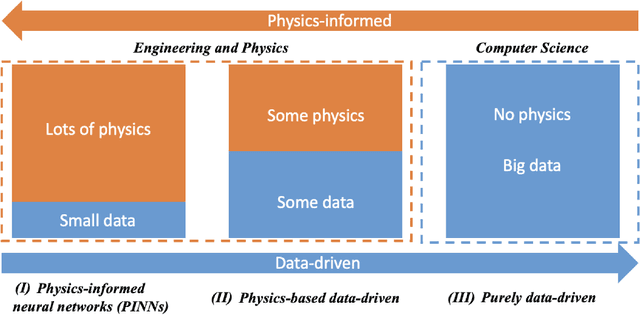
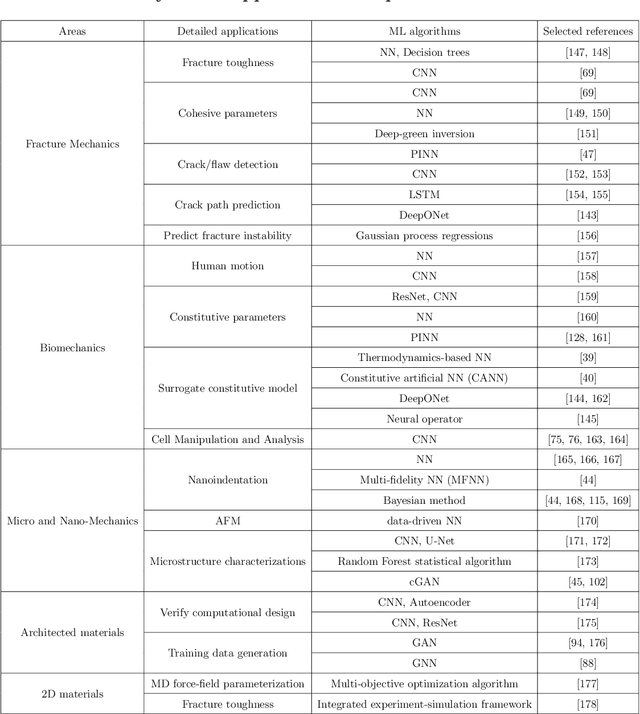
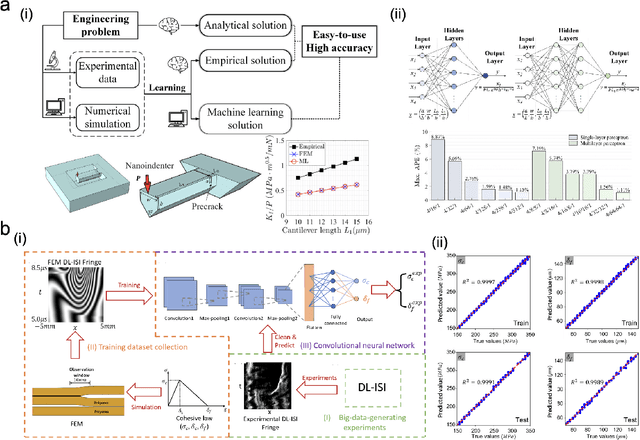
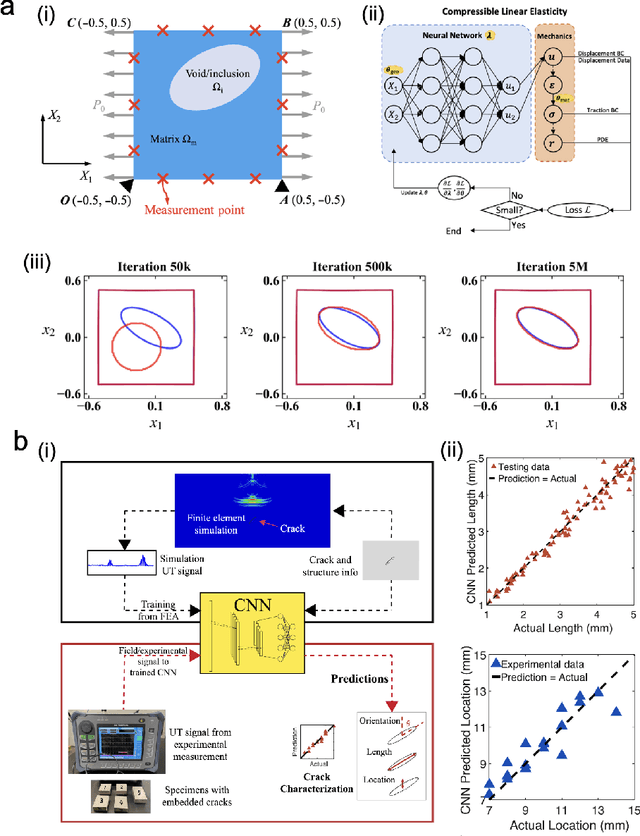
For many decades, experimental solid mechanics has played a crucial role in characterizing and understanding the mechanical properties of natural and novel materials. Recent advances in machine learning (ML) provide new opportunities for the field, including experimental design, data analysis, uncertainty quantification, and inverse problems. As the number of papers published in recent years in this emerging field is exploding, it is timely to conduct a comprehensive and up-to-date review of recent ML applications in experimental solid mechanics. Here, we first provide an overview of common ML algorithms and terminologies that are pertinent to this review, with emphasis placed on physics-informed and physics-based ML methods. Then, we provide thorough coverage of recent ML applications in traditional and emerging areas of experimental mechanics, including fracture mechanics, biomechanics, nano- and micro-mechanics, architected materials, and 2D material. Finally, we highlight some current challenges of applying ML to multi-modality and multi-fidelity experimental datasets and propose several future research directions. This review aims to provide valuable insights into the use of ML methods as well as a variety of examples for researchers in solid mechanics to integrate into their experiments.