 Add to Chrome
 Add to Firefox
 Add to Edge
Achieving $\widetilde{O}(1/ε)$ Sample Complexity for Bilinear Systems Identification under Bounded Noises
Mar 21, 2026
This paper studies finite-sample set-membership identification for discrete-time bilinear systems under bounded symmetric log-concave disturbances. Compared with existing finite-sample results for linear systems and related analyses under stronger noise assumptions, we consider the more challenging bilinear setting with trajectory-dependent regressors and allow marginally stable dynamics with polynomial mean-square state growth. Under these conditions, we prove that the diameter of the feasible parameter set shrinks with sample complexity $\widetilde{O}(1/ε)$. Simulation supports the theory and illustrates the advantage of the proposed estimator for uncertainty quantification.

Privacy Preserving in Non-Intrusive Load Monitoring: A Differential Privacy Perspective
Nov 12, 2020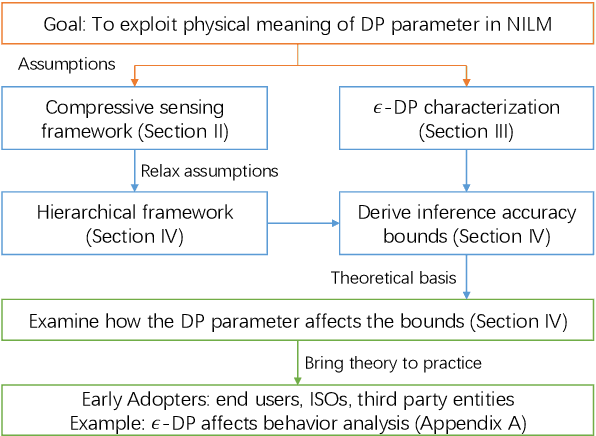
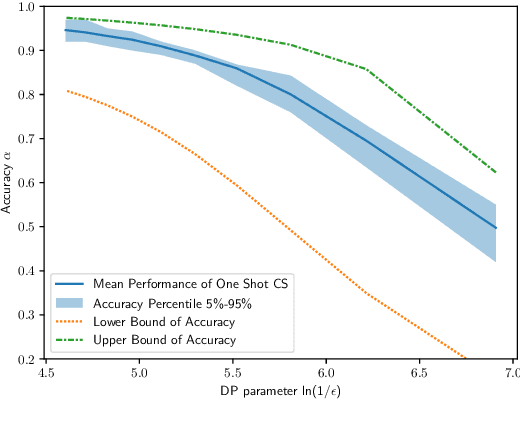
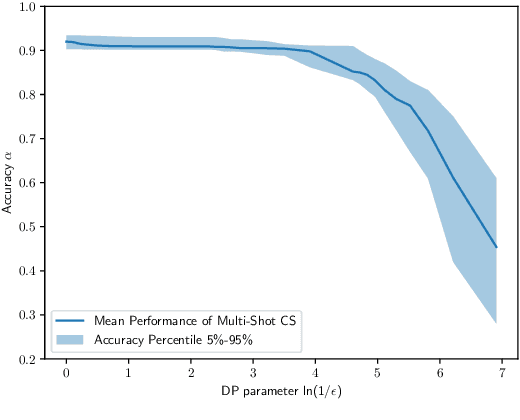
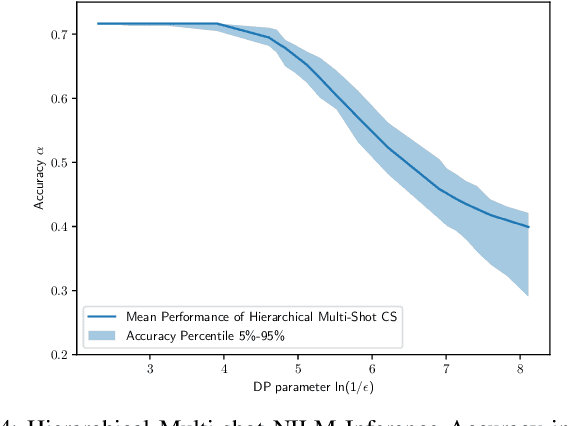
Smart meter devices enable a better understanding of the demand at the potential risk of private information leakage. One promising solution to mitigating such risk is to inject noises into the meter data to achieve a certain level of differential privacy. In this paper, we cast one-shot non-intrusive load monitoring (NILM) in the compressive sensing framework, and bridge the gap between theoretical accuracy of NILM inference and differential privacy's parameters. We then derive the valid theoretical bounds to offer insights on how the differential privacy parameters affect the NILM performance. Moreover, we generalize our conclusions by proposing the hierarchical framework to solve the multi-shot NILM problem. Numerical experiments verify our analytical results and offer better physical insights of differential privacy in various practical scenarios. This also demonstrates the significance of our work for the general privacy preserving mechanism design.
Effective End-to-End Learning Framework for Economic Dispatch
Feb 22, 2020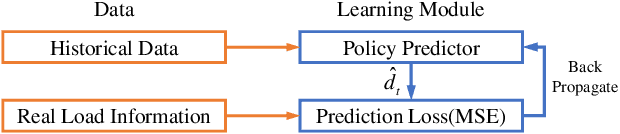
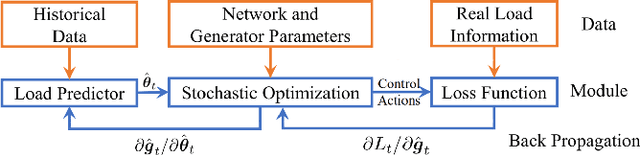
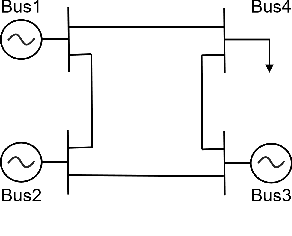
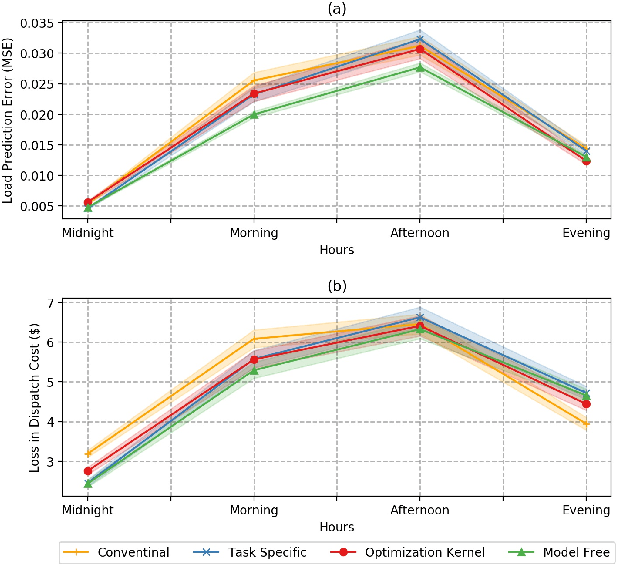
Conventional wisdom to improve the effectiveness of economic dispatch is to design the load forecasting method as accurately as possible. However, this approach can be problematic due to the temporal and spatial correlations between system cost and load prediction errors. This motivates us to adopt the notion of end-to-end machine learning and to propose a task-specific learning criteria to conduct economic dispatch. Specifically, to maximize the data utilization, we design an efficient optimization kernel for the learning process. We provide both theoretical analysis and empirical insights to highlight the effectiveness and efficiency of the proposed learning framework.