 Add to Chrome
 Add to Firefox
 Add to Edge
Featurized Occupation Measures for Structured Global Search in Numerical Optimal Control
Mar 17, 2026
Numerical optimal control is commonly divided between globally structured but dimensionally intractable Hamilton-Jacobi-Bellman (HJB) methods and scalable but local trajectory optimization. We introduce the Featurized Occupation Measure (FOM), a finite-dimensional primal-dual interface for the occupation-measure formulation that unifies trajectory search and global HJB-type certification. FOM is broad yet numerically tractable, covering both explicit weak-form schemes and implicit simulator- or rollout-based sampling methods. Within this framework, approximate HJB subsolutions serve as intrinsic numerical certificates to directly evaluate and guide the primal search. We prove asymptotic consistency with the exact infinite-dimensional occupation-measure problem, and show that for block-organized feasible certificates, finite-dimensional approximation preserves certified lower bounds with blockwise error and complexity control. We also establish persistence of these lower bounds under time shifts and bounded model perturbations. Consequently, these structural properties render global certificates into flexible, reusable computational objects, establishing a systematic basis for certificate-guided optimization in nonlinear control.

Early-Terminable Energy-Safe Iterative Coupling for Parallel Simulation of Port-Hamiltonian Systems
Mar 17, 2026Parallel simulation and control of large-scale robotic systems often rely on partitioned time stepping, yet finite-iteration coupling can inject spurious energy by violating power consistency--even when each subsystem is passive. This letter proposes a novel energy-safe, early-terminable iterative coupling for port-Hamiltonian subsystems by embedding a Douglas--Rachford (DR) splitting scheme in scattering (wave) coordinates. The lossless interconnection is enforced as an orthogonal constraint in the wave domain, while each subsystem contributes a discrete-time scattering port map induced by its one-step integrator. Under a discrete passivity condition on the subsystem time steps and a mild impedance-tuning condition, we prove an augmented-storage inequality certifying discrete passivity of the coupled macro-step for any finite inner-iteration budget, with the remaining mismatch captured by an explicit residual. As the inner budget increases, the partitioned update converges to the monolithic discrete-time update induced by the same integrators, yielding a principled, adaptive accuracy--compute trade-off, supporting energy-consistent real-time parallel simulation under varying computational budgets. Experiments on a coupled-oscillator benchmark validate the passivity certificates at numerical roundoff (on the order of 10e-14 in double precision) and show that the reported RMS state error decays monotonically with increasing inner-iteration budgets, consistent with the hard-coupling limit.
Guided Time-optimal Model Predictive Control of a Multi-rotor
Jan 08, 2024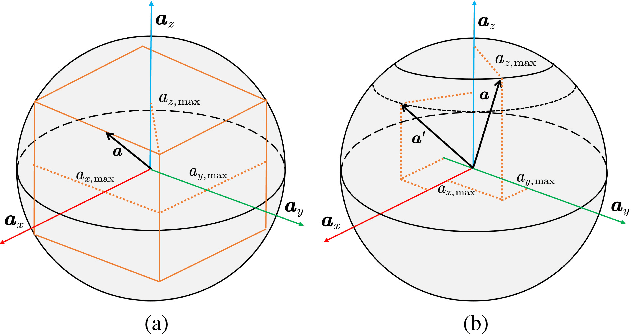

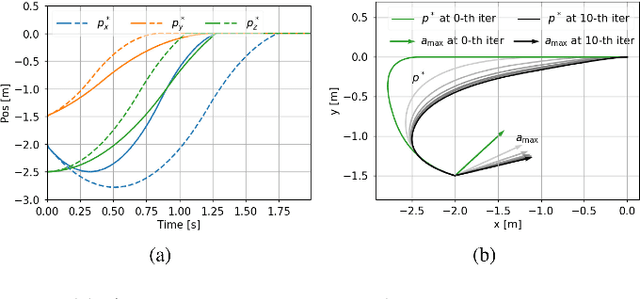
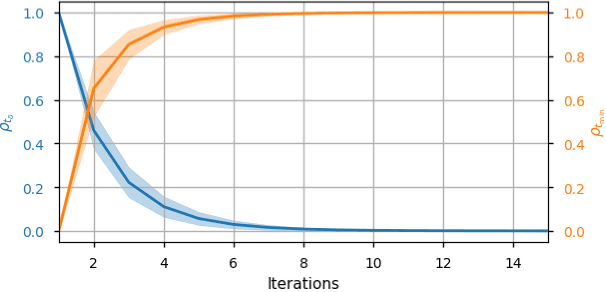
Time-optimal control of a multi-rotor remains an open problem due to the under-actuation and nonlinearity of its dynamics, which make it difficult to solve this problem directly. In this paper, the time-optimal control problem of the multi-rotor is studied. Firstly, a thrust limit optimal decomposition method is proposed, which can reasonably decompose the limited thrust into three directions according to the current state and the target state. As a result, the thrust limit constraint is decomposed as a linear constraint. With the linear constraint and decoupled dynamics, a time-optimal guidance trajectory can be obtained. Then, a cost function is defined based on the time-optimal guidance trajectory, which has a quadratic form and can be used to evaluate the time-optimal performance of the system outputs. Finally, based on the cost function, the time-optimal control problem is reformulated as an MPC (Model Predictive Control) problem. The experimental results demonstrate the feasibility and validity of the proposed methods.
* 6 pages, 5 figures