 Add to Chrome
 Add to Firefox
 Add to Edge
Featurized Occupation Measures for Structured Global Search in Numerical Optimal Control
Mar 17, 2026
Numerical optimal control is commonly divided between globally structured but dimensionally intractable Hamilton-Jacobi-Bellman (HJB) methods and scalable but local trajectory optimization. We introduce the Featurized Occupation Measure (FOM), a finite-dimensional primal-dual interface for the occupation-measure formulation that unifies trajectory search and global HJB-type certification. FOM is broad yet numerically tractable, covering both explicit weak-form schemes and implicit simulator- or rollout-based sampling methods. Within this framework, approximate HJB subsolutions serve as intrinsic numerical certificates to directly evaluate and guide the primal search. We prove asymptotic consistency with the exact infinite-dimensional occupation-measure problem, and show that for block-organized feasible certificates, finite-dimensional approximation preserves certified lower bounds with blockwise error and complexity control. We also establish persistence of these lower bounds under time shifts and bounded model perturbations. Consequently, these structural properties render global certificates into flexible, reusable computational objects, establishing a systematic basis for certificate-guided optimization in nonlinear control.

Early-Terminable Energy-Safe Iterative Coupling for Parallel Simulation of Port-Hamiltonian Systems
Mar 17, 2026Parallel simulation and control of large-scale robotic systems often rely on partitioned time stepping, yet finite-iteration coupling can inject spurious energy by violating power consistency--even when each subsystem is passive. This letter proposes a novel energy-safe, early-terminable iterative coupling for port-Hamiltonian subsystems by embedding a Douglas--Rachford (DR) splitting scheme in scattering (wave) coordinates. The lossless interconnection is enforced as an orthogonal constraint in the wave domain, while each subsystem contributes a discrete-time scattering port map induced by its one-step integrator. Under a discrete passivity condition on the subsystem time steps and a mild impedance-tuning condition, we prove an augmented-storage inequality certifying discrete passivity of the coupled macro-step for any finite inner-iteration budget, with the remaining mismatch captured by an explicit residual. As the inner budget increases, the partitioned update converges to the monolithic discrete-time update induced by the same integrators, yielding a principled, adaptive accuracy--compute trade-off, supporting energy-consistent real-time parallel simulation under varying computational budgets. Experiments on a coupled-oscillator benchmark validate the passivity certificates at numerical roundoff (on the order of 10e-14 in double precision) and show that the reported RMS state error decays monotonically with increasing inner-iteration budgets, consistent with the hard-coupling limit.
Multi-Condition Digital Twin Calibration for Axial Piston Pumps : Compound Fault Simulation
Feb 27, 2026Axial piston pumps are indispensable power sources in high-stakes fluid power systems, including aerospace, marine, and heavy machinery applications. Their operational reliability is frequently compromised by compound faults that simultaneously affect multiple friction pairs. Conventional data-driven diagnosis methods suffer from severe data scarcity for compound faults and poor generalization across varying operating conditions. This paper proposes a novel multi-condition physics-data coupled digital twin calibration framework that explicitly resolves the fundamental uncertainty of pump outlet flow ripple. The framework comprises three synergistic stages: in-situ virtual high-frequency flow sensing on a dedicated rigid metallic segment, surrogate model-assisted calibration of the 3D CFD source model using physically estimated ripple amplitudes, and multi-objective inverse transient analysis for viscoelastic unsteady-friction pipeline parameter identification. Comprehensive experiments on a test rig demonstrate that the calibrated digital twin accurately reproduces both single-fault and two representative compound-fault. These results establish a high-fidelity synthetic fault-generation capability that directly enables robust zero-shot fault diagnosis under previously unseen operating regimes and fault combinations, thereby advancing predictive maintenance in complex hydraulic systems.
Digital Twin-Driven Zero-Shot Fault Diagnosis of Axial Piston Pumps Using Fluid-Borne Noise Signals
Dec 22, 2025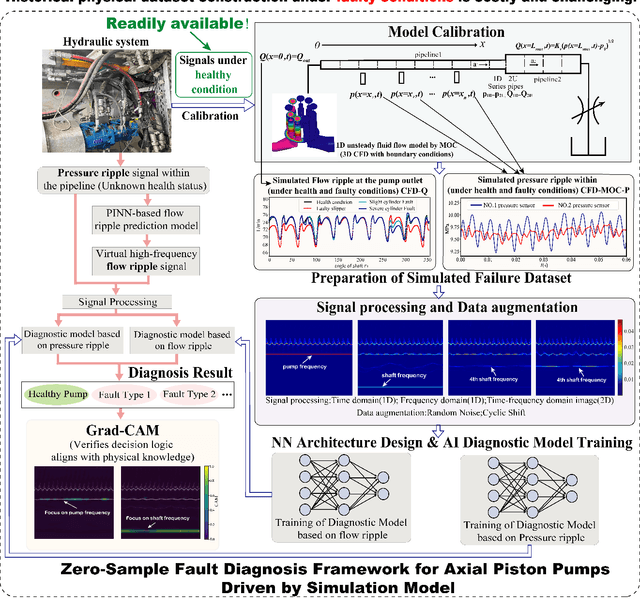
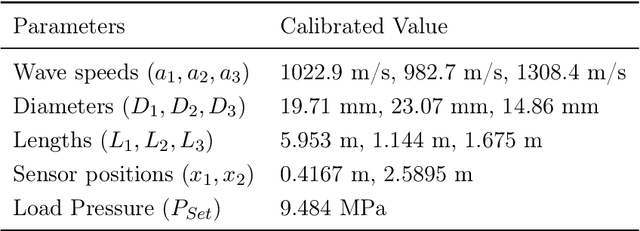
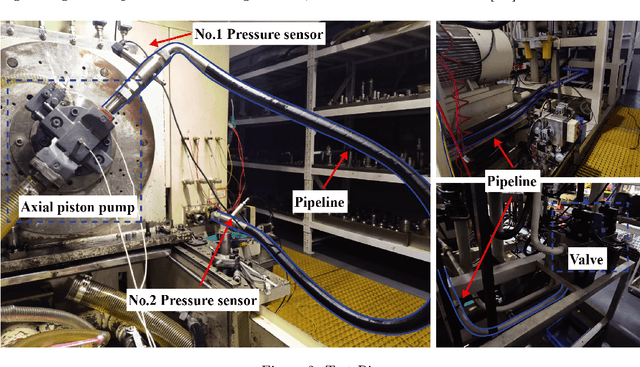
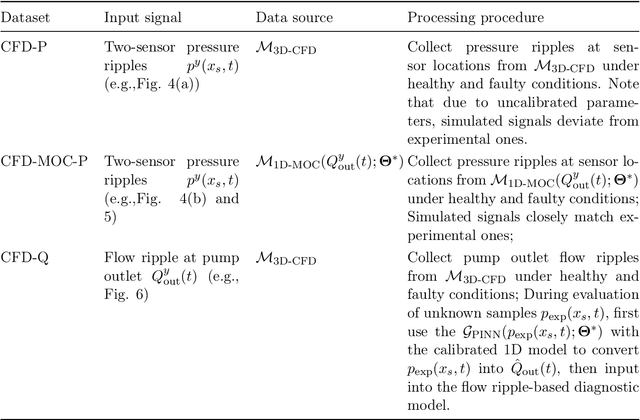
Axial piston pumps are crucial components in fluid power systems, where reliable fault diagnosis is essential for ensuring operational safety and efficiency. Traditional data-driven methods require extensive labeled fault data, which is often impractical to obtain, while model-based approaches suffer from parameter uncertainties. This paper proposes a digital twin (DT)-driven zero-shot fault diagnosis framework utilizing fluid-borne noise (FBN) signals. The framework calibrates a high-fidelity DT model using only healthy-state data, generates synthetic fault signals for training deep learning classifiers, and employs a physics-informed neural network (PINN) as a virtual sensor for flow ripple estimation. Gradient-weighted class activation mapping (Grad-CAM) is integrated to visualize the decision-making process of neural networks, revealing that large kernels matching the subsequence length in time-domain inputs and small kernels in time-frequency domain inputs enable higher diagnostic accuracy by focusing on physically meaningful features. Experimental validations demonstrate that training on signals from the calibrated DT model yields diagnostic accuracies exceeding 95\% on real-world benchmarks, while uncalibrated models result in significantly lower performance, highlighting the framework's effectiveness in data-scarce scenarios.