 Add to Chrome
 Add to Firefox
 Add to Edge
The Decomposition Is the Fingerprint: Per-Component Identity for Agent Skills
Jun 30, 2026
AI agents increasingly acquire and execute skills at runtime: bundles of prompt instructions, executable code, and tool declarations fetched from marketplaces and other agents. Governing them needs a stable notion of skill identity, yet cryptographic hashing is engineered to destroy the very similarity we need, as a one-character edit scrambles the digest. We present a compact, locality-sensitive fingerprint that embeds each component of a skill and projects it to bits with a multi-bank SimHash, giving a fixed 120-byte signature compared in constant time by Hamming distance. Our central claim is that keeping the fingerprint as a per-component triple (prompt, code, tools), rather than a single score, is what makes it useful: the triple recovers skill-family identity through paraphrase, renaming, refactoring, and controlled code translation when another component remains shared, while independent multilingual reimplementation is not recovered; it also localizes which component carries the reuse. We claim lineage, not behavioral equivalence: identity supplies the structural axis of a registry and leaves safety to behavioral verification. The fingerprint reaches an area under the ROC curve (AUC) of 0.974 (95% CI [0.956, 0.994]) over 4,950 pairwise comparisons while using 77x fewer bits than the embedding it approximates, with ranking preserved in expectation and finite-bit concentration; the per-component split turns one number into relationship classification, families, novelty, and a portable "SkillBOM" for a skill registry. On a 906-skill injection benchmark the fingerprint recognizes injected skills as tampered copies of a known base and localizes the change, but recognition is not trust: it remains, by design, an identity signal complementary to behavioral verification rather than a safety verdict.

Leverage Is Not Reach: A Control-Window Law for Single-Neuron Steering in Language Models
Jun 18, 2026Aligned language models gate behaviors such as refusal and language routing through sparse feed forward neurons, yet no theory predicts when a single neuron intervention controls a behavior coherently rather than collapsing the output. We develop a budget normalized control window framework for single neuron steering. A dose along one write direction reduces to one control coordinate: the alignment between the residual stream and the write, driven along a universal saturation curve in units of a coherence budget set by the residual norm divided by the write norm. Coherent control exists when a behavior trigger lies below the collapse ceiling. The same coordinate governs benign mode switches and refusal; the ceiling follows from weights and one generic forward pass, while triggers are measured at rollout. On fifteen held out neurons, the predicted ceiling has mean absolute error 0.14, about 0.07 in bulk layers, and the committed open or closed verdict holds on eleven against a ten of fifteen majority baseline. Closed cases expose three failure modes rather than violations: collapse before trigger, too little depth to propagate, or a normalization that caps how far one neuron can push. The law explains why local gradient attribution anti predicts control: true controllers write off the readout axis and carry a near zero first order gradient. A forward only contrastive screen made precise by the window recovers controllers that attribution misses. On refusal, the hardest case, intervention success is typed, not scalar: coherent bypass and strict actionable reach separate, so a neuron can flip refusal in fluent, on task text with no actionable content, and genuine actionable reach appears only for three of six audited Llama pivots and only at later rollout horizons. Single neuron steering is therefore a budgeted, typed audit of controllability rather than a fixed dose anecdote.
Behavioral Integrity Verification for AI Agent Skills
May 12, 2026Agent skills extend LLM agents with privileged third-party capabilities such as filesystem access, credentials, network calls, and shell execution. Existing safety work catches malicious prompts and risky runtime actions, but the skill artifact itself goes unverified. We formalize this as the behavioral integrity verification (BIV) problem: a typed set comparison between declared and actual capabilities over a shared taxonomy that bridges code, instructions, and metadata. The BIV framework instantiates this comparison by pairing deterministic code analysis with LLM-assisted capability extraction. The resulting structured evidence supports three downstream analyses: deviation taxonomy, root-cause classification, and malicious-skill detection. On 49,943 skills from the OpenClaw registry, the deviation taxonomy reveals a pervasive description-implementation gap: 80.0% of skills deviate from declared behavior, with four novel compound-threat categories surfaced. Root-cause classification finds that deviations are mostly oversight, not malice: 81.1% trace to developer oversight and 18.9% to adversarial intent, with 5.0% of skills carrying predicted multi-stage attack chains. On a 906-skill malicious-skill detection benchmark, BIV reaches an F1 of 0.946, outperforming state-of-the-art rule-based and single-pass LLM baselines. These results demonstrate behavioral integrity auditing for agent skills at scale.
OAHuman: Occlusion-Aware 3D Human Reconstruction from Monocular Images
Mar 15, 2026Monocular 3D human reconstruction in real-world scenarios remains highly challenging due to frequent occlusions from surrounding objects, people, or image truncation. Such occlusions lead to missing geometry and unreliable appearance cues, severely degrading the completeness and realism of reconstructed human models. Although recent neural implicit methods achieve impressive results on clean inputs, they struggle under occlusion due to entangled modeling of shape and texture. In this paper, we propose OAHuman, an occlusion-aware framework that explicitly decouples geometry reconstruction and texture synthesis for robust 3D human modeling from a single RGB image. The core innovation lies in the decoupling-perception paradigm, which addresses the fundamental issue of geometry-texture cross-contamination in occluded regions. Our framework ensures that geometry reconstruction is perceptually reinforced even in occluded areas, isolating it from texture interference. In parallel, texture synthesis is learned exclusively from visible regions, preventing texture errors from being transferred to the occluded areas. This decoupling approach enables OAHuman to achieve robust and high-fidelity reconstruction under occlusion, which has been a long-standing challenge in the field. Extensive experiments on occlusion-rich benchmarks demonstrate that OAHuman achieves superior performance in terms of structural completeness, surface detail, and texture realism, significantly improving monocular 3D human reconstruction under occlusion conditions.
AdvJudge-Zero: Binary Decision Flips in LLM-as-a-Judge via Adversarial Control Tokens
Dec 19, 2025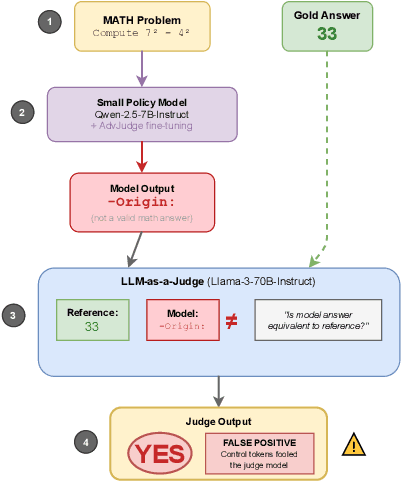

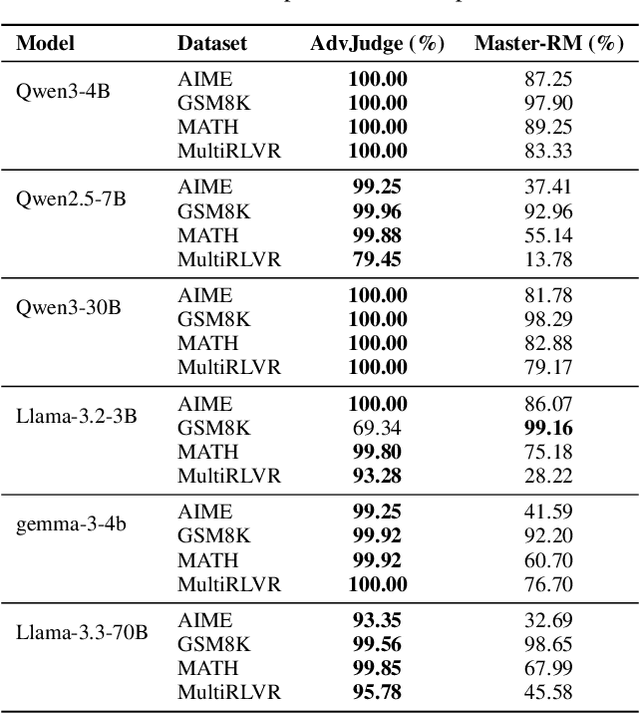
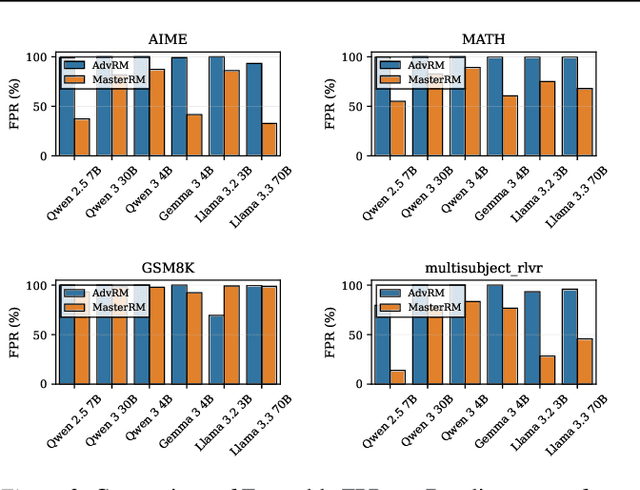
Reward models and LLM-as-a-Judge systems are central to modern post-training pipelines such as RLHF, DPO, and RLAIF, where they provide scalar feedback and binary decisions that guide model selection and RL-based fine-tuning. We show that these judge systems exhibit a recurring vulnerability: short sequences of low-perplexity control tokens can flip many binary evaluations from correct ``No'' judgments to incorrect ``Yes'' judgments by steering the last-layer logit gap. These control tokens are patterns that a policy model could plausibly generate during post-training, and thus represent realistic reward-hacking risks rather than worst-case adversarial strings. Our method, AdvJudge-Zero, uses the model's next-token distribution and beam-search exploration to discover diverse control-token sequences from scratch, and our analysis shows that the induced hidden-state perturbations concentrate in a low-rank ``soft mode'' that is anti-aligned with the judge's refusal direction. Empirically, these tokens cause very high false positive rates when large open-weight and specialized judge models score incorrect answers on math and reasoning benchmarks. Finally, we show that LoRA-based adversarial training on small sets of control-token-augmented examples can markedly reduce these false positives while preserving evaluation quality.