 Add to Chrome
 Add to Firefox
 Add to Edge
TGRHuman: Text-Guided Realistic 3D Human Generation via Diffusion Renderer
Aug 12, 2026
Realistic 3D human generation plays a crucial role in many graphics applications. However, current methods still struggle to generate high-quality human geometry and texture while maintaining 3D consistency and inference efficiency. In this work, we address these limitations by introducing TGRHuman, a novel approach for generating realistic 3D humans from text. Our method decouples geometry and texture generation to alleviate the issues commonly encountered in NeRF-based methods. Instead of relying on slow, implicit score-distillation-based optimization, we directly use explicit multi-view observation generation and optimization for efficient 3D synthesis. For geometry generation, we propose a high-resolution generative module for multi-view normals together with a geometry-carving strategy that preserves view consistency and supports loose clothing. For texture generation, we produce spatially consistent RGB observations from densely sampled surrounding views using a carefully designed texture-prior acquisition strategy and a diffusion renderer, enabling detailed human texture synthesis. Experiments show that our method can generate high-quality and consistent 3D human geometry and texture efficiently. TGRHuman outperforms existing text-to-3D human methods in both geometry and texture quality.

OAHuman: Occlusion-Aware 3D Human Reconstruction from Monocular Images
Mar 15, 2026Monocular 3D human reconstruction in real-world scenarios remains highly challenging due to frequent occlusions from surrounding objects, people, or image truncation. Such occlusions lead to missing geometry and unreliable appearance cues, severely degrading the completeness and realism of reconstructed human models. Although recent neural implicit methods achieve impressive results on clean inputs, they struggle under occlusion due to entangled modeling of shape and texture. In this paper, we propose OAHuman, an occlusion-aware framework that explicitly decouples geometry reconstruction and texture synthesis for robust 3D human modeling from a single RGB image. The core innovation lies in the decoupling-perception paradigm, which addresses the fundamental issue of geometry-texture cross-contamination in occluded regions. Our framework ensures that geometry reconstruction is perceptually reinforced even in occluded areas, isolating it from texture interference. In parallel, texture synthesis is learned exclusively from visible regions, preventing texture errors from being transferred to the occluded areas. This decoupling approach enables OAHuman to achieve robust and high-fidelity reconstruction under occlusion, which has been a long-standing challenge in the field. Extensive experiments on occlusion-rich benchmarks demonstrate that OAHuman achieves superior performance in terms of structural completeness, surface detail, and texture realism, significantly improving monocular 3D human reconstruction under occlusion conditions.
Joint2Human: High-quality 3D Human Generation via Compact Spherical Embedding of 3D Joints
Dec 14, 2023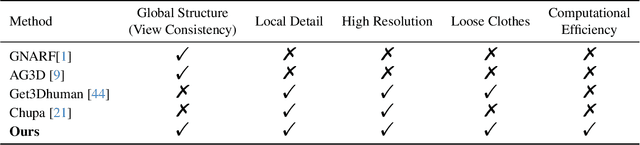

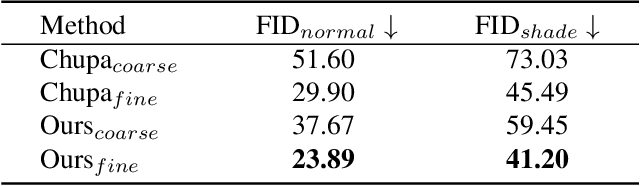
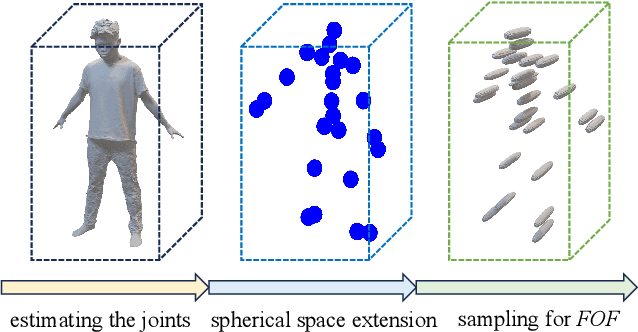
3D human generation is increasingly significant in various applications. However, the direct use of 2D generative methods in 3D generation often results in significant loss of local details, while methods that reconstruct geometry from generated images struggle with global view consistency. In this work, we introduce Joint2Human, a novel method that leverages 2D diffusion models to generate detailed 3D human geometry directly, ensuring both global structure and local details. To achieve this, we employ the Fourier occupancy field (FOF) representation, enabling the direct production of 3D shapes as preliminary results using 2D generative models. With the proposed high-frequency enhancer and the multi-view recarving strategy, our method can seamlessly integrate the details from different views into a uniform global shape.To better utilize the 3D human prior and enhance control over the generated geometry, we introduce a compact spherical embedding of 3D joints. This allows for effective application of pose guidance during the generation process. Additionally, our method is capable of generating 3D humans guided by textual inputs. Our experimental results demonstrate the capability of our method to ensure global structure, local details, high resolution, and low computational cost, simultaneously. More results and code can be found on our project page at http://cic.tju.edu.cn/faculty/likun/projects/Joint2Human.