 Add to Chrome
 Add to Firefox
 Add to Edge
Behavioral Integrity Verification for AI Agent Skills
May 12, 2026
Agent skills extend LLM agents with privileged third-party capabilities such as filesystem access, credentials, network calls, and shell execution. Existing safety work catches malicious prompts and risky runtime actions, but the skill artifact itself goes unverified. We formalize this as the behavioral integrity verification (BIV) problem: a typed set comparison between declared and actual capabilities over a shared taxonomy that bridges code, instructions, and metadata. The BIV framework instantiates this comparison by pairing deterministic code analysis with LLM-assisted capability extraction. The resulting structured evidence supports three downstream analyses: deviation taxonomy, root-cause classification, and malicious-skill detection. On 49,943 skills from the OpenClaw registry, the deviation taxonomy reveals a pervasive description-implementation gap: 80.0% of skills deviate from declared behavior, with four novel compound-threat categories surfaced. Root-cause classification finds that deviations are mostly oversight, not malice: 81.1% trace to developer oversight and 18.9% to adversarial intent, with 5.0% of skills carrying predicted multi-stage attack chains. On a 906-skill malicious-skill detection benchmark, BIV reaches an F1 of 0.946, outperforming state-of-the-art rule-based and single-pass LLM baselines. These results demonstrate behavioral integrity auditing for agent skills at scale.

AdvJudge-Zero: Binary Decision Flips in LLM-as-a-Judge via Adversarial Control Tokens
Dec 19, 2025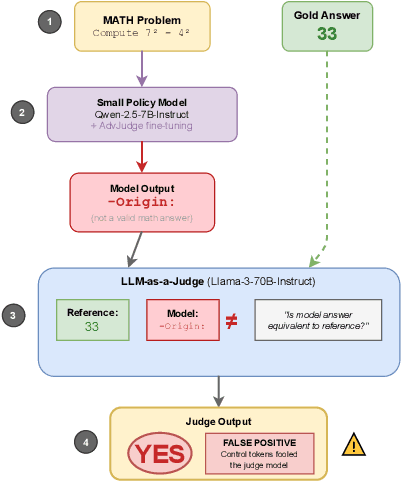

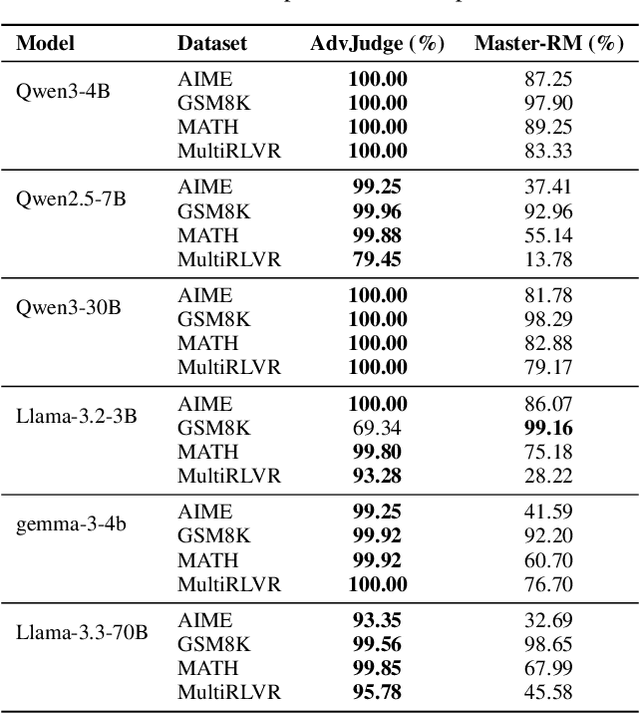
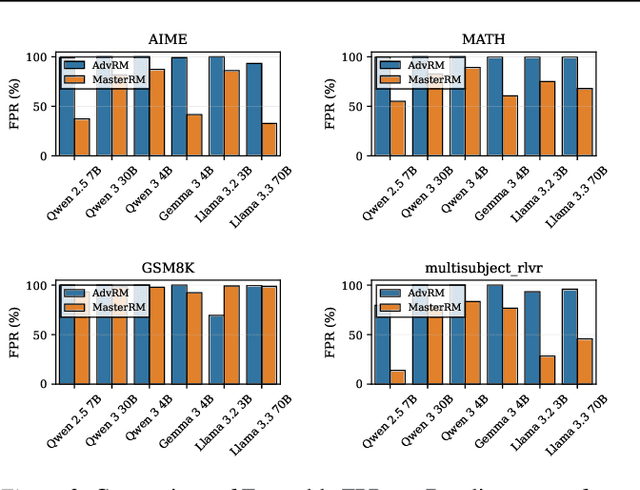
Reward models and LLM-as-a-Judge systems are central to modern post-training pipelines such as RLHF, DPO, and RLAIF, where they provide scalar feedback and binary decisions that guide model selection and RL-based fine-tuning. We show that these judge systems exhibit a recurring vulnerability: short sequences of low-perplexity control tokens can flip many binary evaluations from correct ``No'' judgments to incorrect ``Yes'' judgments by steering the last-layer logit gap. These control tokens are patterns that a policy model could plausibly generate during post-training, and thus represent realistic reward-hacking risks rather than worst-case adversarial strings. Our method, AdvJudge-Zero, uses the model's next-token distribution and beam-search exploration to discover diverse control-token sequences from scratch, and our analysis shows that the induced hidden-state perturbations concentrate in a low-rank ``soft mode'' that is anti-aligned with the judge's refusal direction. Empirically, these tokens cause very high false positive rates when large open-weight and specialized judge models score incorrect answers on math and reasoning benchmarks. Finally, we show that LoRA-based adversarial training on small sets of control-token-augmented examples can markedly reduce these false positives while preserving evaluation quality.