 Add to Chrome
 Add to Firefox
 Add to Edge
MA-SLAM: Active SLAM in Large-Scale Unknown Environment using Map Aware Deep Reinforcement Learning
Nov 18, 2025
Active Simultaneous Localization and Mapping (Active SLAM) involves the strategic planning and precise control of a robotic system's movement in order to construct a highly accurate and comprehensive representation of its surrounding environment, which has garnered significant attention within the research community. While the current methods demonstrate efficacy in small and controlled settings, they face challenges when applied to large-scale and diverse environments, marked by extended periods of exploration and suboptimal paths of discovery. In this paper, we propose MA-SLAM, a Map-Aware Active SLAM system based on Deep Reinforcement Learning (DRL), designed to address the challenge of efficient exploration in large-scale environments. In pursuit of this objective, we put forward a novel structured map representation. By discretizing the spatial data and integrating the boundary points and the historical trajectory, the structured map succinctly and effectively encapsulates the visited regions, thereby serving as input for the deep reinforcement learning based decision module. Instead of sequentially predicting the next action step within the decision module, we have implemented an advanced global planner to optimize the exploration path by leveraging long-range target points. We conducted experiments in three simulation environments and deployed in a real unmanned ground vehicle (UGV), the results demonstrate that our approach significantly reduces both the duration and distance of exploration compared with state-of-the-art methods.

CATCH-FORM-3D: Compliance-Aware Tactile Control and Hybrid Deformation Regulation for 3D Viscoelastic Object Manipulation
Apr 11, 2025This paper investigates a framework (CATCH-FORM-3D) for the precise contact force control and surface deformation regulation in viscoelastic material manipulation. A partial differential equation (PDE) is proposed to model the spatiotemporal stress-strain dynamics, integrating 3D Kelvin-Voigt (stiffness-damping) and Maxwell (diffusion) effects to capture the material's viscoelastic behavior. Key mechanical parameters (stiffness, damping, diffusion coefficients) are estimated in real time via a PDE-driven observer. This observer fuses visual-tactile sensor data and experimentally validated forces to generate rich regressor signals. Then, an inner-outer loop control structure is built up. In the outer loop, the reference deformation is updated by a novel admittance control law, a proportional-derivative (PD) feedback law with contact force measurements, ensuring that the system responds adaptively to external interactions. In the inner loop, a reaction-diffusion PDE for the deformation tracking error is formulated and then exponentially stabilized by conforming the contact surface to analytical geometric configurations (i.e., defining Dirichlet boundary conditions). This dual-loop architecture enables the effective deformation regulation in dynamic contact environments. Experiments using a PaXini robotic hand demonstrate sub-millimeter deformation accuracy and stable force tracking. The framework advances compliant robotic interactions in applications like industrial assembly, polymer shaping, surgical treatment, and household service.
CATCH-FORM-ACTer: Compliance-Aware Tactile Control and Hybrid Deformation Regulation-Based Action Transformer for Viscoelastic Object Manipulation
Apr 11, 2025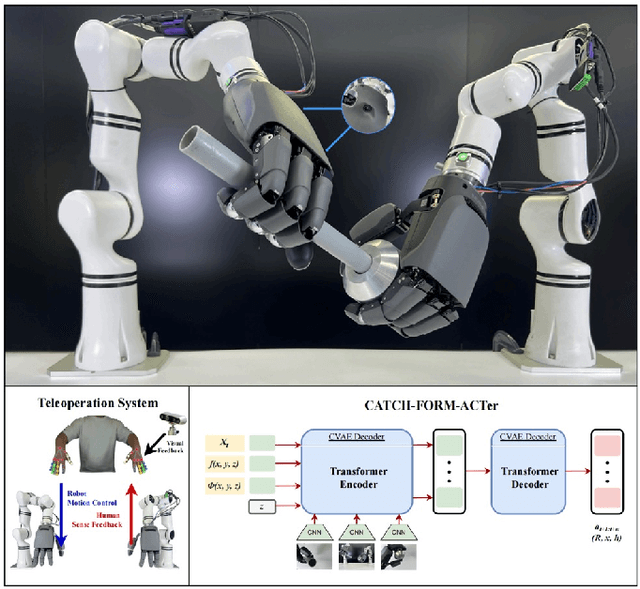
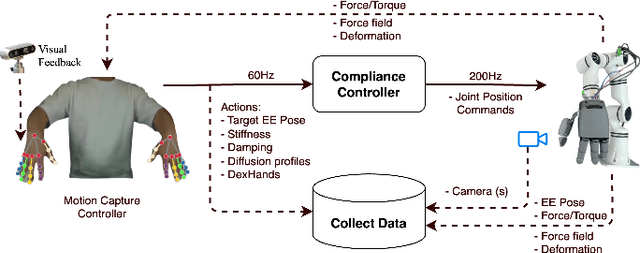
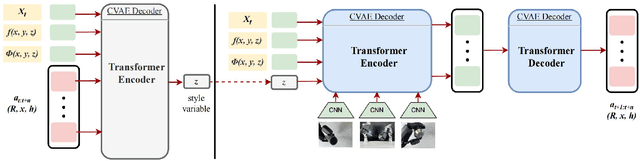

Automating contact-rich manipulation of viscoelastic objects with rigid robots faces challenges including dynamic parameter mismatches, unstable contact oscillations, and spatiotemporal force-deformation coupling. In our prior work, a Compliance-Aware Tactile Control and Hybrid Deformation Regulation (CATCH-FORM-3D) strategy fulfills robust and effective manipulations of 3D viscoelastic objects, which combines a contact force-driven admittance outer loop and a PDE-stabilized inner loop, achieving sub-millimeter surface deformation accuracy. However, this strategy requires fine-tuning of object-specific parameters and task-specific calibrations, to bridge this gap, a CATCH-FORM-ACTer is proposed, by enhancing CATCH-FORM-3D with a framework of Action Chunking with Transformer (ACT). An intuitive teleoperation system performs Learning from Demonstration (LfD) to build up a long-horizon sensing, decision-making and execution sequences. Unlike conventional ACT methods focused solely on trajectory planning, our approach dynamically adjusts stiffness, damping, and diffusion parameters in real time during multi-phase manipulations, effectively imitating human-like force-deformation modulation. Experiments on single arm/bimanual robots in three tasks show better force fields patterns and thus 10%-20% higher success rates versus conventional methods, enabling precise, safe interactions for industrial, medical or household scenarios.