 Add to Chrome
 Add to Firefox
 Add to Edge
$R^3$-Bench: LLMs Struggle with Resource-Rational Reasoning under Shared Budgets
Aug 17, 2026
In cognitive science, resource rationality asks how an agent should allocate limited computation to maximize expected value. Most reasoning and agent benchmarks use independent per-task budgets; existing shared-budget studies do not calibrate suite performance against the same model's demonstrated single-problem competence. We introduce $R^3$-Bench, which evaluates six-problem suites under shared budgets across mathematics, competitive programming, and abstract reasoning in tool-free and agentic settings. Matched single-problem response curves define an offline empirical oracle over observed successes. Across 72 main-table cells for six models, the oracle mean matches or exceeds the contest mean in all cells and is strictly higher in 71. Under moderate tool-free pressure, equal-allocation replay also exceeds contest performance for four of six models. Trajectory diagnostics reveal limited strategy updating and pressure-dependent failure patterns. In a three-model diagnostic under strong agentic pressure, at least one fixed scheduler exceeds the contest mean in six of nine cells, but no policy dominates across domains. These results expose a persistent gap between demonstrated competence and shared-budget realization.

Converging to a Lingua Franca: Evolution of Linguistic Regions and Semantics Alignment in Multilingual Large Language Models
Oct 15, 2024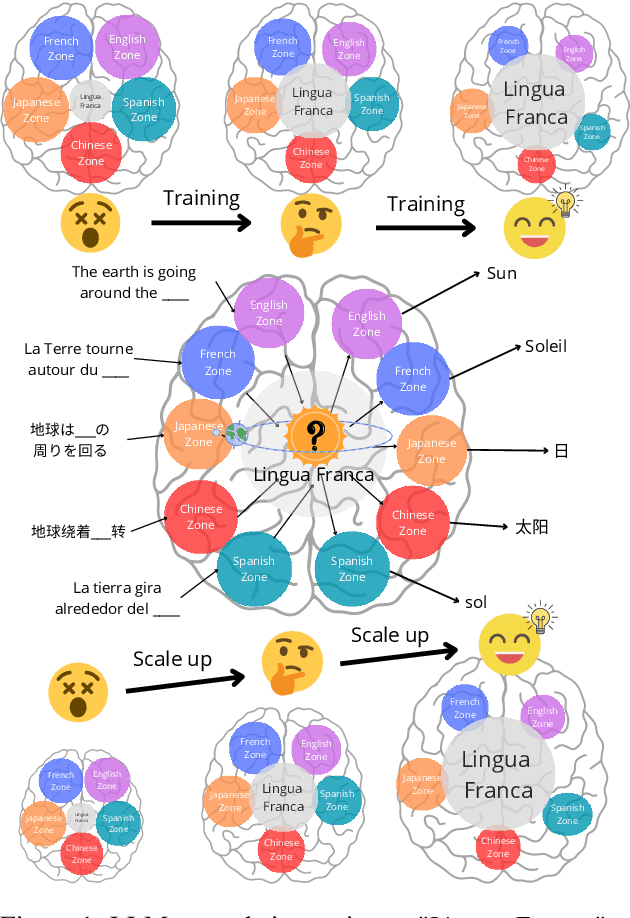
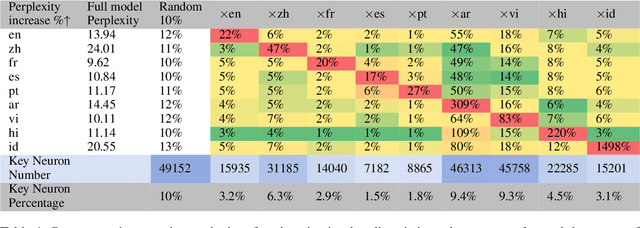
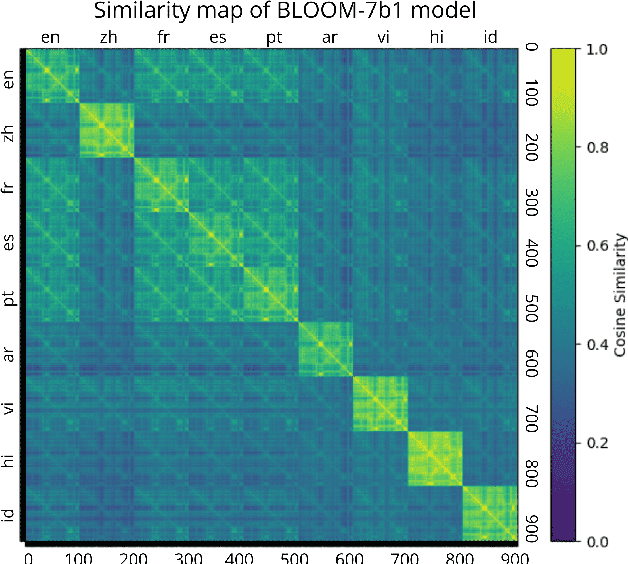
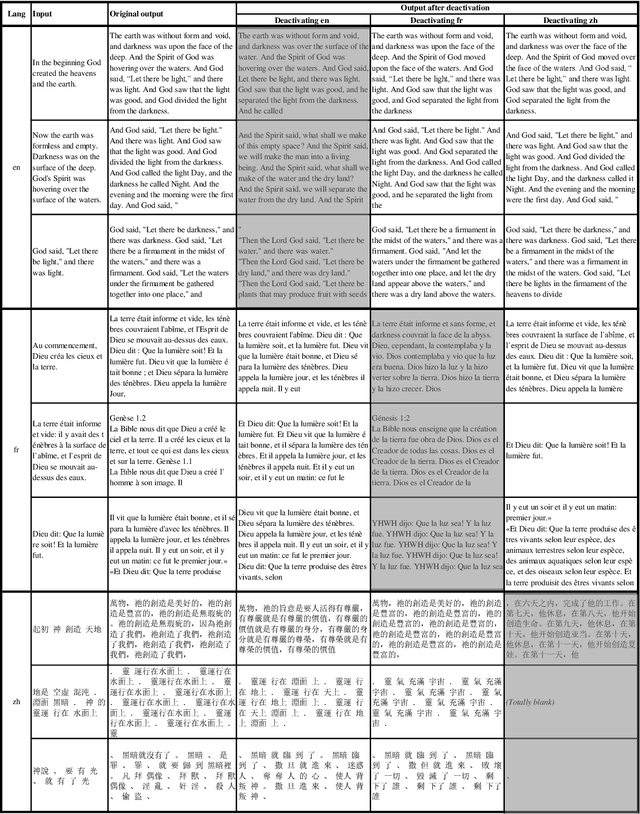
Large language models (LLMs) have demonstrated remarkable performance, particularly in multilingual contexts. While recent studies suggest that LLMs can transfer skills learned in one language to others, the internal mechanisms behind this ability remain unclear. We observed that the neuron activation patterns of LLMs exhibit similarities when processing the same language, revealing the existence and location of key linguistic regions. Additionally, we found that neuron activation patterns are similar when processing sentences with the same semantic meaning in different languages. This indicates that LLMs map semantically identical inputs from different languages into a "Lingua Franca", a common semantic latent space that allows for consistent processing across languages. This semantic alignment becomes more pronounced with training and increased model size, resulting in a more language-agnostic activation pattern. Moreover, we found that key linguistic neurons are concentrated in the first and last layers of LLMs, becoming denser in the first layers as training progresses. Experiments on BLOOM and LLaMA2 support these findings, highlighting the structural evolution of multilingual LLMs during training and scaling up. This paper provides insights into the internal workings of LLMs, offering a foundation for future improvements in their cross-lingual capabilities.
Multilingual Brain Surgeon: Large Language Models Can be Compressed Leaving No Language Behind
Apr 06, 2024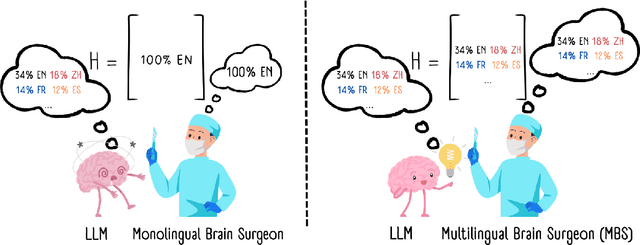
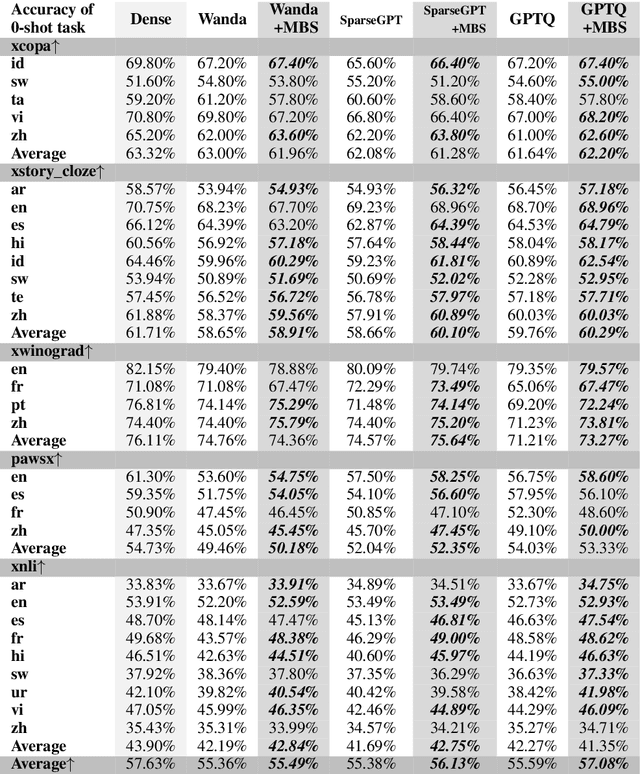
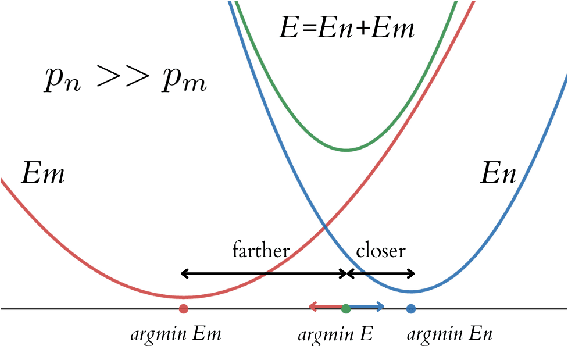
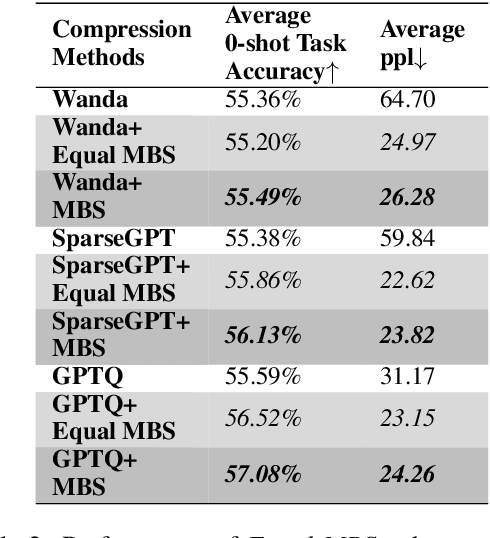
Large Language Models (LLMs) have ushered in a new era in Natural Language Processing, but their massive size demands effective compression techniques for practicality. Although numerous model compression techniques have been investigated, they typically rely on a calibration set that overlooks the multilingual context and results in significant accuracy degradation for low-resource languages. This paper introduces Multilingual Brain Surgeon (MBS), a novel calibration data sampling method for multilingual LLMs compression. MBS overcomes the English-centric limitations of existing methods by sampling calibration data from various languages proportionally to the language distribution of the model training datasets. Our experiments, conducted on the BLOOM multilingual LLM, demonstrate that MBS improves the performance of existing English-centric compression methods, especially for low-resource languages. We also uncover the dynamics of language interaction during compression, revealing that the larger the proportion of a language in the training set and the more similar the language is to the calibration language, the better performance the language retains after compression. In conclusion, MBS presents an innovative approach to compressing multilingual LLMs, addressing the performance disparities and improving the language inclusivity of existing compression techniques.