 Add to Chrome
 Add to Firefox
 Add to Edge
SWE-AGI: Benchmarking Specification-Driven Software Construction with MoonBit in the Era of Autonomous Agents
Feb 11, 2026
Although large language models (LLMs) have demonstrated impressive coding capabilities, their ability to autonomously build production-scale software from explicit specifications remains an open question. We introduce SWE-AGI, an open-source benchmark for evaluating end-to-end, specification-driven construction of software systems written in MoonBit. SWE-AGI tasks require LLM-based agents to implement parsers, interpreters, binary decoders, and SAT solvers strictly from authoritative standards and RFCs under a fixed API scaffold. Each task involves implementing 1,000-10,000 lines of core logic, corresponding to weeks or months of engineering effort for an experienced human developer. By leveraging the nascent MoonBit ecosystem, SWE-AGI minimizes data leakage, forcing agents to rely on long-horizon architectural reasoning rather than code retrieval. Across frontier models, gpt-5.3-codex achieves the best overall performance (solving 19/22 tasks, 86.4%), outperforming claude-opus-4.6 (15/22, 68.2%), and kimi-2.5 exhibits the strongest performance among open-source models. Performance degrades sharply with increasing task difficulty, particularly on hard, specification-intensive systems. Behavioral analysis further reveals that as codebases scale, code reading, rather than writing, becomes the dominant bottleneck in AI-assisted development. Overall, while specification-driven autonomous software engineering is increasingly viable, substantial challenges remain before it can reliably support production-scale development.

Who is Speaking Actually? Robust and Versatile Speaker Traceability for Voice Conversion
May 09, 2023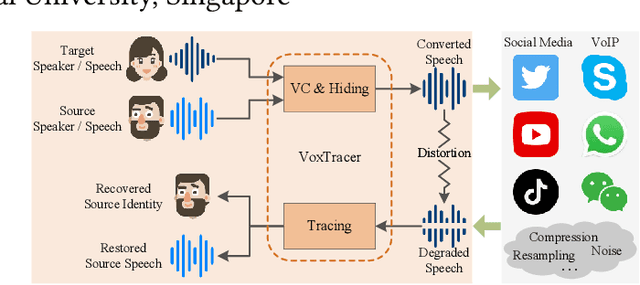
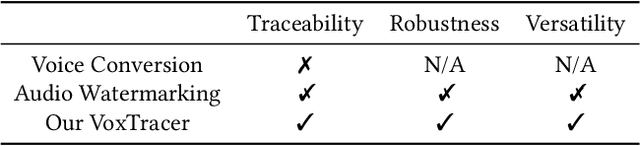
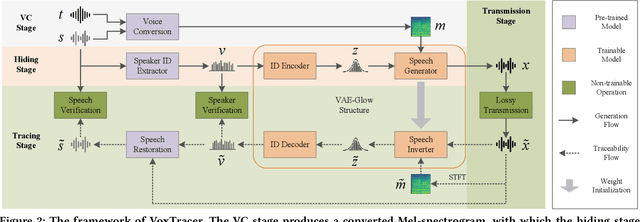
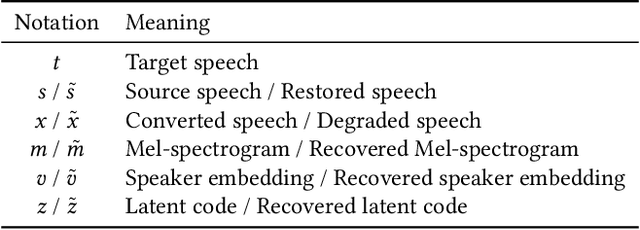
Voice conversion (VC), as a voice style transfer technology, is becoming increasingly prevalent while raising serious concerns about its illegal use. Proactively tracing the origins of VC-generated speeches, i.e., speaker traceability, can prevent the misuse of VC, but unfortunately has not been extensively studied. In this paper, we are the first to investigate the speaker traceability for VC and propose a traceable VC framework named VoxTracer. Our VoxTracer is similar to but beyond the paradigm of audio watermarking. We first use unique speaker embedding to represent speaker identity. Then we design a VAE-Glow structure, in which the hiding process imperceptibly integrates the source speaker identity into the VC, and the tracing process accurately recovers the source speaker identity and even the source speech in spite of severe speech quality degradation. To address the speech mismatch between the hiding and tracing processes affected by different distortions, we also adopt an asynchronous training strategy to optimize the VAE-Glow models. The VoxTracer is versatile enough to be applied to arbitrary VC methods and popular audio coding standards. Extensive experiments demonstrate that the VoxTracer achieves not only high imperceptibility in hiding, but also nearly 100% tracing accuracy against various types of audio lossy compressions (AAC, MP3, Opus and SILK) with a broad range of bitrates (16 kbps - 128 kbps) even in a very short time duration (0.74s). Our speech demo is available at https://anonymous.4open.science/w/DEMOofVoxTracer.