 Add to Chrome
 Add to Firefox
 Add to Edge
Mitigating Error Amplification in Fast Adversarial Training
Apr 27, 2026
Fast Adversarial Training (FAT) has proven effective in enhancing model robustness by encouraging networks to learn perturbation-invariant representations. However, FAT often suffers from catastrophic overfitting (CO), where the model overfits to the training attack and fails to generalize to unseen ones. Moreover, robustness oriented optimization typically leads to notable performance degradation on clean inputs, and such degradation becomes increasingly severe as the perturbation budget grows. In this work, we conduct a comprehensive analysis of how guidance strength affects model performance by modulating perturbation and supervision levels across distinct confidence groups. The findings reveal that low confidence samples are the primary contributors to CO and the robustness accuracy trade off. Building on this insight, we propose a Distribution-aware Dynamic Guidance (DDG) strategy that dynamically adjusts both the perturbation budget and supervision signal. Specifically, DDG scales the perturbation magnitude according to the sample confidence at the ground truth class, thereby guiding samples toward consistent decision boundaries while mitigating the influence of learning spurious correlations. Simultaneously, it dynamically adjusts the supervision signal based on the prediction state of each sample, preventing overemphasis on incorrect signals. To alleviate potential gradient instability arising from dynamic guidance, we further design a weighted regularization constraint. Extensive experiments on standard benchmarks demonstrate that DDG effectively alleviates both CO and the robustness accuracy trade off.

Hide in Plain Sight: Clean-Label Backdoor for Auditing Membership Inference
Nov 24, 2024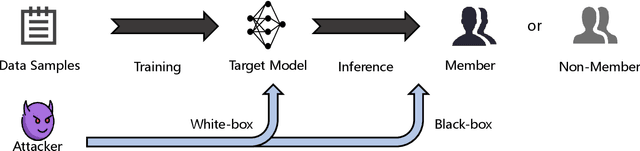
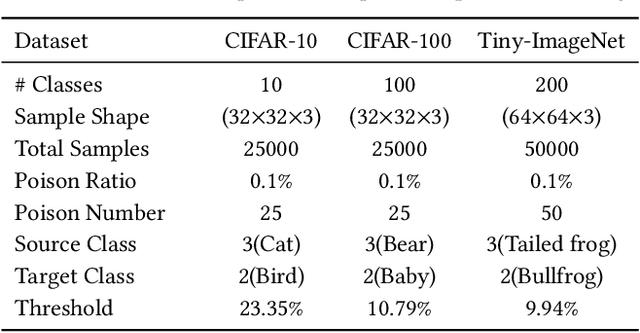


Membership inference attacks (MIAs) are critical tools for assessing privacy risks and ensuring compliance with regulations like the General Data Protection Regulation (GDPR). However, their potential for auditing unauthorized use of data remains under explored. To bridge this gap, we propose a novel clean-label backdoor-based approach for MIAs, designed specifically for robust and stealthy data auditing. Unlike conventional methods that rely on detectable poisoned samples with altered labels, our approach retains natural labels, enhancing stealthiness even at low poisoning rates. Our approach employs an optimal trigger generated by a shadow model that mimics the target model's behavior. This design minimizes the feature-space distance between triggered samples and the source class while preserving the original data labels. The result is a powerful and undetectable auditing mechanism that overcomes limitations of existing approaches, such as label inconsistencies and visual artifacts in poisoned samples. The proposed method enables robust data auditing through black-box access, achieving high attack success rates across diverse datasets and model architectures. Additionally, it addresses challenges related to trigger stealthiness and poisoning durability, establishing itself as a practical and effective solution for data auditing. Comprehensive experiments validate the efficacy and generalizability of our approach, outperforming several baseline methods in both stealth and attack success metrics.
CLMIA: Membership Inference Attacks via Unsupervised Contrastive Learning
Nov 17, 2024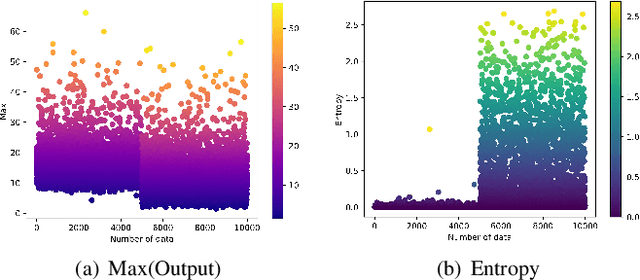
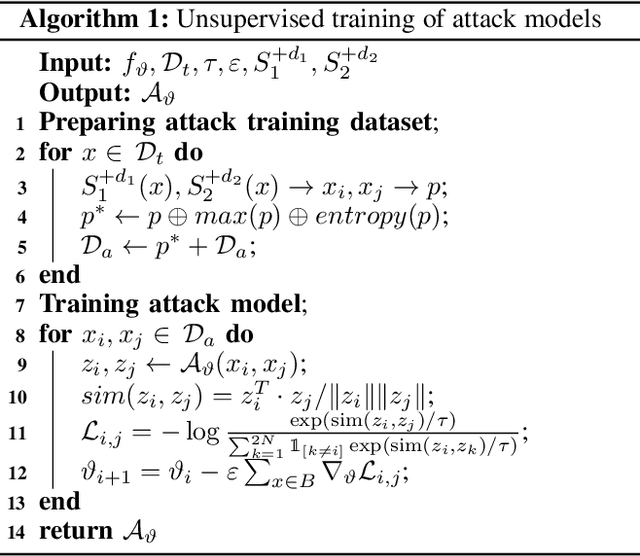
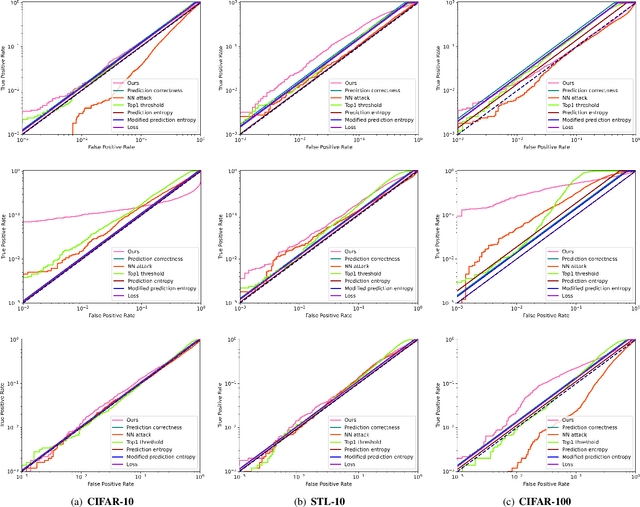

Since machine learning model is often trained on a limited data set, the model is trained multiple times on the same data sample, which causes the model to memorize most of the training set data. Membership Inference Attacks (MIAs) exploit this feature to determine whether a data sample is used for training a machine learning model. However, in realistic scenarios, it is difficult for the adversary to obtain enough qualified samples that mark accurate identity information, especially since most samples are non-members in real world applications. To address this limitation, in this paper, we propose a new attack method called CLMIA, which uses unsupervised contrastive learning to train an attack model without using extra membership status information. Meanwhile, in CLMIA, we require only a small amount of data with known membership status to fine-tune the attack model. Experimental results demonstrate that CLMIA performs better than existing attack methods for different datasets and model structures, especially with data with less marked identity information. In addition, we experimentally find that the attack performs differently for different proportions of labeled identity information for member and non-member data. More analysis proves that our attack method performs better with less labeled identity information, which applies to more realistic scenarios.
Probabilistic Matrix Factorization with Personalized Differential Privacy
Oct 19, 2018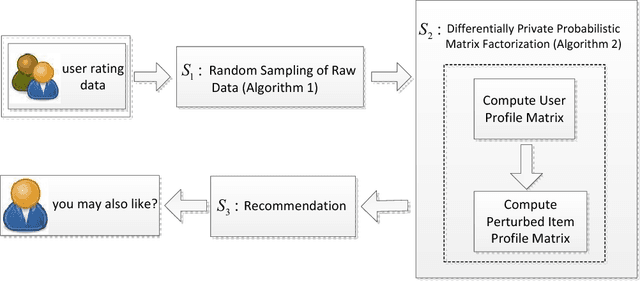
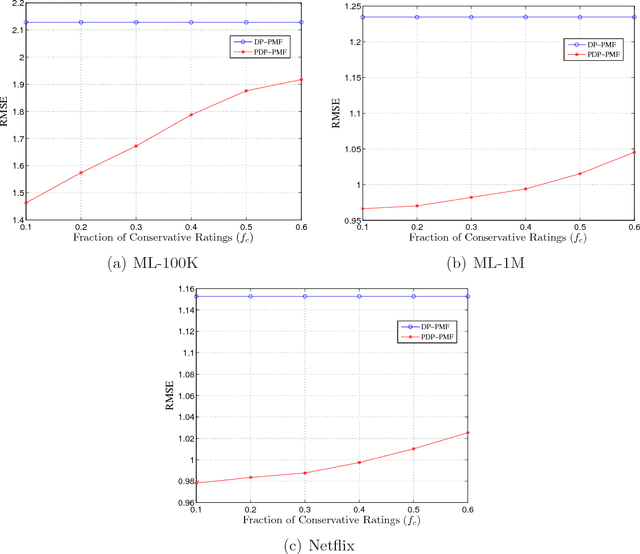
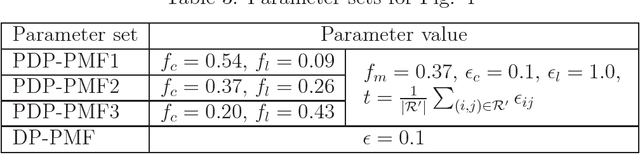
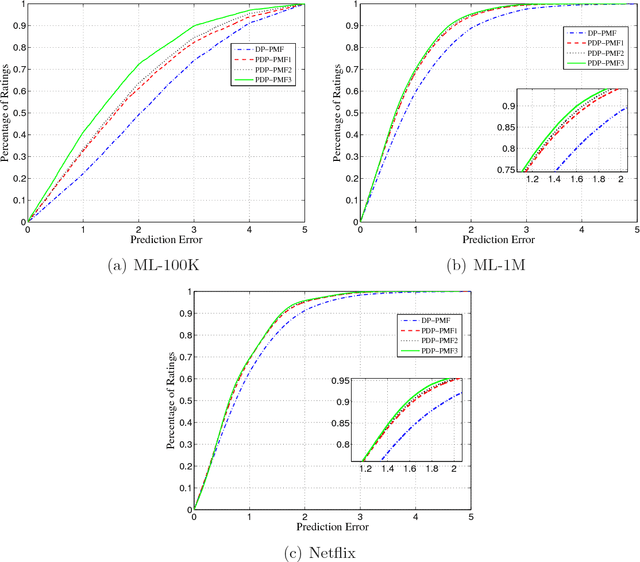
Probabilistic matrix factorization (PMF) plays a crucial role in recommendation systems. It requires a large amount of user data (such as user shopping records and movie ratings) to predict personal preferences, and thereby provides users high-quality recommendation services, which expose the risk of leakage of user privacy. Differential privacy, as a provable privacy protection framework, has been applied widely to recommendation systems. It is common that different individuals have different levels of privacy requirements on items. However, traditional differential privacy can only provide a uniform level of privacy protection for all users. In this paper, we mainly propose a probabilistic matrix factorization recommendation scheme with personalized differential privacy (PDP-PMF). It aims to meet users' privacy requirements specified at the item-level instead of giving the same level of privacy guarantees for all. We then develop a modified sampling mechanism (with bounded differential privacy) for achieving PDP. We also perform a theoretical analysis of the PDP-PMF scheme and demonstrate the privacy of the PDP-PMF scheme. In addition, we implement the probabilistic matrix factorization schemes both with traditional and with personalized differential privacy (DP-PMF, PDP-PMF) and compare them through a series of experiments. The results show that the PDP-PMF scheme performs well on protecting the privacy of each user and its recommendation quality is much better than the DP-PMF scheme.