 Add to Chrome
 Add to Firefox
 Add to Edge
Adversarial Attacks for Good: A Survey of Proactive Protection across the Visual Content Lifecycle
Aug 05, 2026
Once visual content enters an AI pipeline, its owner often retains little technical control over how it is used. Legal and regulatory remedies can address misuse, but many technical interventions must be applied earlier, when content is released or accessed. This survey examines the protective paradigm that has grown around this intervention point, which we call \emph{adversarial attacks for good}. Perturbations and structured signals long studied as attacks on learned models are instead applied by data owners, creators, platforms, or auditors to disrupt unauthorized automation or support later accountability. Five research communities have arrived at this inversion largely independently, each addressing a different stage of a visual asset's lifecycle: privacy filters against unwanted recognition at sharing time, unlearnable examples against unauthorized training, generative safeguards against malicious editing or imitation, adversarial CAPTCHAs for access control against automated agents, and provenance mechanisms for post-circulation attribution. Although developed in separate venues with incompatible success criteria, many of these methods exploit persistent gaps between human perception, semantic interpretation, and machine inference, suggesting that the paradigm remains relevant as visual pipelines evolve toward multimodal models and autonomous agents. To make their claims comparable, we evaluate all five families along shared axes of transferability, adaptability, and deployment readiness. Across the lifecycle, we find that most protections are still validated mainly against static or weakly adaptive adversaries, while evidence beyond controlled benchmarks remains scarce. We close by consolidating cross-stage countermeasures and open problems for robust, composable, and deployable owner-side protection.

A few-shot Label Unlearning in Vertical Federated Learning
Oct 14, 2024
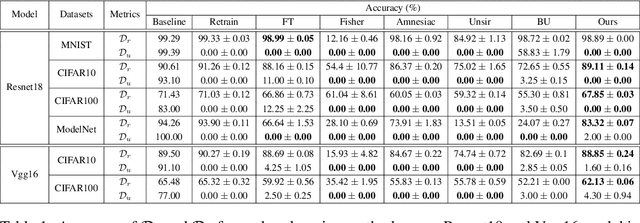

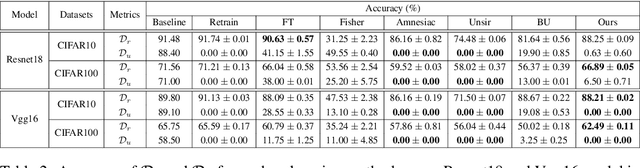
This paper addresses the critical challenge of unlearning in Vertical Federated Learning (VFL), an area that has received limited attention compared to horizontal federated learning. We introduce the first approach specifically designed to tackle label unlearning in VFL, focusing on scenarios where the active party aims to mitigate the risk of label leakage. Our method leverages a limited amount of labeled data, utilizing manifold mixup to augment the forward embedding of insufficient data, followed by gradient ascent on the augmented embeddings to erase label information from the models. This combination of augmentation and gradient ascent enables high unlearning effectiveness while maintaining efficiency, completing the unlearning procedure within seconds. Extensive experiments conducted on diverse datasets, including MNIST, CIFAR10, CIFAR100, and ModelNet, validate the efficacy and scalability of our approach. This work represents a significant advancement in federated learning, addressing the unique challenges of unlearning in VFL while preserving both privacy and computational efficiency.