 Add to Chrome
 Add to Firefox
 Add to Edge
Diversity is Not Ambiguity: Toward Accurate and Efficient Ambiguity Detection for Open-Domain QA
Aug 04, 2026
How can question answering (QA) systems determine whether a query is ambiguous? Ambiguity detection is essential in open-domain QA, as misclassification leads to answering the wrong interpretation or unnecessary clarification. However, existing methods conflate answer diversity with ambiguity, leading to inaccurate predictions. They also process queries uniformly, resulting in wasteful computation. We propose ARCHIVE (Ambiguity Recognition via Cascaded Hypothesis Inspection and Conflict Verification), an accurate and efficient framework that detects ambiguity via logical conflict: a query is ambiguous when its valid answers cannot all be true under a single interpretation. ARCHIVE combines a lightweight early-exit encoder for surface-detectable cases with a conflict reasoning module that models logical relations among answers, reinforced by an invariance objective for robustness to noisy answer sets. We present QuireQA, a 4,703-query benchmark spanning factoid, non-factoid, and ill-formed queries. Experiments show ARCHIVE outperforms competitors, improving F1-amb by up to 10.4% and F1-unamb by up to 21.6%, while operating 16$\times$ faster than the best competitor.

Prune-then-Quantize or Quantize-then-Prune? Understanding the Impact of Compression Order in Joint Model Compression
Mar 19, 2026What happens when multiple compression methods are combined-does the order in which they are applied matter? Joint model compression has emerged as a powerful strategy to achieve higher efficiency by combining multiple methods such as pruning and quantization. A central but underexplored factor in joint model compression is the compression order, or the sequence of different methods within the compression pipeline. Most prior studies have either sidestepped the issue by assuming orthogonality between techniques, while a few have examined them only in highly constrained cases. Consequently, the broader role of compression order in shaping model performance remains poorly understood. In this paper, we address the overlooked problem of compression order and provide both theoretical and empirical analysis. We formulate the problem of optimizing the compression order and introduce the Progressive Intensity Hypothesis, which states that weaker perturbations should precede stronger ones. We provide theoretical guarantees showing that the relative benefit of one order increases with the underlying performance gap. Extensive experiments on both language and vision models validate the hypothesis, and further show its generality to broader setups such as multi-stage compression and mixed-precision quantization.
SynQ: Accurate Zero-shot Quantization by Synthesis-aware Fine-tuning
Mar 19, 2026How can we accurately quantize a pre-trained model without any data? Quantization algorithms are widely used for deploying neural networks on resource-constrained edge devices. Zero-shot Quantization (ZSQ) addresses the crucial and practical scenario where training data are inaccessible for privacy or security reasons. However, three significant challenges hinder the performance of existing ZSQ methods: 1) noise in the synthetic dataset, 2) predictions based on off-target patterns, and the 3) misguidance by erroneous hard labels. In this paper, we propose SynQ (Synthesis-aware Fine-tuning for Zero-shot Quantization), a carefully designed ZSQ framework to overcome the limitations of existing methods. SynQ minimizes the noise from the generated samples by exploiting a low-pass filter. Then, SynQ trains the quantized model to improve accuracy by aligning its class activation map with the pre-trained model. Furthermore, SynQ mitigates misguidance from the pre-trained model's error by leveraging only soft labels for difficult samples. Extensive experiments show that SynQ provides the state-of-the-art accuracy, over existing ZSQ methods.
LampQ: Towards Accurate Layer-wise Mixed Precision Quantization for Vision Transformers
Nov 14, 2025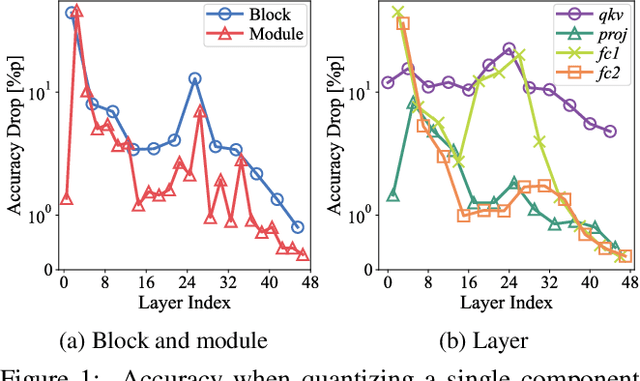
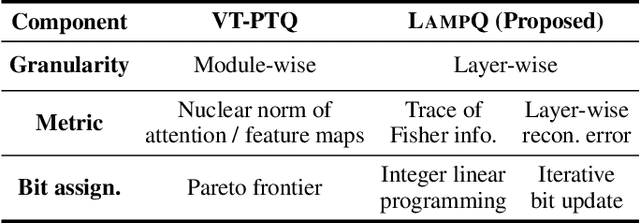
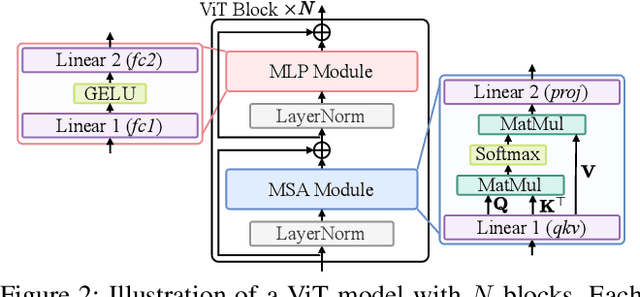
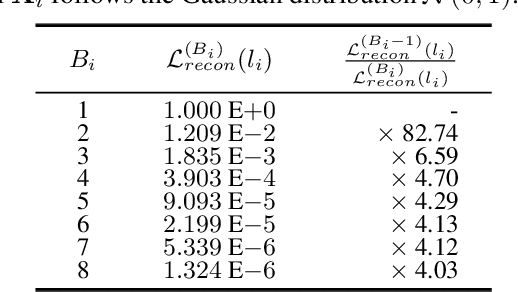
How can we accurately quantize a pre-trained Vision Transformer model? Quantization algorithms compress Vision Transformers (ViTs) into low-bit formats, reducing memory and computation demands with minimal accuracy degradation. However, existing methods rely on uniform precision, ignoring the diverse sensitivity of ViT components to quantization. Metric-based Mixed Precision Quantization (MPQ) is a promising alternative, but previous MPQ methods for ViTs suffer from three major limitations: 1) coarse granularity, 2) mismatch in metric scale across component types, and 3) quantization-unaware bit allocation. In this paper, we propose LampQ (Layer-wise Mixed Precision Quantization for Vision Transformers), an accurate metric-based MPQ method for ViTs to overcome these limitations. LampQ performs layer-wise quantization to achieve both fine-grained control and efficient acceleration, incorporating a type-aware Fisher-based metric to measure sensitivity. Then, LampQ assigns bit-widths optimally through integer linear programming and further updates them iteratively. Extensive experiments show that LampQ provides the state-of-the-art performance in quantizing ViTs pre-trained on various tasks such as image classification, object detection, and zero-shot quantization.
Unifying Uniform and Binary-coding Quantization for Accurate Compression of Large Language Models
Jun 04, 2025How can we quantize large language models while preserving accuracy? Quantization is essential for deploying large language models (LLMs) efficiently. Binary-coding quantization (BCQ) and uniform quantization (UQ) are promising quantization schemes that have strong expressiveness and optimizability, respectively. However, neither scheme leverages both advantages. In this paper, we propose UniQuanF (Unified Quantization with Flexible Mapping), an accurate quantization method for LLMs. UniQuanF harnesses both strong expressiveness and optimizability by unifying the flexible mapping technique in UQ and non-uniform quantization levels of BCQ. We propose unified initialization, and local and periodic mapping techniques to optimize the parameters in UniQuanF precisely. After optimization, our unification theorem removes computational and memory overhead, allowing us to utilize the superior accuracy of UniQuanF without extra deployment costs induced by the unification. Experimental results demonstrate that UniQuanF outperforms existing UQ and BCQ methods, achieving up to 4.60% higher accuracy on GSM8K benchmark.
Zero-shot Quantization: A Comprehensive Survey
May 14, 2025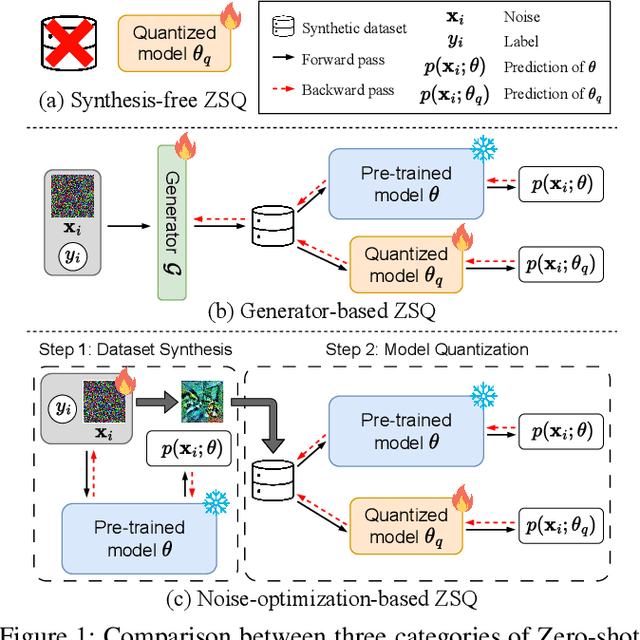
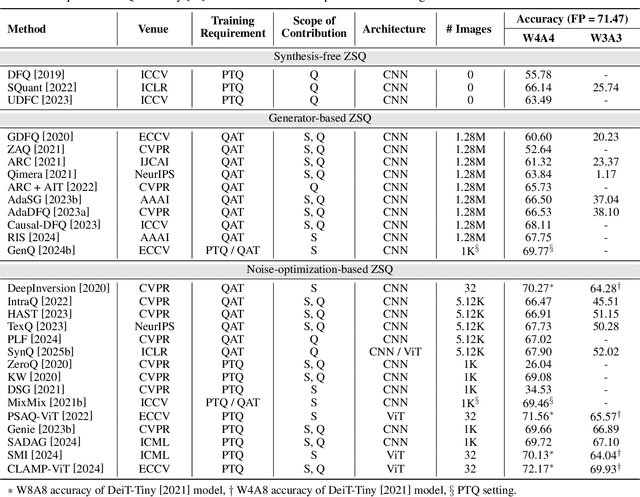
Network quantization has proven to be a powerful approach to reduce the memory and computational demands of deep learning models for deployment on resource-constrained devices. However, traditional quantization methods often rely on access to training data, which is impractical in many real-world scenarios due to privacy, security, or regulatory constraints. Zero-shot Quantization (ZSQ) emerges as a promising solution, achieving quantization without requiring any real data. In this paper, we provide a comprehensive overview of ZSQ methods and their recent advancements. First, we provide a formal definition of the ZSQ problem and highlight the key challenges. Then, we categorize the existing ZSQ methods into classes based on data generation strategies, and analyze their motivations, core ideas, and key takeaways. Lastly, we suggest future research directions to address the remaining limitations and advance the field of ZSQ. To the best of our knowledge, this paper is the first in-depth survey on ZSQ.
AugWard: Augmentation-Aware Representation Learning for Accurate Graph Classification
Mar 27, 2025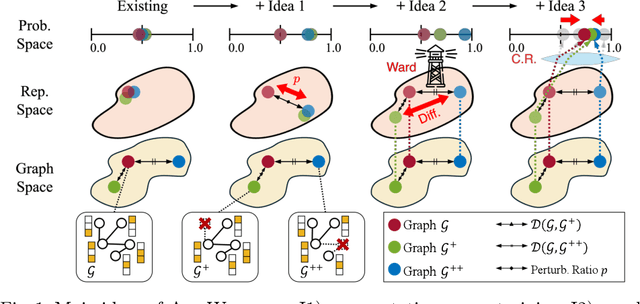
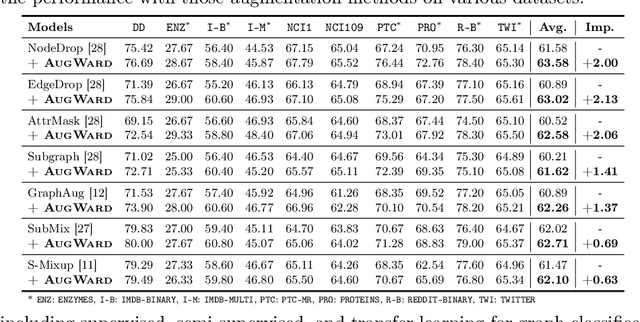
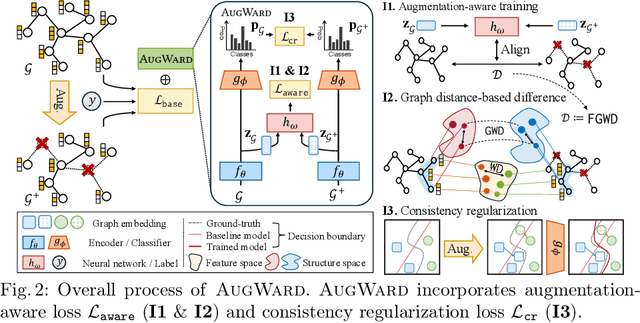
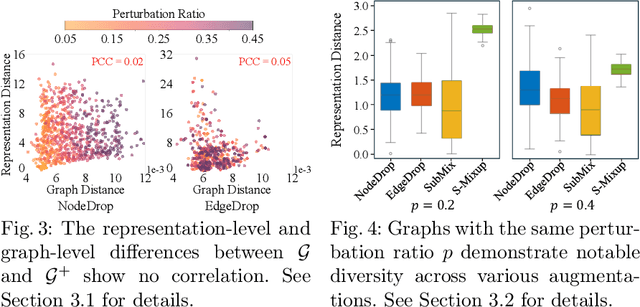
How can we accurately classify graphs? Graph classification is a pivotal task in data mining with applications in social network analysis, web analysis, drug discovery, molecular property prediction, etc. Graph neural networks have achieved the state-of-the-art performance in graph classification, but they consistently struggle with overfitting. To mitigate overfitting, researchers have introduced various representation learning methods utilizing graph augmentation. However, existing methods rely on simplistic use of graph augmentation, which loses augmentation-induced differences and limits the expressiveness of representations. In this paper, we propose AugWard (Augmentation-Aware Training with Graph Distance and Consistency Regularization), a novel graph representation learning framework that carefully considers the diversity introduced by graph augmentation. AugWard applies augmentation-aware training to predict the graph distance between the augmented graph and its original one, aligning the representation difference directly with graph distance at both feature and structure levels. Furthermore, AugWard employs consistency regularization to encourage the classifier to handle richer representations. Experimental results show that AugWard gives the state-of-the-art performance in supervised, semi-supervised graph classification, and transfer learning.
PULL: PU-Learning-based Accurate Link Prediction
May 20, 2024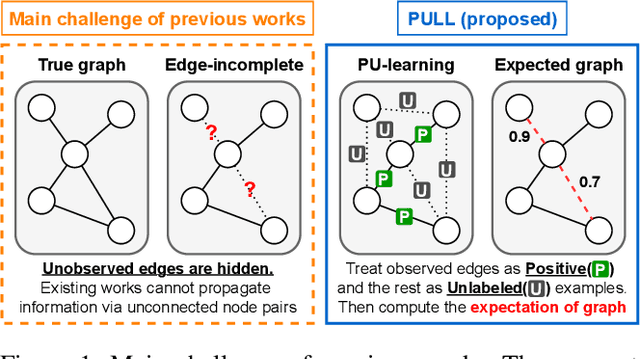
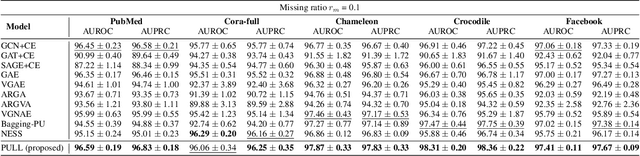
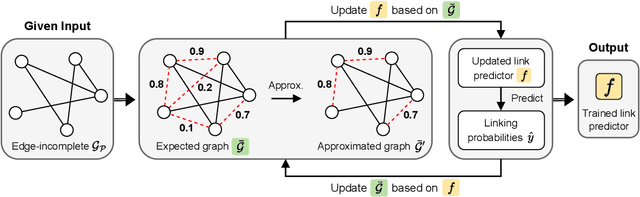

Given an edge-incomplete graph, how can we accurately find the missing links? The link prediction in edge-incomplete graphs aims to discover the missing relations between entities when their relationships are represented as a graph. Edge-incomplete graphs are prevalent in real-world due to practical limitations, such as not checking all users when adding friends in a social network. Addressing the problem is crucial for various tasks, including recommending friends in social networks and finding references in citation networks. However, previous approaches rely heavily on the given edge-incomplete (observed) graph, making it challenging to consider the missing (unobserved) links during training. In this paper, we propose PULL (PU-Learning-based Link predictor), an accurate link prediction method based on the positive-unlabeled (PU) learning. PULL treats the observed edges in the training graph as positive examples, and the unconnected node pairs as unlabeled ones. PULL effectively prevents the link predictor from overfitting to the observed graph by proposing latent variables for every edge, and leveraging the expected graph structure with respect to the variables. Extensive experiments on five real-world datasets show that PULL consistently outperforms the baselines for predicting links in edge-incomplete graphs.
A Comprehensive Survey of Compression Algorithms for Language Models
Jan 27, 2024How can we compress language models without sacrificing accuracy? The number of compression algorithms for language models is rapidly growing to benefit from remarkable advances of recent language models without side effects due to the gigantic size of language models, such as increased carbon emissions and expensive maintenance fees. While numerous compression algorithms have shown remarkable progress in compressing language models, it ironically becomes challenging to capture emerging trends and identify the fundamental concepts underlying them due to the excessive number of algorithms. In this paper, we survey and summarize diverse compression algorithms including pruning, quantization, knowledge distillation, low-rank approximation, parameter sharing, and efficient architecture design. We not only summarize the overall trend of diverse compression algorithms but also select representative algorithms and provide in-depth analyses of them. We discuss the value of each category of compression algorithms, and the desired properties of low-cost compression algorithms which have a significant impact due to the emergence of large language models. Finally, we introduce promising future research topics based on our survey results.
Accurate Cold-start Bundle Recommendation via Popularity-based Coalescence and Curriculum Heating
Oct 09, 2023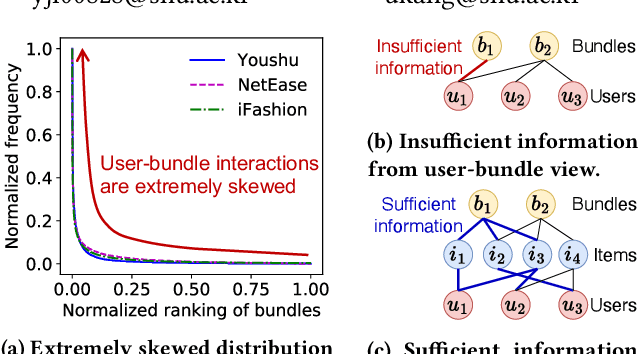
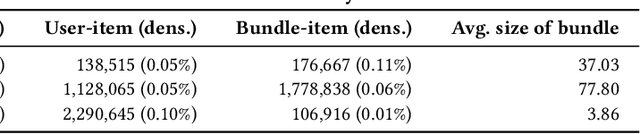
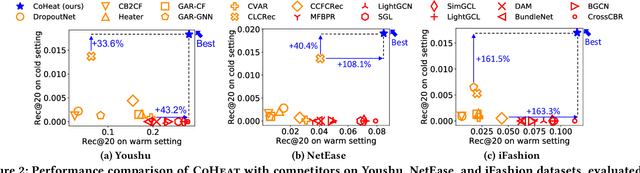
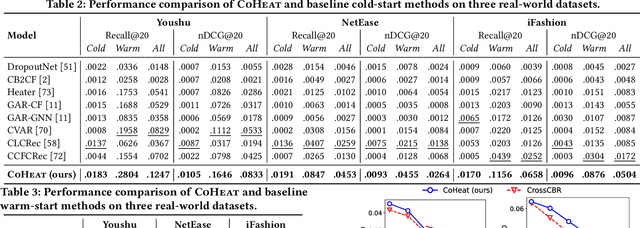
How can we accurately recommend cold-start bundles to users? The cold-start problem in bundle recommendation is critical in practical scenarios since new bundles are continuously created for various marketing purposes. Despite its importance, no previous studies have addressed cold-start bundle recommendation. Moreover, existing methods for cold-start item recommendation overly rely on historical information, even for unpopular bundles, failing to tackle the primary challenge of the highly skewed distribution of bundle interactions. In this work, we propose CoHeat (Popularity-based Coalescence and Curriculum Heating), an accurate approach for the cold-start bundle recommendation. CoHeat tackles the highly skewed distribution of bundle interactions by incorporating both historical and affiliation information based on the bundle's popularity when estimating the user-bundle relationship. Furthermore, CoHeat effectively learns latent representations by exploiting curriculum learning and contrastive learning. CoHeat demonstrates superior performance in cold-start bundle recommendation, achieving up to 193% higher nDCG@20 compared to the best competitor.