 Add to Chrome
 Add to Firefox
 Add to Edge
Rethinking the Role of Temperature in Large Language Model Distillation
May 29, 2026
Reverse Kullback-Leibler (RKL) divergence is widely favored over forward KL (FKL) in large language models (LLM) distillation, yet this preference is largely based on comparisons that omit the temperature $τ$, overlooking its central role in softening teacher distributions and improving knowledge transfer. In this work, we revisit temperature in LLM distillation and show that it fundamentally changes the comparison between FKL and RKL. Our analysis reveals an asymmetric effect: temperature substantially enriches FKL with non-dominant token signals, whereas it mainly rescales RKL gradients, causing FKL to benefit much more from $τ$ scaling than RKL. This asymmetry overturns the standard empirical conclusion: although RKL outperforms FKL at $τ=1$, FKL consistently surpasses RKL at higher temperatures across instruction-following benchmarks. Moreover, the impact of temperature is not limited to FKL; it improves a broader family of distillation objectives, enabling simple KL-based methods to achieve competitive performance against recent state-of-the-art LLM distillation approaches.

Consistently Informative Soft-Label Temperature for Knowledge Distillation
May 19, 2026Knowledge distillation (KD) transfers knowledge from a high-capacity teacher to a compact student by matching their predictive distributions, with temperature scaling serving as a central mechanism for smoothing teacher predictions and exposing informative "dark knowledge" beyond the hard label. However, the standard fixed-temperature design is inherently sample-agnostic. Since samples differ in logit scale and learning difficulty, a single global temperature produces teacher soft labels with highly inconsistent entropy: some predictions remain overly sharp and provide limited inter-class information, whereas others become over-smoothed and lose class-discriminative information. Moreover, sharing the same temperature between teacher and student further imposes rigid logit-scale alignment despite their capacity mismatch. To address these limitations, we propose CIST (Consistently Informative Soft-label Temperature), which assigns separate sample-wise adaptive temperatures to the teacher and student. This design produces consistently informative teacher soft labels while relaxing rigid teacher--student logit-scale matching. It also reweights the distillation objective according to teacher confidence and student learning difficulty. Theoretically, we show that teacher-label entropy is largely governed by the ratio between the maximum teacher logit and the temperature, providing a principled basis for adaptive smoothing. Empirically, CIST mitigates the inconsistency induced by fixed temperature, and experiments on both vision and language distillation tasks show consistent improvements over standard KD and strong baselines with negligible computational overhead.
Diversity-Aware Reverse Kullback-Leibler Divergence for Large Language Model Distillation
Mar 31, 2026Reverse Kullback-Leibler (RKL) divergence has recently emerged as the preferred objective for large language model (LLM) distillation, consistently outperforming forward KL (FKL), particularly in regimes with large vocabularies and significant teacher-student capacity mismatch, where RKL focuses learning on dominant modes rather than enforcing dense alignment. However, RKL introduces a structural limitation that drives the student toward overconfident predictions. We first provide an analysis of RKL by decomposing its gradients into target and non-target components, and show that non-target gradients consistently push the target logit upward even when the student already matches the teacher, thereby reducing output diversity. In addition, RKL provides weak supervision over non-target classes, leading to poor tail alignment. To address these issues, we propose Diversity-aware RKL (DRKL), which removes this gradient effect and strengthens non-target supervision while preserving the optimization benefits of RKL. Extensive experiments across datasets and model families demonstrate that DRKL consistently outperforms FKL, RKL, and other state-of-the-art distillation objectives, achieving better performance and a superior fidelity-diversity trade-off.
Why LoRA Fails to Forget: Regularized Low-Rank Adaptation Against Backdoors in Language Models
Jan 09, 2026Low-Rank Adaptation (LoRA) is widely used for parameter-efficient fine-tuning of large language models, but it is notably ineffective at removing backdoor behaviors from poisoned pretrained models when fine-tuning on clean dataset. Contrary to the common belief that this weakness is caused primarily by low rank, we show that LoRA's vulnerability is fundamentally spectral. Our analysis identifies two key factors: LoRA updates (i) possess insufficient spectral strength, with singular values far below those of pretrained weights, and (ii) exhibit unfavorable spectral alignment, weakly matching clean-task directions while retaining overlap with trigger-sensitive subspaces. We further establish a critical scaling threshold beyond which LoRA can theoretically suppress trigger-induced activations, and we show empirically that standard LoRA rarely reaches this regime. We introduce Regularized Low-Rank Adaptation (RoRA), which improves forgetting by increasing spectral strength and correcting alignment through clean-strengthened regularization, trigger-insensitive constraints, and post-training spectral rescaling. Experiments across multiple NLP benchmarks and attack settings show that RoRA substantially reduces attack success rates while maintaining clean accuracy.
Improving Resistance to Noisy Label Fitting by Reweighting Gradient in SAM
Nov 26, 2024Noisy labels pose a substantial challenge in machine learning, often resulting in overfitting and poor generalization. Sharpness-Aware Minimization (SAM), as demonstrated in Foret et al. (2021), improves generalization over traditional Stochastic Gradient Descent (SGD) in classification tasks with noisy labels by implicitly slowing noisy learning. While SAM's ability to generalize in noisy environments has been studied in several simplified settings, its full potential in more realistic training settings remains underexplored. In this work, we analyze SAM's behavior at each iteration, identifying specific components of the gradient vector that contribute significantly to its robustness against noisy labels. Based on these insights, we propose SANER (Sharpness-Aware Noise-Explicit Reweighting), an effective variant that enhances SAM's ability to manage noisy fitting rate. Our experiments on CIFAR-10, CIFAR-100, and Mini-WebVision demonstrate that SANER consistently outperforms SAM, achieving up to an 8% increase on CIFAR-100 with 50% label noise.
TextANIMAR: Text-based 3D Animal Fine-Grained Retrieval
Apr 12, 2023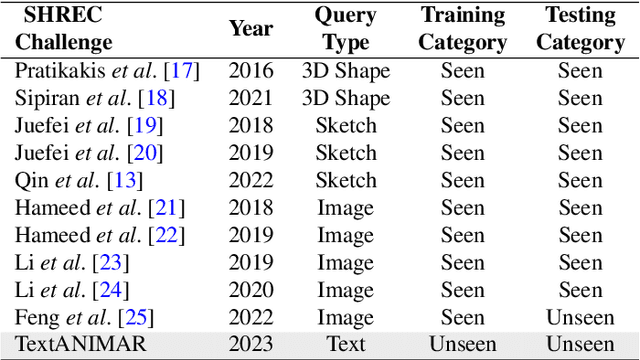
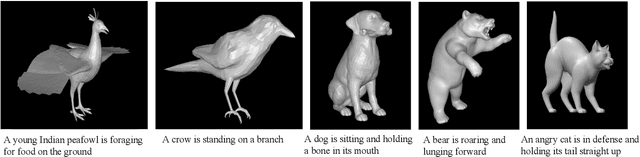
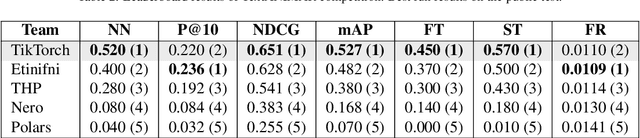
3D object retrieval is an important yet challenging task, which has drawn more and more attention in recent years. While existing approaches have made strides in addressing this issue, they are often limited to restricted settings such as image and sketch queries, which are often unfriendly interactions for common users. In order to overcome these limitations, this paper presents a novel SHREC challenge track focusing on text-based fine-grained retrieval of 3D animal models. Unlike previous SHREC challenge tracks, the proposed task is considerably more challenging, requiring participants to develop innovative approaches to tackle the problem of text-based retrieval. Despite the increased difficulty, we believe that this task has the potential to drive useful applications in practice and facilitate more intuitive interactions with 3D objects. Five groups participated in our competition, submitting a total of 114 runs. While the results obtained in our competition are satisfactory, we note that the challenges presented by this task are far from being fully solved. As such, we provide insights into potential areas for future research and improvements. We believe that we can help push the boundaries of 3D object retrieval and facilitate more user-friendly interactions via vision-language technologies.