 Add to Chrome
 Add to Firefox
 Add to Edge
ImagenWorld: Stress-Testing Image Generation Models with Explainable Human Evaluation on Open-ended Real-World Tasks
Mar 29, 2026
Advances in diffusion, autoregressive, and hybrid models have enabled high-quality image synthesis for tasks such as text-to-image, editing, and reference-guided composition. Yet, existing benchmarks remain limited, either focus on isolated tasks, cover only narrow domains, or provide opaque scores without explaining failure modes. We introduce \textbf{ImagenWorld}, a benchmark of 3.6K condition sets spanning six core tasks (generation and editing, with single or multiple references) and six topical domains (artworks, photorealistic images, information graphics, textual graphics, computer graphics, and screenshots). The benchmark is supported by 20K fine-grained human annotations and an explainable evaluation schema that tags localized object-level and segment-level errors, complementing automated VLM-based metrics. Our large-scale evaluation of 14 models yields several insights: (1) models typically struggle more in editing tasks than in generation tasks, especially in local edits. (2) models excel in artistic and photorealistic settings but struggle with symbolic and text-heavy domains such as screenshots and information graphics. (3) closed-source systems lead overall, while targeted data curation (e.g., Qwen-Image) narrows the gap in text-heavy cases. (4) modern VLM-based metrics achieve Kendall accuracies up to 0.79, approximating human ranking, but fall short of fine-grained, explainable error attribution. ImagenWorld provides both a rigorous benchmark and a diagnostic tool to advance robust image generation.

Do Large Multimodal Models Solve Caption Generation for Scientific Figures? Lessons Learned from SCICAP Challenge 2023
Jan 31, 2025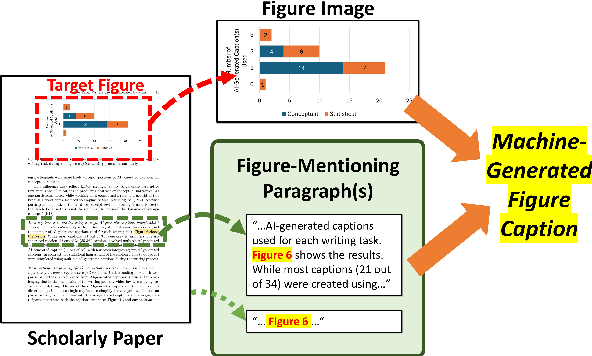
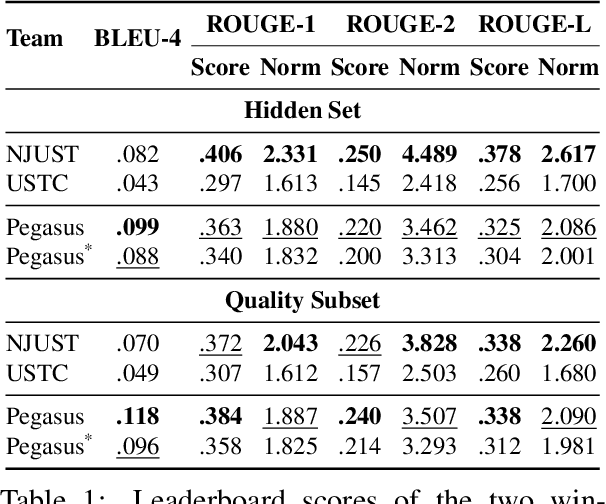
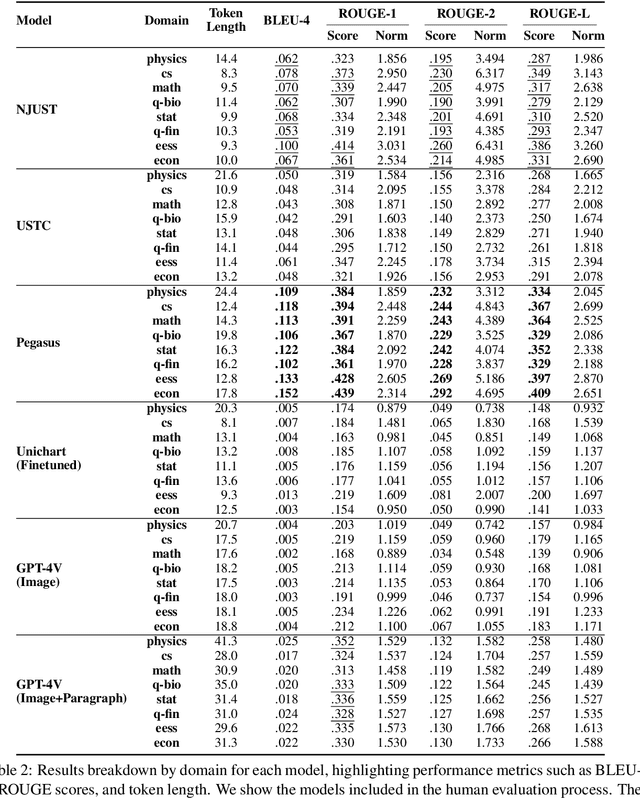
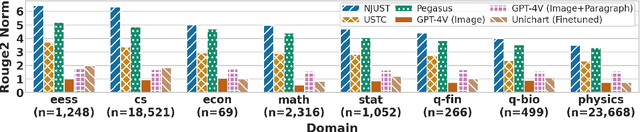
Since the SCICAP datasets launch in 2021, the research community has made significant progress in generating captions for scientific figures in scholarly articles. In 2023, the first SCICAP Challenge took place, inviting global teams to use an expanded SCICAP dataset to develop models for captioning diverse figure types across various academic fields. At the same time, text generation models advanced quickly, with many powerful pre-trained large multimodal models (LMMs) emerging that showed impressive capabilities in various vision-and-language tasks. This paper presents an overview of the first SCICAP Challenge and details the performance of various models on its data, capturing a snapshot of the fields state. We found that professional editors overwhelmingly preferred figure captions generated by GPT-4V over those from all other models and even the original captions written by authors. Following this key finding, we conducted detailed analyses to answer this question: Have advanced LMMs solved the task of generating captions for scientific figures?