 Add to Chrome
 Add to Firefox
 Add to Edge
IndustryBench-MIPU: Benchmarking Multi-Image Attribute Value Extraction for Industrial Products
Jun 12, 2026
Industrial products such as valves and circuit breakers are defined by dense technical specifications that govern procurement, compatibility, and safety across supply chains. These specifications are scattered across multiple heterogeneous product images, including specification tables, nameplates, and technical drawings, yet whether Multimodal Large Language Models (MLLMs) can reliably recover them remains underexplored. To fill this gap, we introduce IndustryBench-MIPU, the first large-scale benchmark for multi-image industrial product understanding, built around structured attribute extraction -- recovering property-value pairs from product images. This task jointly probes text recognition on specification tables and nameplates, visual reasoning over technical drawings, domain knowledge to decode industrial terminology, and cross-image evidence integration to assemble scattered specifications. Concretely, the benchmark comprises 4,559 products across 27,652 images with 103,703 annotations spanning 18 industrial categories, constructed through multi-model consensus and three-tier quality assurance. Evaluating nine MLLMs under both single-image and product-level multi-image settings reveals a stark completeness gap: models achieve high precision (86--94%) but the best recovers only 49.9% of product-level attributes; moving from single-image to multi-image extraction costs 15--34 percentage points of recall. Multi-image completeness, not single-image accuracy, is the core bottleneck. Dataset and code are publicly available.

Large Language Models for Constructing and Optimizing Machine Learning Workflows: A Survey
Nov 11, 2024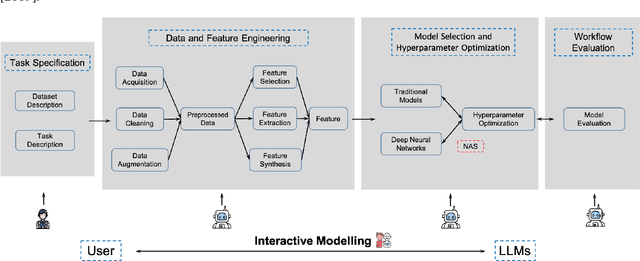
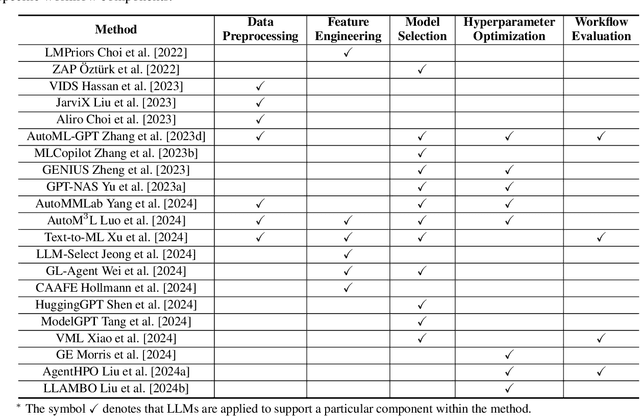
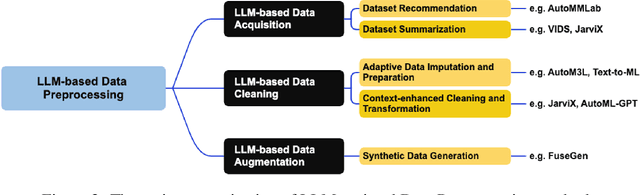
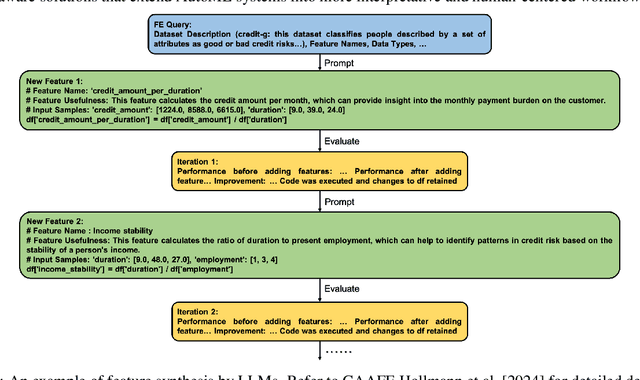
Building effective machine learning (ML) workflows to address complex tasks is a primary focus of the Automatic ML (AutoML) community and a critical step toward achieving artificial general intelligence (AGI). Recently, the integration of Large Language Models (LLMs) into ML workflows has shown great potential for automating and enhancing various stages of the ML pipeline. This survey provides a comprehensive and up-to-date review of recent advancements in using LLMs to construct and optimize ML workflows, focusing on key components encompassing data and feature engineering, model selection and hyperparameter optimization, and workflow evaluation. We discuss both the advantages and limitations of LLM-driven approaches, emphasizing their capacity to streamline and enhance ML workflow modeling process through language understanding, reasoning, interaction, and generation. Finally, we highlight open challenges and propose future research directions to advance the effective application of LLMs in ML workflows.