 Add to Chrome
 Add to Firefox
 Add to Edge
Evaluating the Feasibility of Inferring Dietary Behavior Change Receptivity from Egocentric Images of Eating Environment
May 27, 2026
Accurately assessing dietary behavior change receptivity is essential for designing effective just-in-time adaptive interventions (JITAIs) that promote healthier eating habits. However, self-report-based assessment of behavior change receptivity is sparse and delayed, limiting its practical use in continuous monitoring. To explore whether passive sensing may help address this challenge, this study conducts a pilot investigation of inferring participants' self-reported behavior change receptivity from egocentric eating images collected by a wearable camera. We use pilot data obtained from free-living eating episodes using the Automatic Ingestion Monitor v2 (AIM-2). The data included egocentric image sequences captured during eating and paired with responses to questions assessing specific dimensions of behavior change receptivity (awareness, interaction capability, and motivation). To examine whether visual information contained any relevancy to these responses, we evaluated a transfer-learning-assisted framework that combines a pre-trained Contrastive Language-Image Pre-Training (CLIP) vision encoder with a lightweight transformer classifier. The model processes eating episode image sequences to extract potential semantic and temporal cues related to behavior change receptivity. Preliminary experimental results show promising improvements over simple baseline models for behavior change receptivity indicators. These early findings suggest that egocentric eating episode images may contain cues related to dietary behavior change receptivity, and warrant further investigation with larger and more comprehensive datasets.

Long-Tailed Continual Learning For Visual Food Recognition
Jul 01, 2023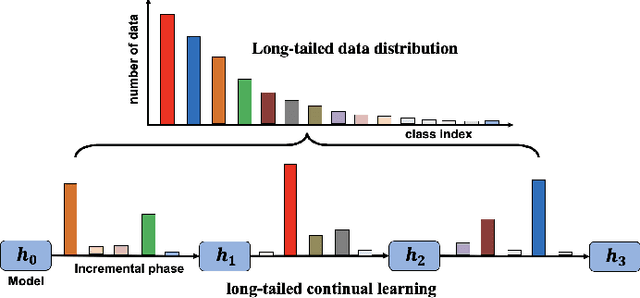
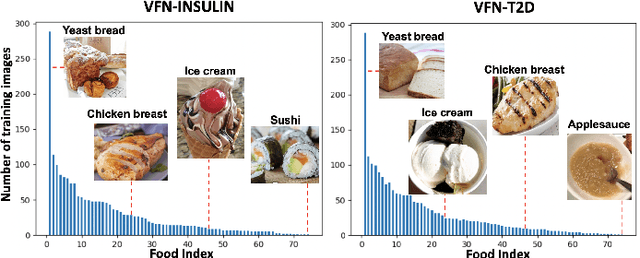
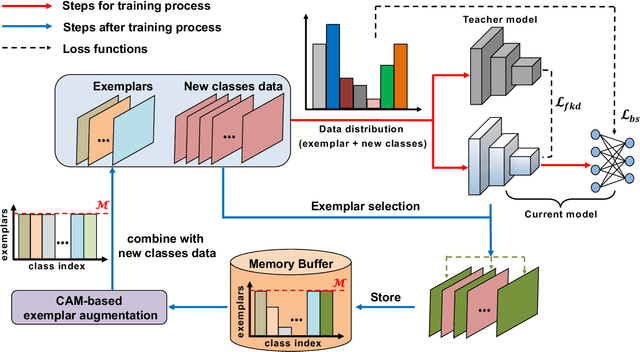
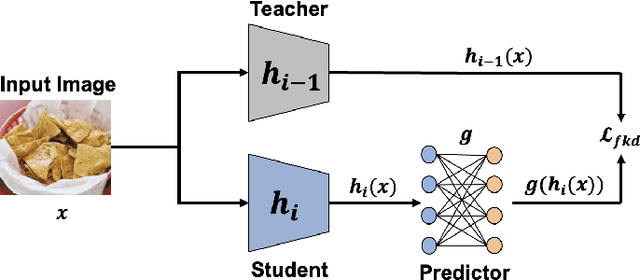
Deep learning based food recognition has achieved remarkable progress in predicting food types given an eating occasion image. However, there are two major obstacles that hinder deployment in real world scenario. First, as new foods appear sequentially overtime, a trained model needs to learn the new classes continuously without causing catastrophic forgetting for already learned knowledge of existing food types. Second, the distribution of food images in real life is usually long-tailed as a small number of popular food types are consumed more frequently than others, which can vary in different populations. This requires the food recognition method to learn from class-imbalanced data by improving the generalization ability on instance-rare food classes. In this work, we focus on long-tailed continual learning and aim to address both aforementioned challenges. As existing long-tailed food image datasets only consider healthy people population, we introduce two new benchmark food image datasets, VFN-INSULIN and VFN-T2D, which exhibits on the real world food consumption for insulin takers and individuals with type 2 diabetes without taking insulin, respectively. We propose a novel end-to-end framework for long-tailed continual learning, which effectively addresses the catastrophic forgetting by applying an additional predictor for knowledge distillation to avoid misalignment of representation during continual learning. We also introduce a novel data augmentation technique by integrating class-activation-map (CAM) and CutMix, which significantly improves the generalization ability for instance-rare food classes to address the class-imbalance issue. The proposed method show promising performance with large margin improvements compared with existing methods.
Improving Dietary Assessment Via Integrated Hierarchy Food Classification
Sep 06, 2021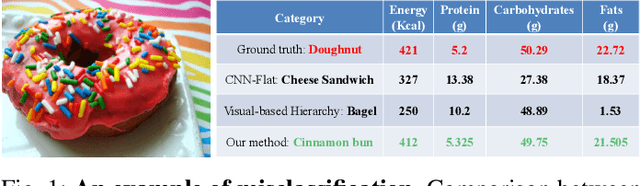
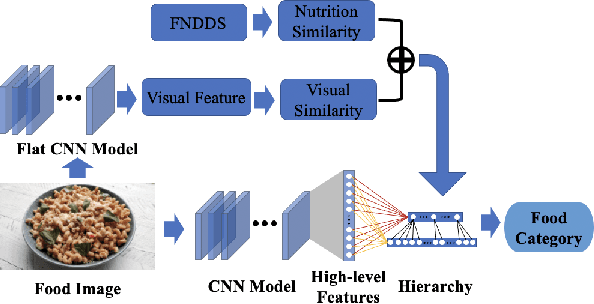
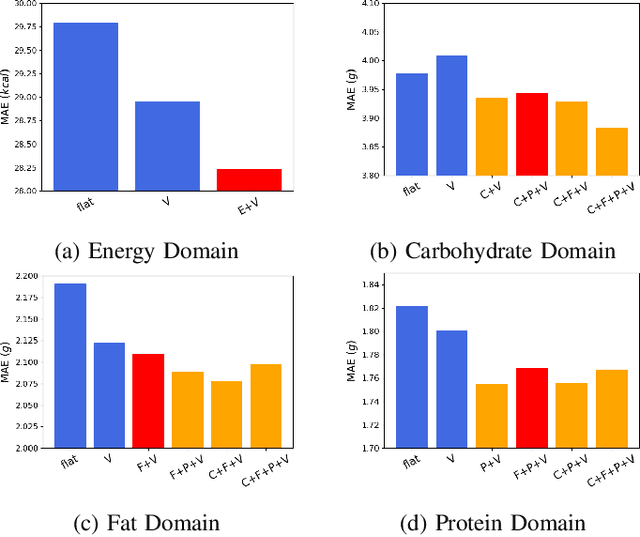

Image-based dietary assessment refers to the process of determining what someone eats and how much energy and nutrients are consumed from visual data. Food classification is the first and most crucial step. Existing methods focus on improving accuracy measured by the rate of correct classification based on visual information alone, which is very challenging due to the high complexity and inter-class similarity of foods. Further, accuracy in food classification is conceptual as description of a food can always be improved. In this work, we introduce a new food classification framework to improve the quality of predictions by integrating the information from multiple domains while maintaining the classification accuracy. We apply a multi-task network based on a hierarchical structure that uses both visual and nutrition domain specific information to cluster similar foods. Our method is validated on the modified VIPER-FoodNet (VFN) food image dataset by including associated energy and nutrient information. We achieve comparable classification accuracy with existing methods that use visual information only, but with less error in terms of energy and nutrient values for the wrong predictions.