 Add to Chrome
 Add to Firefox
 Add to Edge
MemEvolve: Meta-Evolution of Agent Memory Systems
Dec 21, 2025
Self-evolving memory systems are unprecedentedly reshaping the evolutionary paradigm of large language model (LLM)-based agents. Prior work has predominantly relied on manually engineered memory architectures to store trajectories, distill experience, and synthesize reusable tools, enabling agents to evolve on the fly within environment interactions. However, this paradigm is fundamentally constrained by the staticity of the memory system itself: while memory facilitates agent-level evolving, the underlying memory architecture cannot be meta-adapted to diverse task contexts. To address this gap, we propose MemEvolve, a meta-evolutionary framework that jointly evolves agents' experiential knowledge and their memory architecture, allowing agent systems not only to accumulate experience but also to progressively refine how they learn from it. To ground MemEvolve in prior research and foster openness in future self-evolving systems, we introduce EvolveLab, a unified self-evolving memory codebase that distills twelve representative memory systems into a modular design space (encode, store, retrieve, manage), providing both a standardized implementation substrate and a fair experimental arena. Extensive evaluations on four challenging agentic benchmarks demonstrate that MemEvolve achieves (I) substantial performance gains, improving frameworks such as SmolAgent and Flash-Searcher by up to $17.06\%$; and (II) strong cross-task and cross-LLM generalization, designing memory architectures that transfer effectively across diverse benchmarks and backbone models.

Multi-label Learning from Privacy-Label
Dec 20, 2023Multi-abel Learning (MLL) often involves the assignment of multiple relevant labels to each instance, which can lead to the leakage of sensitive information (such as smoking, diseases, etc.) about the instances. However, existing MLL suffer from failures in protection for sensitive information. In this paper, we propose a novel setting named Multi-Label Learning from Privacy-Label (MLLPL), which Concealing Labels via Privacy-Label Unit (CLPLU). Specifically, during the labeling phase, each privacy-label is randomly combined with a non-privacy label to form a Privacy-Label Unit (PLU). If any label within a PLU is positive, the unit is labeled as positive; otherwise, it is labeled negative, as shown in Figure 1. PLU ensures that only non-privacy labels are appear in the label set, while the privacy-labels remain concealed. Moreover, we further propose a Privacy-Label Unit Loss (PLUL) to learn the optimal classifier by minimizing the empirical risk of PLU. Experimental results on multiple benchmark datasets demonstrate the effectiveness and superiority of the proposed method.
Experimental Security Analysis of DNN-based Adaptive Cruise Control under Context-Aware Perception Attacks
Jul 18, 2023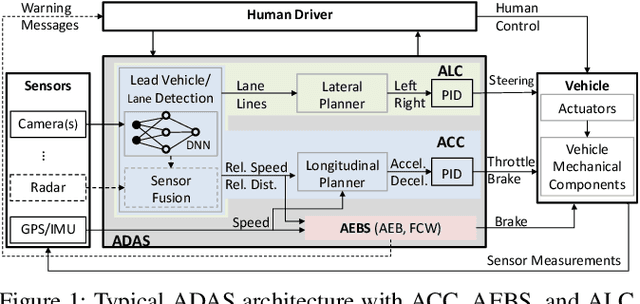
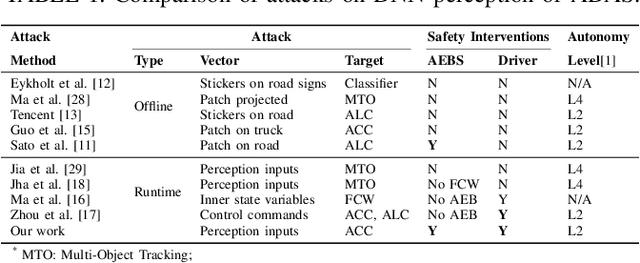

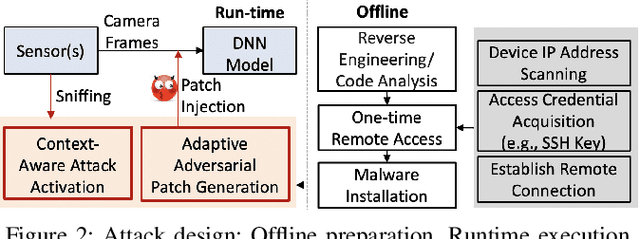
Adaptive Cruise Control (ACC) is a widely used driver assistance feature for maintaining desired speed and safe distance to the leading vehicles. This paper evaluates the security of the deep neural network (DNN) based ACC systems under stealthy perception attacks that strategically inject perturbations into camera data to cause forward collisions. We present a combined knowledge-and-data-driven approach to design a context-aware strategy for the selection of the most critical times for triggering the attacks and a novel optimization-based method for the adaptive generation of image perturbations at run-time. We evaluate the effectiveness of the proposed attack using an actual driving dataset and a realistic simulation platform with the control software from a production ACC system and a physical-world driving simulator while considering interventions by the driver and safety features such as Automatic Emergency Braking (AEB) and Forward Collision Warning (FCW). Experimental results show that the proposed attack achieves 142.9x higher success rate in causing accidents than random attacks and is mitigated 89.6% less by the safety features while being stealthy and robust to real-world factors and dynamic changes in the environment. This study provides insights into the role of human operators and basic safety interventions in preventing attacks.