 Add to Chrome
 Add to Firefox
 Add to Edge
Intelligent recognition of GPR road hidden defect images based on feature fusion and attention mechanism
Dec 25, 2025
Ground Penetrating Radar (GPR) has emerged as a pivotal tool for non-destructive evaluation of subsurface road defects. However, conventional GPR image interpretation remains heavily reliant on subjective expertise, introducing inefficiencies and inaccuracies. This study introduces a comprehensive framework to address these limitations: (1) A DCGAN-based data augmentation strategy synthesizes high-fidelity GPR images to mitigate data scarcity while preserving defect morphology under complex backgrounds; (2) A novel Multi-modal Chain and Global Attention Network (MCGA-Net) is proposed, integrating Multi-modal Chain Feature Fusion (MCFF) for hierarchical multi-scale defect representation and Global Attention Mechanism (GAM) for context-aware feature enhancement; (3) MS COCO transfer learning fine-tunes the backbone network, accelerating convergence and improving generalization. Ablation and comparison experiments validate the framework's efficacy. MCGA-Net achieves Precision (92.8%), Recall (92.5%), and mAP@50 (95.9%). In the detection of Gaussian noise, weak signals and small targets, MCGA-Net maintains robustness and outperforms other models. This work establishes a new paradigm for automated GPR-based defect detection, balancing computational efficiency with high accuracy in complex subsurface environments.
* Accepted for publication in *IEEE Transactions on Geoscience and Remote Sensing*

Lightweight framework for underground pipeline recognition and spatial localization based on multi-view 2D GPR images
Dec 24, 2025To address the issues of weak correlation between multi-view features, low recognition accuracy of small-scale targets, and insufficient robustness in complex scenarios in underground pipeline detection using 3D GPR, this paper proposes a 3D pipeline intelligent detection framework. First, based on a B/C/D-Scan three-view joint analysis strategy, a three-dimensional pipeline three-view feature evaluation method is established by cross-validating forward simulation results obtained using FDTD methods with actual measurement data. Second, the DCO-YOLO framework is proposed, which integrates DySample, CGLU, and OutlookAttention cross-dimensional correlation mechanisms into the original YOLOv11 algorithm, significantly improving the small-scale pipeline edge feature extraction capability. Furthermore, a 3D-DIoU spatial feature matching algorithm is proposed, which integrates three-dimensional geometric constraints and center distance penalty terms to achieve automated association of multi-view annotations. The three-view fusion strategy resolves inherent ambiguities in single-view detection. Experiments based on real urban underground pipeline data show that the proposed method achieves accuracy, recall, and mean average precision of 96.2%, 93.3%, and 96.7%, respectively, in complex multi-pipeline scenarios, which are 2.0%, 2.1%, and 0.9% higher than the baseline model. Ablation experiments validated the synergistic optimization effect of the dynamic feature enhancement module and Grad-CAM++ heatmap visualization demonstrated that the improved model significantly enhanced its ability to focus on pipeline geometric features. This study integrates deep learning optimization strategies with the physical characteristics of 3D GPR, offering an efficient and reliable novel technical framework for the intelligent recognition and localization of underground pipelines.
DMFourLLIE: Dual-Stage and Multi-Branch Fourier Network for Low-Light Image Enhancement
Dec 01, 2024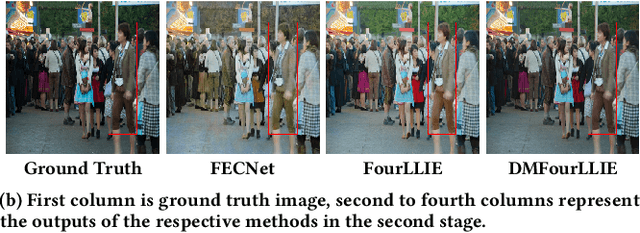
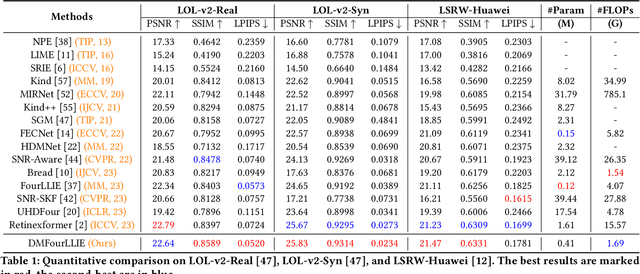
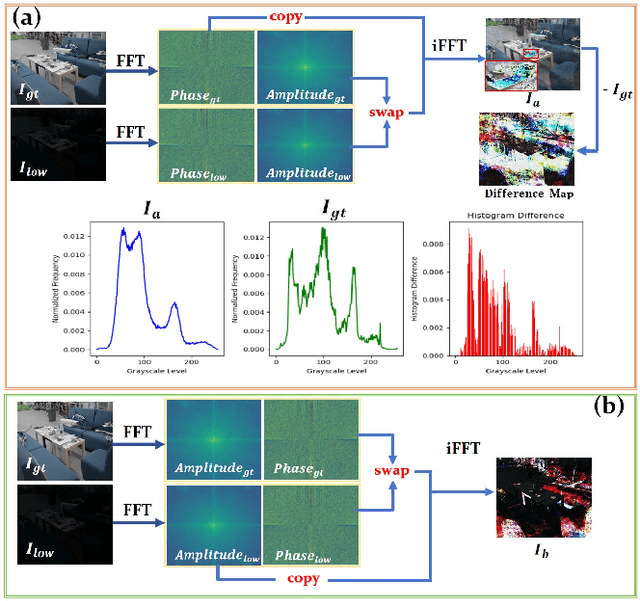

In the Fourier frequency domain, luminance information is primarily encoded in the amplitude component, while spatial structure information is significantly contained within the phase component. Existing low-light image enhancement techniques using Fourier transform have mainly focused on amplifying the amplitude component and simply replicating the phase component, an approach that often leads to color distortions and noise issues. In this paper, we propose a Dual-Stage Multi-Branch Fourier Low-Light Image Enhancement (DMFourLLIE) framework to address these limitations by emphasizing the phase component's role in preserving image structure and detail. The first stage integrates structural information from infrared images to enhance the phase component and employs a luminance-attention mechanism in the luminance-chrominance color space to precisely control amplitude enhancement. The second stage combines multi-scale and Fourier convolutional branches for robust image reconstruction, effectively recovering spatial structures and textures. This dual-branch joint optimization process ensures that complex image information is retained, overcoming the limitations of previous methods that neglected the interplay between amplitude and phase. Extensive experiments across multiple datasets demonstrate that DMFourLLIE outperforms current state-of-the-art methods in low-light image enhancement. Our code is available at https://github.com/bywlzts/DMFourLLIE.