 Add to Chrome
 Add to Firefox
 Add to Edge
Learning Predictive Control with Deep Koopman Operators for Autonomous Vehicle Motion Planning
Jun 06, 2026
Model Predictive Control (MPC) is widely used for autonomous-vehicle (AV) motion planning, but its real-time applicability is often limited by the need for accurate models and online solution of nonlinear, nonconvex optimization problems in dynamic road environments. Actor-critic reinforcement learning offers a promising alternative for online policy generation, yet its policy-learning process often lacks explicit control-theoretic structure. This article proposes a learning predictive control (LPC) framework with deep Koopman operators for efficient real-time motion planning under nonconvex constraints. To address nonlinear and uncertain vehicle dynamics, a deep-Koopman-based predictor is used to lift the system into an interpretable linear observable space in a data-driven manner. Unlike traditional MPC, which computes open-loop control sequences, the proposed LPC framework yields a closed-loop state-feedback policy within each prediction interval through receding-horizon actor-critic learning. To ensure safety under nonconvex environmental constraints, LPC constructs convex local surrogate representations of obstacles and defines corresponding potential-field functions. These functions and their gradients are directly embedded into the actor-critic structure, enabling efficient, safety-aware policy learning. Extensive simulations and real-world experiments on the HongQi-EHS3 platform demonstrate favorable performance in diverse obstacle-avoidance scenarios in terms of safety, computational efficiency, and driving comfort, compared with benchmark methods such as CBF-MPC and LMPCC.

Knowledge Transfer from Simple to Complex: A Safe and Efficient Reinforcement Learning Framework for Autonomous Driving Decision-Making
Oct 21, 2024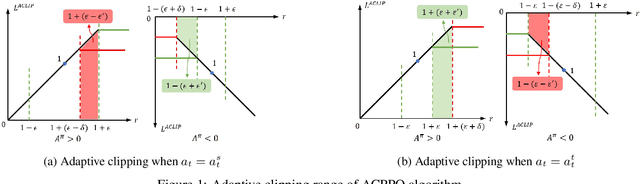
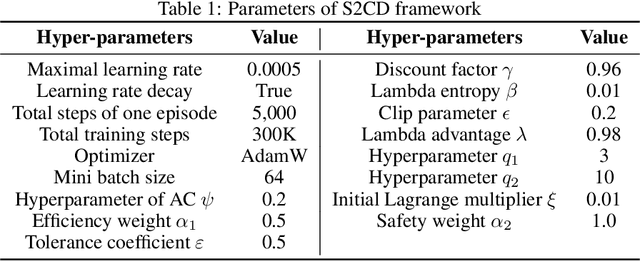
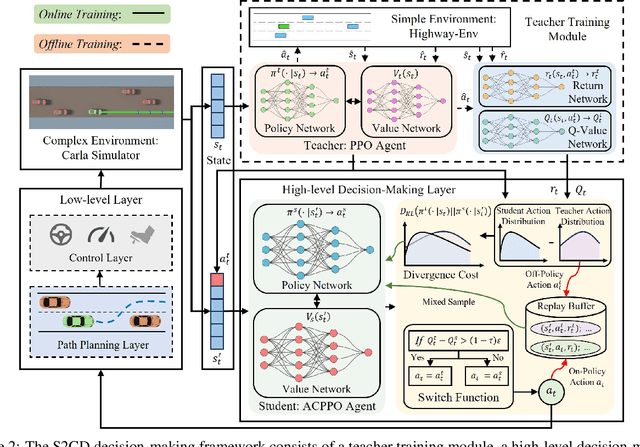
A safe and efficient decision-making system is crucial for autonomous vehicles. However, the complexity and variability of driving environments limit the effectiveness of many rule-based and machine learning-based decision-making approaches. Reinforcement Learning in autonomous driving offers a promising solution to these challenges. Nevertheless, concerns regarding safety and efficiency during training remain major obstacles to its widespread application. To address these concerns, we propose a novel RL framework named Simple to Complex Collaborative Decision. First, we rapidly train the teacher model using the Proximal Policy Optimization algorithm in a lightweight simulation environment. In the more intricate simulation environment, the teacher model intervenes when the student agent exhibits suboptimal behavior by assessing the value of actions to avert dangerous situations. We also introduce an innovative RL algorithm called Adaptive Clipping PPO, which is trained using a combination of samples generated by both teacher and student policies, and employs dynamic clipping strategies based on sample importance. Additionally, we employ the KL divergence as a constraint on policy optimization, transforming it into an unconstrained problem to accelerate the student's learning of the teacher's policy. Finally, a gradual weaning strategy is employed to ensure that, over time, the student agent learns to explore independently. Simulation experiments in highway lane-change scenarios demonstrate that the S2CD framework enhances learning efficiency, reduces training costs, and significantly improves safety during training when compared with state-of-the-art baseline algorithms. This approach also ensures effective knowledge transfer between teacher and student models, and even when the teacher model is suboptimal.