 Add to Chrome
 Add to Firefox
 Add to Edge
When Only the Final Text Survives: Implicit Execution Tracing for Multi-Agent Attribution
Mar 19, 2026
When a multi-agent system produces an incorrect or harmful answer, who is accountable if execution logs and agent identifiers are unavailable? Multi-agent language systems increasingly rely on structured interactions such as delegation and iterative refinement, yet the final output often obscures the underlying interaction topology and agent contributions. We introduce IET (Implicit Execution Tracing), a metadata-independent framework that enables token-level attribution directly from generated text and a simple mechanism for interaction topology reconstruction. During generation, agent-specific keyed signals are embedded into the token distribution, transforming the text into a self-describing execution trace detectable only with a secret key. At detection time, a transition-aware scoring method identifies agent handover points and reconstructs the interaction graph. Experiments show that IET recovers agent segments and coordination structure with high accuracy while preserving generation quality, enabling privacy-preserving auditing for multi-agent language systems.

Coordinated Navigation Control of Cross-Domain Unmanned Systems via Guiding Vector Fields
Dec 18, 2023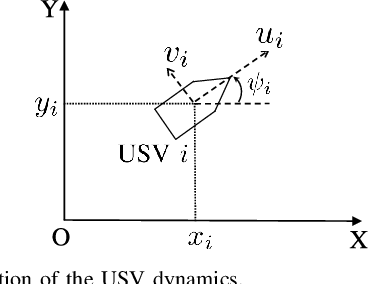
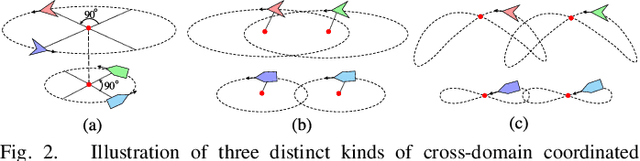
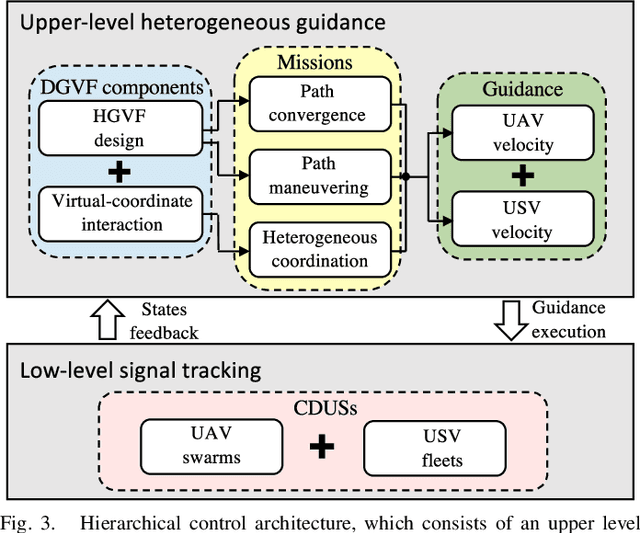
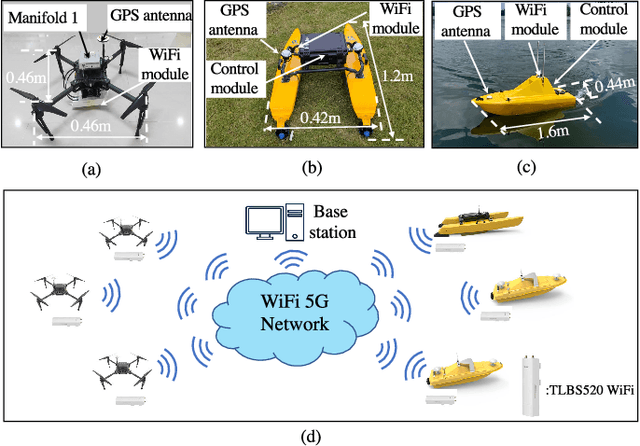
This paper proposes a distributed guiding-vector-field (DGVF) controller for cross-domain unmanned systems (CDUSs) consisting of heterogeneous unmanned aerial vehicles (UAVs) and unmanned surface vehicles (USVs), to achieve coordinated navigation whereas maneuvering along their prescribed paths. In particular, the DGVF controller provides a hierarchical architecture of an upper-level heterogeneous guidance velocity controller and a lower-level signal tracking regulator. Therein, the upper-level controller is to govern multiple heterogeneous USVs and UAVs to approach and maneuver along the prescribed paths and coordinate the formation simultaneously, whereas the low-level regulator is to track the corresponding desired guidance signals provided by the upper-level module. Significantly, the heterogeneous coordination among neighboring UAVs and USVs is achieved merely by the lightweight communication of a scalar (i.e., the additional virtual coordinate), which substantially decreases the communication and computational costs. Sufficient conditions assuring asymptotical convergence of the closed-loop system are derived in presence of the exponentially vanishing tracking errors. Finally, real-lake experiments are conducted on a self-established cross-domain heterogeneous platform consisting of three M-100 UAVs, two HUSTER-16 USVs, a HUSTER-12C USV, and a WiFi 5G wireless communication station to verify the effectiveness of the present DGVF controller.
* 14 pages