 Add to Chrome
 Add to Firefox
 Add to Edge
Hybrid STAR-RIS Architecture for Joint Localization, Communication, and Power Transfer
Aug 12, 2026
We propose a hybrid simultaneously transmitting and reflecting reconfigurable intelligent surface (STAR-RIS) architecture with dynamically switched active and passive elements to support joint localization, communication, and wireless power transfer (WPT). We first pursue a parallel factor analysis with the alternating least squares (PARAFAC-ALS)-based tensor decomposition approach that decouples the base station (BS)-reconfigurable intelligent surface (RIS) and RIS-user channels, thereby enabling low-overhead channel acquisition. Based on this, we formulate a system energy efficiency (EE) maximization problem, subject to the spectral efficiency (SE) requirements of communication users, sensing signal-to-interference-plus-noise ratio constraints, and the nonlinear energy harvesting requirements of energy-harvesting users. The optimization problem is nonconvex since the transmit power allocation, STAR-RIS coefficients, and active/passive mode assignments are tightly coupled in both the objective and constraints. We address this issue by alternating between two subproblems, and solving them via fractional programming, successive convex approximation and a multi-seed greedy strategy employed as an initialization step. Numerical results demonstrate that selectively activating a small, well-chosen subset of STAR-RIS elements achieves 1.5 to 3 times EE improvements compared with fully passive/active architectures, while satisfying communication, sensing, and power-transfer requirements.

A Neural Difference-of-Entropies Estimator for Mutual Information
Feb 18, 2025Estimating Mutual Information (MI), a key measure of dependence of random quantities without specific modelling assumptions, is a challenging problem in high dimensions. We propose a novel mutual information estimator based on parametrizing conditional densities using normalizing flows, a deep generative model that has gained popularity in recent years. This estimator leverages a block autoregressive structure to achieve improved bias-variance trade-offs on standard benchmark tasks.
Channel Modeling for UAV-to-Ground Communications with Posture Variation and Fuselage Scattering Effect
Oct 11, 2022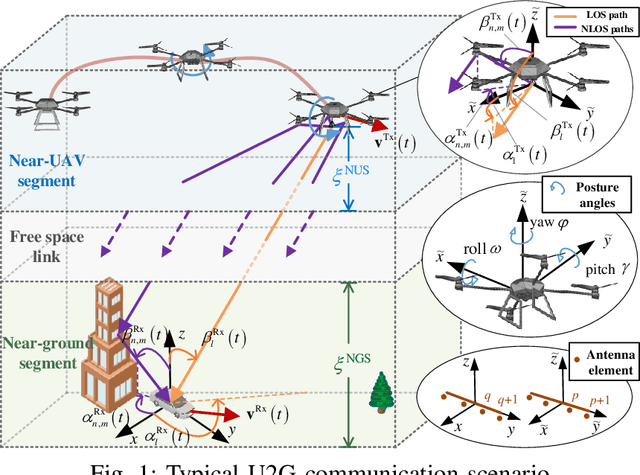
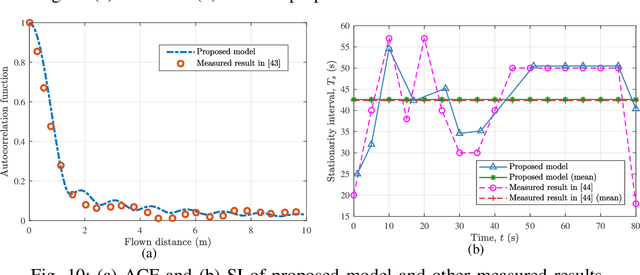
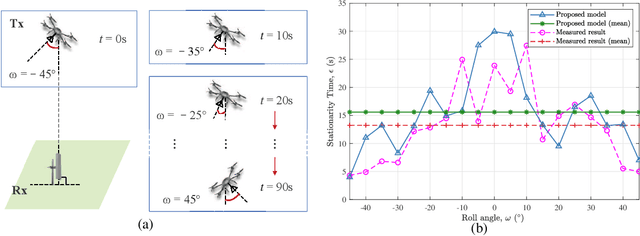
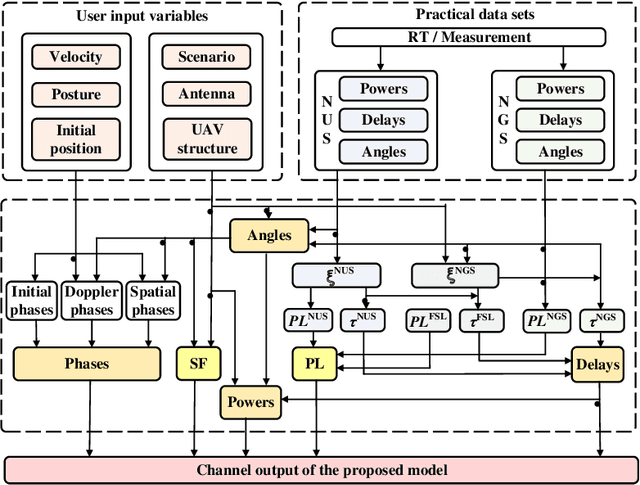
Unmanned aerial vehicle (UAV)-to-ground (U2G) channel models play a pivotal role for reliable communications between UAV and ground terminal. This paper proposes a three-dimensional (3D) non-stationary hybrid model including both large-scale and small-scale fading for U2G multiple-input-multiple-output (MIMO) channels. Distinctive channel characteristics under U2G scenarios, i.e., 3D trajectory and posture of UAV, fuselage scattering effect (FSE), and posture variation fading (PVF), are incorporated into the proposed model. The channel parameters, i.e., path loss (PL), shadow fading (SF), path delay, and path angle, are generated incorporating machine learning (ML) and ray tracing (RT) techniques to capture the structure-related characteristics. In order to guarantee the physical continuity of channel parameters such as Doppler phase and path power, the time evolution methods of inter- and intra- stationary intervals are proposed. Key statistical properties , i.e., temporal autocorrection function (ACF), power delay profile (PDP), level crossing rate (LCR), average fading duration (AFD), and stationary interval (SI) are given, and the impact of the change of fuselage and posture variation is analyzed. It is demonstrated that both posture variation and fuselage scattering have crucial effects on channel characteristics. The validity and practicability of the proposed model are verified by comparing the simulation results with the measured ones.