 Add to Chrome
 Add to Firefox
 Add to Edge
SLQ: Bridging Modalities via Shared Latent Queries for Retrieval with Frozen MLLMs
Apr 16, 2026
Multimodal Large Language Models (MLLMs) exhibit strong reasoning and world knowledge, yet adapting them for retrieval remains challenging. Existing approaches rely on invasive parameter updates, such as full fine-tuning and LoRA, which may disrupt the pre-trained semantic space and impair the structured knowledge essential for reasoning. In this work, we argue that adapting MLLMs for retrieval should focus on eliciting pre-trained representations rather than overwriting them. To this end, we propose SLQ, an effective and efficient framework that adapts a frozen MLLM into a retriever through a small set of Shared Latent Queries. Appended to the end of both text and image token sequences, these queries leverage the model's native causal attention to serve as global aggregation interfaces, producing compact embeddings in a unified space while keeping the backbone unchanged. Furthermore, to better evaluate retrieval beyond superficial pattern matching, we construct KARR-Bench, a benchmark designed for knowledge-aware reasoning retrieval. Extensive experiments show that SLQ outperforms full fine-tuning and LoRA on COCO and Flickr30K, while achieving competitive performance on MMEB and yielding substantial gains on KARR-Bench. The results demonstrate that SLQ, which preserves pre-trained representations, provides an effective and efficient framework for adapting MLLMs to retrieval.

FireRed-OCR Technical Report
Mar 02, 2026We present FireRed-OCR, a systematic framework to specialize general VLMs into high-performance OCR models. Large Vision-Language Models (VLMs) have demonstrated impressive general capabilities but frequently suffer from ``structural hallucination'' when processing complex documents, limiting their utility in industrial OCR applications. In this paper, we introduce FireRed-OCR, a novel framework designed to transform general-purpose VLMs (based on Qwen3-VL) into pixel-precise structural document parsing experts. To address the scarcity of high-quality structured data, we construct a ``Geometry + Semantics'' Data Factory. Unlike traditional random sampling, our pipeline leverages geometric feature clustering and multi-dimensional tagging to synthesize and curate a highly balanced dataset, effectively handling long-tail layouts and rare document types. Furthermore, we propose a Three-Stage Progressive Training strategy that guides the model from pixel-level perception to logical structure generation. This curriculum includes: (1) Multi-task Pre-alignment to ground the model's understanding of document structure; (2) Specialized SFT for standardizing full-image Markdown output; and (3) Format-Constrained Group Relative Policy Optimization (GRPO), which utilizes reinforcement learning to enforce strict syntactic validity and structural integrity (e.g., table closure, formula syntax). Extensive evaluations on OmniDocBench v1.5 demonstrate that FireRed-OCR achieves state-of-the-art performance with an overall score of 92.94\%, significantly outperforming strong baselines such as DeepSeek-OCR 2 and OCRVerse across text, formula, table, and reading order metrics. We open-source our code and model weights to facilitate the ``General VLM to Specialized Structural Expert'' paradigm.
MIND: A Multi-agent Framework for Zero-shot Harmful Meme Detection
Jul 09, 2025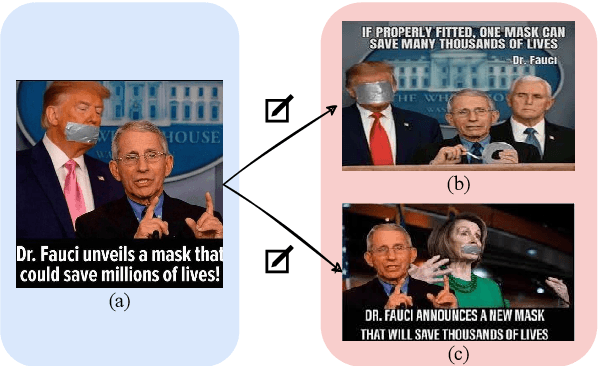
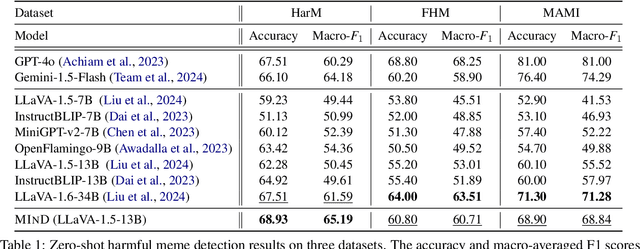
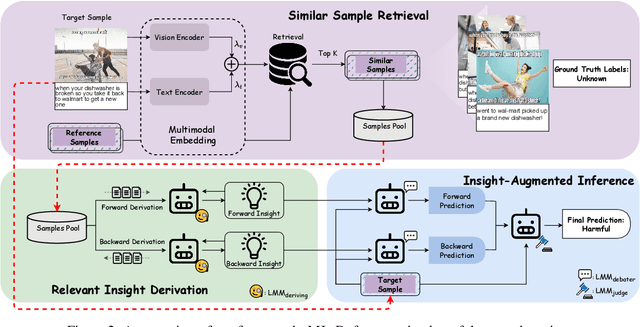
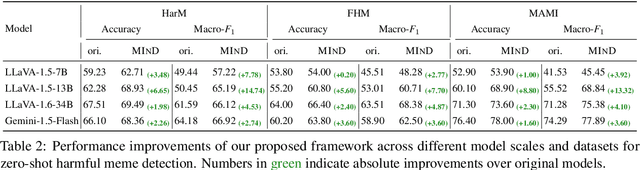
The rapid expansion of memes on social media has highlighted the urgent need for effective approaches to detect harmful content. However, traditional data-driven approaches struggle to detect new memes due to their evolving nature and the lack of up-to-date annotated data. To address this issue, we propose MIND, a multi-agent framework for zero-shot harmful meme detection that does not rely on annotated data. MIND implements three key strategies: 1) We retrieve similar memes from an unannotated reference set to provide contextual information. 2) We propose a bi-directional insight derivation mechanism to extract a comprehensive understanding of similar memes. 3) We then employ a multi-agent debate mechanism to ensure robust decision-making through reasoned arbitration. Extensive experiments on three meme datasets demonstrate that our proposed framework not only outperforms existing zero-shot approaches but also shows strong generalization across different model architectures and parameter scales, providing a scalable solution for harmful meme detection. The code is available at https://github.com/destroy-lonely/MIND.