 Add to Chrome
 Add to Firefox
 Add to Edge
FiRE: Enhancing MLLMs with Fine-Grained Context Learning for Complex Image Retrieval
Jul 30, 2026
Due to their strong generalizable multimodal processing and reasoning capabilities, Multimodal Large Language Models (MLLMs) have demonstrated significant potential as universal image retrievers, effectively addressing diverse real-world image retrieval tasks. Nevertheless, pioneering studies, while promising, overlook the potential of fine-grained context modeling and disentangled fine-tuning objectives in enhancing MLLMs' retrieval performance, particularly for complex tasks such as long-text-to-image retrieval, visual dialog retrieval, and composed image retrieval (CIR). Therefore, in this work, we propose an automated fine-grained multimodal quintuple dataset construction pipeline and a novel two-stage fine-grained multimodal fine-tuning strategy. The dataset generation pipeline produces a comprehensive CIR dataset with fine-grained image captions and modification text, facilitating fine-grained context modeling. Beyond the previously entangled fine-tuning paradigm, our approach separates the fine-tuning process into two distinct stages: (1) fine-grained context reasoning-oriented fine-tuning and (2) fine-grained retrieval-oriented fine-tuning. These stages aim to sequentially enhance the model's context understanding and query-target alignment capabilities, thereby improving retrieval performance. Extensive experiments across five datasets encompassing diverse and complex image retrieval tasks demonstrate the remarkable superiority of our method over existing approaches in zero-shot retrieval settings, even with a more lightweight MLLM backbone compared to those methods.

Fine-grained Textual Inversion Network for Zero-Shot Composed Image Retrieval
Mar 25, 2025Composed Image Retrieval (CIR) allows users to search target images with a multimodal query, comprising a reference image and a modification text that describes the user's modification demand over the reference image. Nevertheless, due to the expensive labor cost of training data annotation, recent researchers have shifted to the challenging task of zero-shot CIR (ZS-CIR), which targets fulfilling CIR without annotated triplets. The pioneer ZS-CIR studies focus on converting the CIR task into a standard text-to-image retrieval task by pre-training a textual inversion network that can map a given image into a single pseudo-word token. Despite their significant progress, their coarse-grained textual inversion may be insufficient to capture the full content of the image accurately. To overcome this issue, in this work, we propose a novel Fine-grained Textual Inversion Network for ZS-CIR, named FTI4CIR. In particular, FTI4CIR comprises two main components: fine-grained pseudo-word token mapping and tri-wise caption-based semantic regularization. The former maps the image into a subject-oriented pseudo-word token and several attribute-oriented pseudo-word tokens to comprehensively express the image in the textual form, while the latter works on jointly aligning the fine-grained pseudo-word tokens to the real-word token embedding space based on a BLIP-generated image caption template. Extensive experiments conducted on three benchmark datasets demonstrate the superiority of our proposed method.
A Comprehensive Survey on Composed Image Retrieval
Feb 19, 2025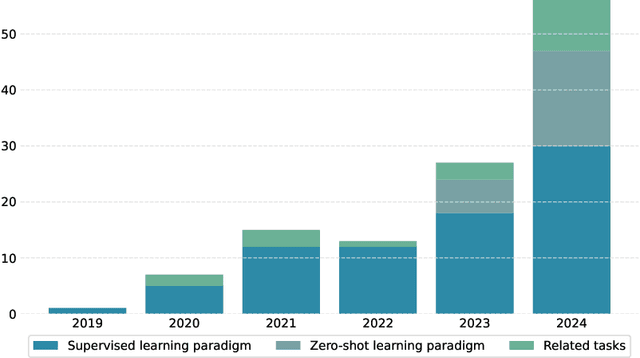
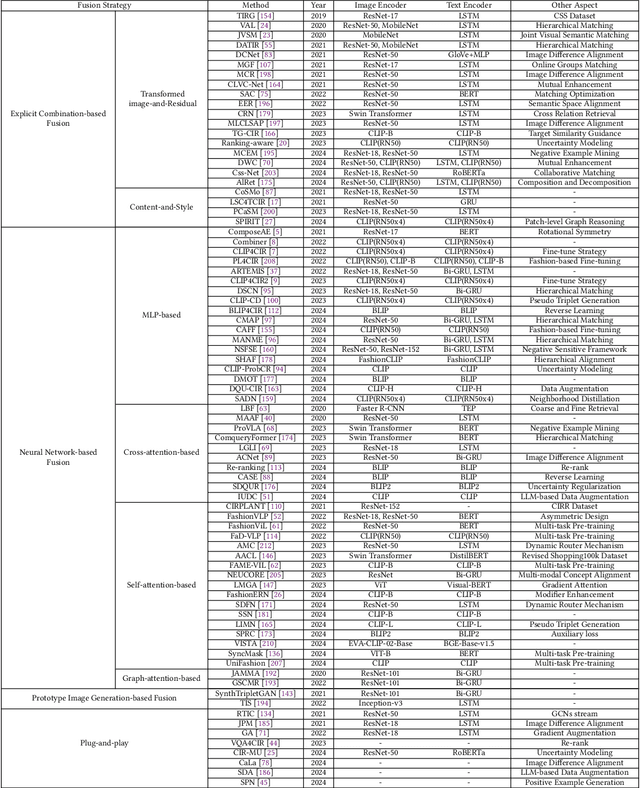
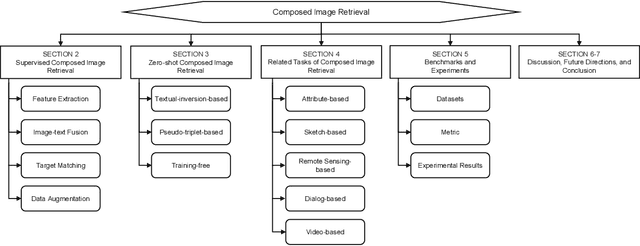
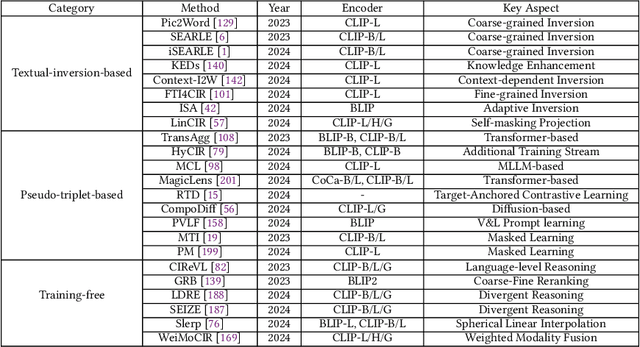
Composed Image Retrieval (CIR) is an emerging yet challenging task that allows users to search for target images using a multimodal query, comprising a reference image and a modification text specifying the user's desired changes to the reference image. Given its significant academic and practical value, CIR has become a rapidly growing area of interest in the computer vision and machine learning communities, particularly with the advances in deep learning. To the best of our knowledge, there is currently no comprehensive review of CIR to provide a timely overview of this field. Therefore, we synthesize insights from over 120 publications in top conferences and journals, including ACM TOIS, SIGIR, and CVPR In particular, we systematically categorize existing supervised CIR and zero-shot CIR models using a fine-grained taxonomy. For a comprehensive review, we also briefly discuss approaches for tasks closely related to CIR, such as attribute-based CIR and dialog-based CIR. Additionally, we summarize benchmark datasets for evaluation and analyze existing supervised and zero-shot CIR methods by comparing experimental results across multiple datasets. Furthermore, we present promising future directions in this field, offering practical insights for researchers interested in further exploration.
Pseudo-triplet Guided Few-shot Composed Image Retrieval
Jul 08, 2024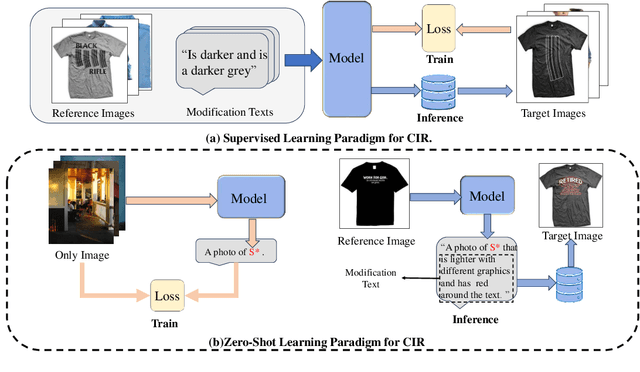
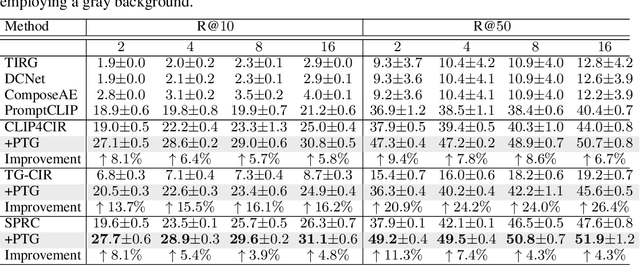

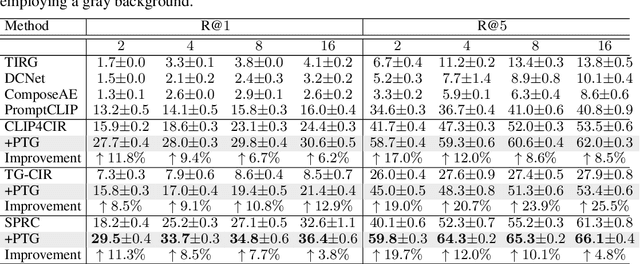
Composed Image Retrieval (CIR) is a challenging task that aims to retrieve the target image based on a multimodal query, i.e., a reference image and its corresponding modification text. While previous supervised or zero-shot learning paradigms all fail to strike a good trade-off between time-consuming annotation cost and retrieval performance, recent researchers introduced the task of few-shot CIR (FS-CIR) and proposed a textual inversion-based network based on pretrained CLIP model to realize it. Despite its promising performance, the approach suffers from two key limitations: insufficient multimodal query composition training and indiscriminative training triplet selection. To address these two limitations, in this work, we propose a novel two-stage pseudo triplet guided few-shot CIR scheme, dubbed PTG-FSCIR. In the first stage, we employ a masked training strategy and advanced image caption generator to construct pseudo triplets from pure image data to enable the model to acquire primary knowledge related to multimodal query composition. In the second stage, based on active learning, we design a pseudo modification text-based query-target distance metric to evaluate the challenging score for each unlabeled sample. Meanwhile, we propose a robust top range-based random sampling strategy according to the 3-$\sigma$ rule in statistics, to sample the challenging samples for fine-tuning the pretrained model. Notably, our scheme is plug-and-play and compatible with any existing supervised CIR models. We tested our scheme across three backbones on three public datasets (i.e., FashionIQ, CIRR, and Birds-to-Words), achieving maximum improvements of 26.4%, 25.5% and 21.6% respectively, demonstrating our scheme's effectiveness.