 Add to Chrome
 Add to Firefox
 Add to Edge
Beyond Native Success: Auditing Deployment-Interface Exposure of CLIP Backdoors
Jun 16, 2026
Contrastive Language-Image Pre-training models are widely reused across downstream interfaces, including feature extraction, retrieval, reranking, and selection. Existing CLIP backdoor, however, usually validate attacks on a small attack-native task, leaving unclear whether the same poisoned checkpoint remains exposed, weakens, or becomes not applicable when reused through other interfaces. We introduce DIFE, a Deployment-Interface Footprint Evaluation framework that audits backdoored CLIP checkpoints across deployment interfaces. DIFE makes various evaluations comparable by specifying each interface's component readout, trigger channel, target event, reference condition, and metric. DIFE also introduces effective-footprint diagnosis to identify the reusable CLIP component or component combination that carries exposure and explains where risk transfers. Auditing reproduced CLIP backdoors with DIFE reveals a structured landscape: native success is not a checkpoint-level risk certificate, exposure follows component footprints, text-side poisoning does not yield textual-encoder control, and some coupled attacks remain mechanism-bound. This audit reveals a import gapin existing CLIP backdoors: a textual encoder that itself becomes a reusable carrier of adversarial behavior. We therefore introduce BadTextTower to fill this gap. BadTextTower produces strong text-conditioned retrieval, reranking, and selection exposure while leaving visual-only reuse nearly clean.

Delayed Backdoor Attacks: Exploring the Temporal Dimension as a New Attack Surface in Pre-Trained Models
Mar 12, 2026Backdoor attacks against pre-trained models (PTMs) have traditionally operated under an ``immediacy assumption,'' where malicious behavior manifests instantly upon trigger occurrence. This work revisits and challenges this paradigm by introducing \textit{\textbf{Delayed Backdoor Attacks (DBA)}}, a new class of threats in which activation is temporally decoupled from trigger exposure. We propose that this \textbf{temporal dimension} is the key to unlocking a previously infeasible class of attacks: those that use common, everyday words as triggers. To examine the feasibility of this paradigm, we design and implement a proof-of-concept prototype, termed \underline{D}elayed Backdoor Attacks Based on \underline{N}onlinear \underline{D}ecay (DND). DND embeds a lightweight, stateful logic module that postpones activation until a configurable threshold is reached, producing a distinct latency phase followed by a controlled outbreak. We derive a formal model to characterize this latency behavior and propose a dual-metric evaluation framework (ASR and ASR$_{delay}$) to empirically measure the delay effect. Extensive experiments on four (natural language processing)NLP benchmarks validate the core capabilities of DND: it remains dormant for a controllable duration, sustains high clean accuracy ($\ge$94\%), and achieves near-perfect post-activation attack success rates ($\approx$99\%, The average of other methods is below 95\%.). Moreover, DND exhibits resilience against several state-of-the-art defenses. This study provides the first empirical evidence that the temporal dimension constitutes a viable yet unprotected attack surface in PTMs, underscoring the need for next-generation, stateful, and time-aware defense mechanisms.
DDFAD: Dataset Distillation Framework for Audio Data
Jul 15, 2024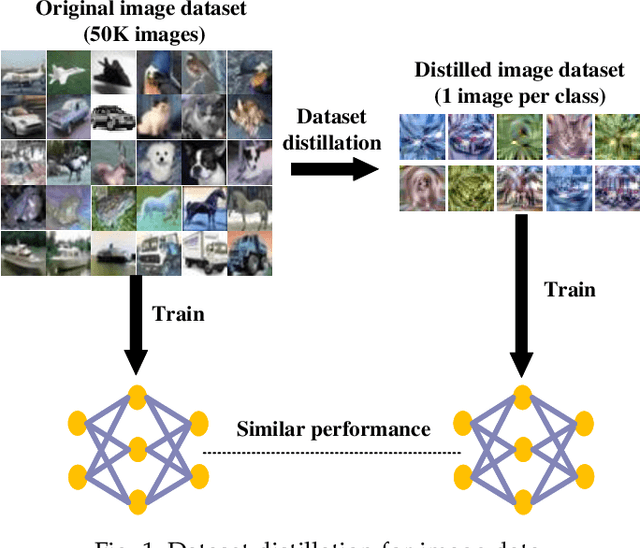


Deep neural networks (DNNs) have achieved significant success in numerous applications. The remarkable performance of DNNs is largely attributed to the availability of massive, high-quality training datasets. However, processing such massive training data requires huge computational and storage resources. Dataset distillation is a promising solution to this problem, offering the capability to compress a large dataset into a smaller distilled dataset. The model trained on the distilled dataset can achieve comparable performance to the model trained on the whole dataset. While dataset distillation has been demonstrated in image data, none have explored dataset distillation for audio data. In this work, for the first time, we propose a Dataset Distillation Framework for Audio Data (DDFAD). Specifically, we first propose the Fused Differential MFCC (FD-MFCC) as extracted features for audio data. After that, the FD-MFCC is distilled through the matching training trajectory distillation method. Finally, we propose an audio signal reconstruction algorithm based on the Griffin-Lim Algorithm to reconstruct the audio signal from the distilled FD-MFCC. Extensive experiments demonstrate the effectiveness of DDFAD on various audio datasets. In addition, we show that DDFAD has promising application prospects in many applications, such as continual learning and neural architecture search.