 Add to Chrome
 Add to Firefox
 Add to Edge
EVAF: A Test-Retest Protocol for Selective Parametric Consolidation
Jun 29, 2026
Long-running language agents need mechanisms for deciding which experiences should persist after the working context is gone. Retrieval systems can reinsert past text, but they do not by themselves show that an experience has been selectively consolidated into the model's own behavior. We introduce EVAF, an Echo-Valence Attractor Field mechanism for gated LoRA consolidation, and a test-retest protocol for measuring selective parametric consolidation under controlled interference. Across GPT-2 and TinyLlama, EVAF preferentially consolidates high-valence, high-surprise experiences while preserving retrieval-accessible factual memory through a complementary routed memory path. Test-retest measurements show stronger post-interference behavioral persistence than frozen, retrieval-only, and ungated continual-update baselines, while keeping parameter drift and cross-persona contamination low. The results support a separation between memory access and memory depth: retrieving a fact and internalizing an experience are distinct computational operations.

From Detecting Agency to Doing Work: Self-Caused Credit Builds a Durable Behavioral Self in a Minimal Spiking Agent
Jun 29, 2026How does an agent that can tell self from world come to be durably shaped by that distinction? Recent work shows that a predictive system can detect its own agency (Ye, 2026), but detecting agency does not explain durable, self-shaped behavior. We show that agency-gated slow credit -- a conjunctive term Own*Agency*Salience driving a slow parameter update -- produces post-unload behavioral residue: on a spiking substrate (Nengo LIF/PES), a learned self-preserving choice survives episodic buffer removal (retained fraction 0.96, N=50) and collapses when the slow decoders are reset or the agency gate is removed. Reproducing the agency comparator and toggling only the slow-credit channel, we find a clean dissociation: at matched agency gain, durable behavior develops only when self-credit performs slow work (post-unload self-preservation 1.00 vs 0.00). The same dissociation holds in 24-dimensional partially-observed control (0.74 vs 0.00), and a plastic-work analysis shows that basin deformation equals net self-credit work. Across eight sequentially-learned tasks under exogenous interference, the multiplicative veto also prevents forgetting: it retains old tasks (final post-unload accuracy 0.88, forgetting 0.13) where additive pooling collapses to chance-level recall, the no-agency ablation falls below chance, and episodic/replay baselines stay near chance after unload -- all with no replay buffer and no task-boundary-dependent protection mechanism (N=50). We formalize the durable residue as an operational behavioral self and argue that self-caused credit doing slow work is a necessary building block for agents that develop a self. No claim of consciousness is made.
Memory Depth, Not Memory Access: Selective Parametric Consolidation for Long-Running Language Agents
Jun 25, 2026Long-running language agents need more than memory access. Retrieval systems can fetch past facts at query time, but they do not decide which experiences should continue to shape behavior after the working context is unloaded. We study this separate problem as memory depth: durable goal-conditioned tendencies written into a small parametric store. We introduce the loop-drift protocol, a controlled stress test in which the retrieval index remains intact while working context is unloaded and goal-conditioned behavior must persist under long-loop interference. We evaluate EVAF, a surprise- and valence-gated LoRA consolidation mechanism. Across GPT-2 and TinyLlama, retrieval is strongest on shallow factual recall (short-fact accuracy 0.956--0.973), while EVAF is strongest on goal persistence and post-unload recovery (0.812--0.904) with only 2--3 parametric writes per 200 events. Mechanism controls show that selective consolidation factorizes into two controllable dimensions: selection and actuation. Matched random gates isolate selection beyond sparse writing; fixed-inner controls across GPT-2, TinyLlama, and Mistral-7B show that inner-loop write strength is model-dependent; and a Mistral-7B matched-gate inversion reveals asymmetric selection-actuation coupling under miscalibrated actuation. Public Memora event streams serve as an external diagnostic, exposing stale-memory invalidation as an unresolved boundary. Within this probe, selective parametric consolidation supplies memory depth distinct from and complementary to retrieval access.
GaussTrace: Provenance Analysis of 3D Gaussian Splatting Models with Evidence-based LLM Reasoning
Jun 09, 20263D Gaussian Splatting (3DGS) is a powerful technique for creating high-fidelity 3D assets. However, the widespread sharing and iterative modification of 3DGS models across digital platforms create pressing challenges for intellectual property protection and forensic traceability. To address this, we propose GaussTrace, a novel framework for constructing directed provenance graphs for 3DGS models. GaussTrace formulates provenance analysis as an evidence-based reasoning problem. It builds upon attribute-wise statistical profiling of 3DGS parameters to capture intrinsic properties. Moreover, we introduce hypothesis-driven editing simulations of common operations to provide auxiliary evidence for plausible transformation pathways. These statistical and simulated cues jointly enable a Large Language Model (LLM) to perform structured Chain-of-Thought (CoT) reasoning, yielding directional provenance inferences and explainable edge reasons. Experimental results demonstrate that GaussTrace effectively constructs evolutionary relationships among diverse 3DGS models, delivering accurate, interpretable, and robust provenance graphs without requiring model training or access to editing histories. Project page: https://haolianghan.github.io/GaussTrace.
Object-fabrication Targeted Attack for Object Detection
Dec 14, 2022Recent researches show that the deep learning based object detection is vulnerable to adversarial examples. Generally, the adversarial attack for object detection contains targeted attack and untargeted attack. According to our detailed investigations, the research on the former is relatively fewer than the latter and all the existing methods for the targeted attack follow the same mode, i.e., the object-mislabeling mode that misleads detectors to mislabel the detected object as a specific wrong label. However, this mode has limited attack success rate, universal and generalization performances. In this paper, we propose a new object-fabrication targeted attack mode which can mislead detectors to `fabricate' extra false objects with specific target labels. Furthermore, we design a dual attention based targeted feature space attack method to implement the proposed targeted attack mode. The attack performances of the proposed mode and method are evaluated on MS COCO and BDD100K datasets using FasterRCNN and YOLOv5. Evaluation results demonstrate that, the proposed object-fabrication targeted attack mode and the corresponding targeted feature space attack method show significant improvements in terms of image-specific attack, universal performance and generalization capability, compared with the previous targeted attack for object detection. Code will be made available.
Artificial Intelligence Security Competition (AISC)
Dec 07, 2022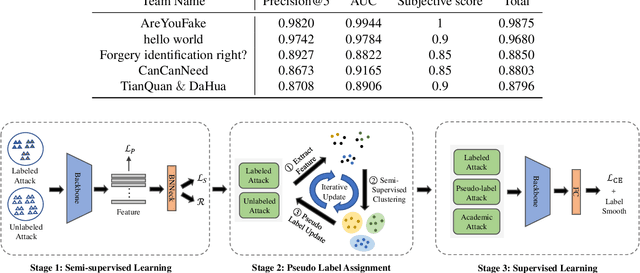
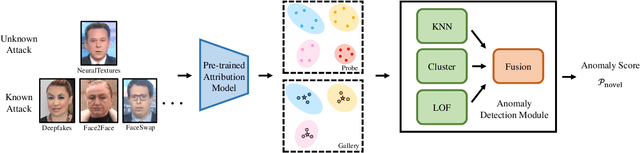


The security of artificial intelligence (AI) is an important research area towards safe, reliable, and trustworthy AI systems. To accelerate the research on AI security, the Artificial Intelligence Security Competition (AISC) was organized by the Zhongguancun Laboratory, China Industrial Control Systems Cyber Emergency Response Team, Institute for Artificial Intelligence, Tsinghua University, and RealAI as part of the Zhongguancun International Frontier Technology Innovation Competition (https://www.zgc-aisc.com/en). The competition consists of three tracks, including Deepfake Security Competition, Autonomous Driving Security Competition, and Face Recognition Security Competition. This report will introduce the competition rules of these three tracks and the solutions of top-ranking teams in each track.