 Add to Chrome
 Add to Firefox
 Add to Edge
MobileKernelBench: Can LLMs Write Efficient Kernels for Mobile Devices?
Mar 12, 2026
Large language models (LLMs) have demonstrated remarkable capabilities in code generation, yet their potential for generating kernels specifically for mobile de- vices remains largely unexplored. In this work, we extend the scope of automated kernel generation to the mobile domain to investigate the central question: Can LLMs write efficient kernels for mobile devices? To enable systematic investigation, we introduce MobileKernelBench, a comprehensive evaluation framework comprising a benchmark prioritizing operator diversity and cross-framework interoperability, coupled with an automated pipeline that bridges the host-device gap for on-device verification. Leveraging this framework, we conduct extensive evaluation on the CPU backend of Mobile Neural Network (MNN), revealing that current LLMs struggle with the engineering complexity and data scarcity inher-ent to mobile frameworks; standard models and even fine-tuned variants exhibit high compilation failure rates (over 54%) and negligible performance gains due to hallucinations and a lack of domain-specific grounding. To overcome these limitations, we propose the Mobile K ernel A gent (MoKA), a multi-agent system equipped with repository-aware reasoning and a plan-and-execute paradigm.Validated on MobileKernelBench, MoKA achieves state-of-the-art performance, boosting compilation success to 93.7% and enabling 27.4% of generated kernelsto deliver measurable speedups over native libraries.

DICE: Diffusion Large Language Models Excel at Generating CUDA Kernels
Feb 12, 2026Diffusion large language models (dLLMs) have emerged as a compelling alternative to autoregressive (AR) LLMs, owing to their capacity for parallel token generation. This paradigm is particularly well-suited for code generation, where holistic structural planning and non-sequential refinement are critical. Despite this potential, tailoring dLLMs for CUDA kernel generation remains challenging, obstructed not only by the high specialization but also by the severe lack of high-quality training data. To address these challenges, we construct CuKe, an augmented supervised fine-tuning dataset optimized for high-performance CUDA kernels. On top of it, we propose a bi-phase curated reinforcement learning (BiC-RL) framework consisting of a CUDA kernel infilling stage and an end-to-end CUDA kernel generation stage. Leveraging this training framework, we introduce DICE, a series of diffusion large language models designed for CUDA kernel generation, spanning three parameter scales, 1.7B, 4B, and 8B. Extensive experiments on KernelBench demonstrate that DICE significantly outperforms both autoregressive and diffusion LLMs of comparable scale, establishing a new state-of-the-art for CUDA kernel generation.
ResSVD: Residual Compensated SVD for Large Language Model Compression
May 26, 2025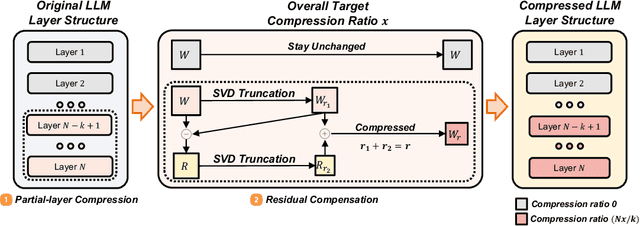
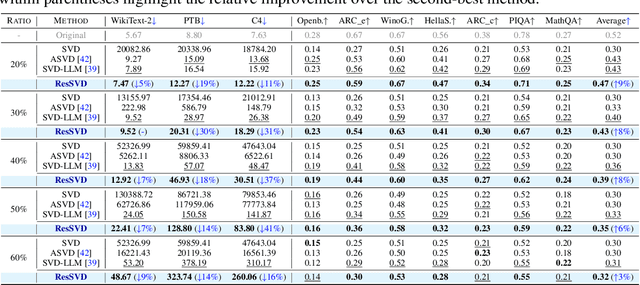
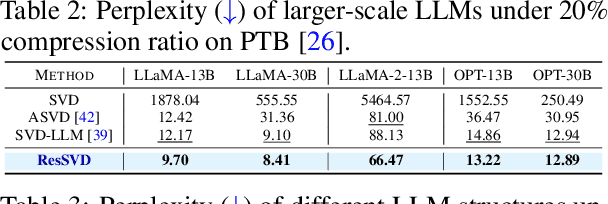
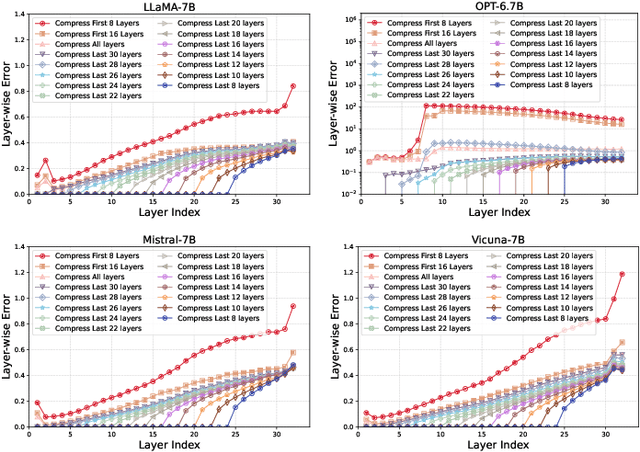
Large language models (LLMs) have demonstrated impressive capabilities in a wide range of downstream natural language processing tasks. Nevertheless, their considerable sizes and memory demands hinder practical deployment, underscoring the importance of developing efficient compression strategies. Singular value decomposition (SVD) decomposes a matrix into orthogonal components, enabling efficient low-rank approximation. This is particularly suitable for LLM compression, where weight matrices often exhibit significant redundancy. However, current SVD-based methods neglect the residual matrix from truncation, resulting in significant truncation loss. Additionally, compressing all layers of the model results in severe performance degradation. To overcome these limitations, we propose ResSVD, a new post-training SVD-based LLM compression method. Specifically, we leverage the residual matrix generated during the truncation process to reduce truncation loss. Moreover, under a fixed overall compression ratio, we selectively compress the last few layers of the model, which mitigates error propagation and significantly improves the performance of compressed models.Comprehensive evaluations of ResSVD on diverse LLM families and multiple benchmark datasets indicate that ResSVD consistently achieves superior performance over existing counterpart methods, demonstrating its practical effectiveness.