 Add to Chrome
 Add to Firefox
 Add to Edge
Parallel Jacobi Decoding for Fast Autoregressive Image Generation
Jun 04, 2026
Autoregressive (AR) models have demonstrated remarkable performance in generating high-fidelity images. However, their inherently sequential next-token prediction leads to significantly slower inference. Recent studies have introduced Jacobi-style decoding to accelerate autoregressive image generation. Extending the draft sequence initially improves efficiency, yet the acceleration quickly saturates as error propagation in the one-dimensional sequence hinders convergence. Observing that images exhibit strong local spatial correlations, we propose Parallel Jacobi Decoding (PJD), a training-free decoding approach that expands draft tokens in the two-dimensional spatial domain to enable efficient spatially parallel refinement. PJD adjusts the attention mask to mitigate error accumulation and improve convergence stability. Extensive experiments on diverse datasets show that PJD achieves 4.8x-6.4x acceleration across multiple autoregressive image generation models while maintaining competitive generation quality.

RankE: End-to-End Post-Training for Discrete Text-to-Image Generation with Decoder Co-Evolution
May 20, 2026Discrete autoregressive (AR) text-to-image (T2I) models pair a VQ tokenizer with an AR policy, and current post-training pipelines optimize only the policy while keeping the VQ decoder frozen. Recent diffusion T2I work, exemplified by REPA-E, has shown that the VAE itself constitutes a key alignment bottleneck, yet no analogous investigation exists for discrete AR models. We show that policy-only optimization induces Latent Covariate Shift: as the policy evolves, the resulting token distribution diverges from the ground-truth distribution on which the decoder was trained, such that reward scores improve while decoded image quality degrades. To address this mismatch, we propose RankE, the first end-to-end post-training framework for discrete T2I generation. Rather than optimizing the policy against a fixed decoder, RankE co-evolves both components through alternating optimization: each module maximizes a ranking-based alignment objective while being regularized by a stability-preserving anchor suited to its parameter space. This co-evolution breaks the fidelity--alignment trade-off that plagues frozen-decoder approaches: on LlamaGen-XL (775M), standard RL improves CLIP but degrades FID, whereas RankE improves both simultaneously (FID 15.21, CLIP 33.76 on MS-COCO 30K). Consistent gains on Janus-Pro (1B) confirm that decoder co-evolution reliably converts reward optimization into pixel-space quality improvements.
ResSVD: Residual Compensated SVD for Large Language Model Compression
May 26, 2025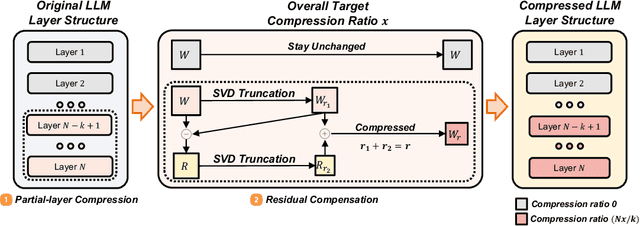
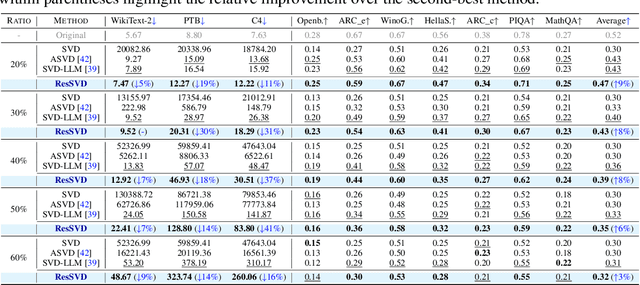
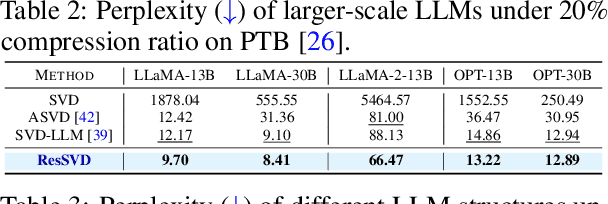
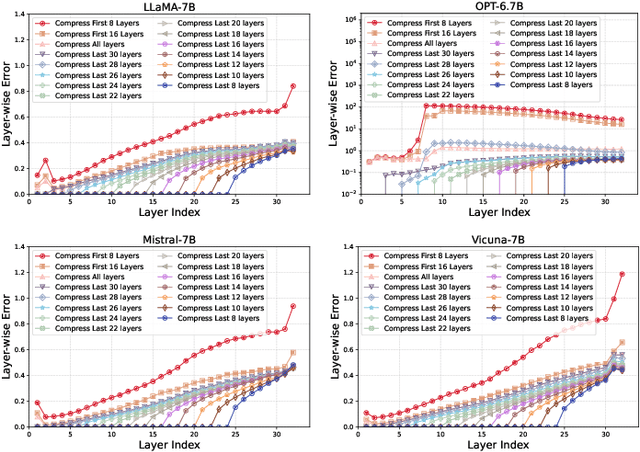
Large language models (LLMs) have demonstrated impressive capabilities in a wide range of downstream natural language processing tasks. Nevertheless, their considerable sizes and memory demands hinder practical deployment, underscoring the importance of developing efficient compression strategies. Singular value decomposition (SVD) decomposes a matrix into orthogonal components, enabling efficient low-rank approximation. This is particularly suitable for LLM compression, where weight matrices often exhibit significant redundancy. However, current SVD-based methods neglect the residual matrix from truncation, resulting in significant truncation loss. Additionally, compressing all layers of the model results in severe performance degradation. To overcome these limitations, we propose ResSVD, a new post-training SVD-based LLM compression method. Specifically, we leverage the residual matrix generated during the truncation process to reduce truncation loss. Moreover, under a fixed overall compression ratio, we selectively compress the last few layers of the model, which mitigates error propagation and significantly improves the performance of compressed models.Comprehensive evaluations of ResSVD on diverse LLM families and multiple benchmark datasets indicate that ResSVD consistently achieves superior performance over existing counterpart methods, demonstrating its practical effectiveness.